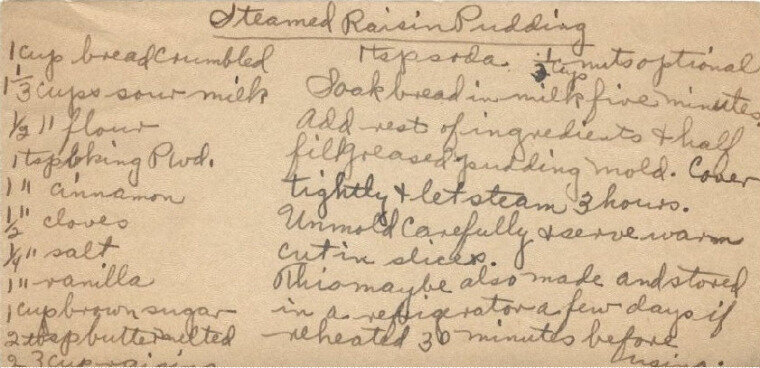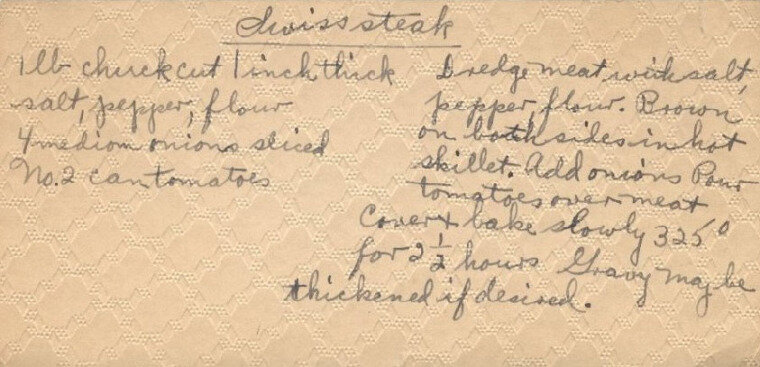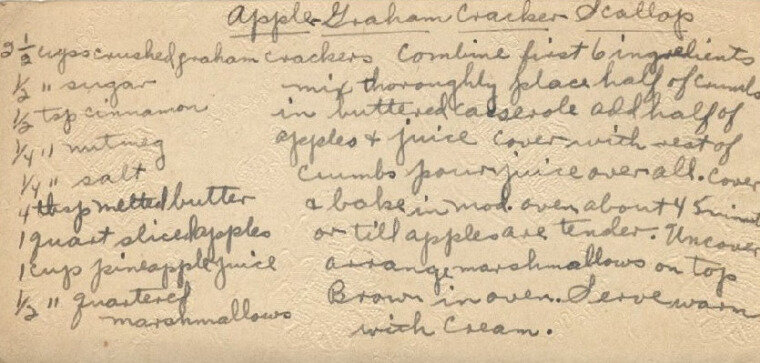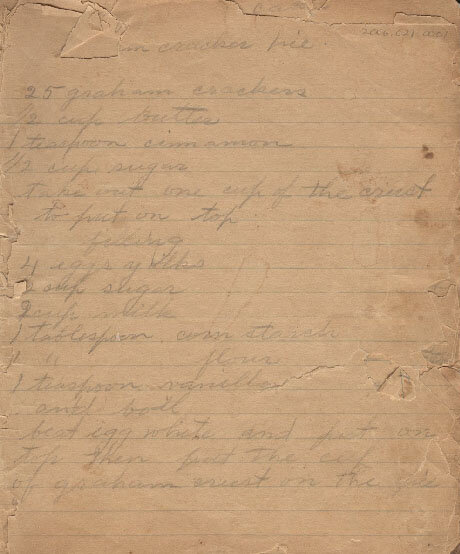
Handwritten Recipes

December is a special time for many people – it is a month full of wonder, for the holiday spirit is just around the corner. For many of us in Minnesota, it is a time of beautiful snow flakes outside and of cuddling together with a blanket before a fire or a television. December is a time of sweet smells of crisp air, pine trees, and of course, delicious aromas of food.

Nothing brings individuals together like that of a warm meal or tasty dessert at the table. Before long, families and friends will be together to celebrate Christmas and the New Year. In honor of this time of feast, I thought it appropriate to look through SCHS’s collections and see what we have concerning food and their recipes.

The first thing that came to mind was cookbooks. We have many different types of cookbooks – indeed, the museum holds nearly fifty-five cookbooks, many from the various churches or clubs in the county, and standard cookbooks manufactured from around the United States. The oldest cookbook we have is one from 1890 called the “Compendium of Cookery and Reliable Recipes”. Upon seeing that SCHS has so many cookbooks, my interest was piqued on what we had for handwritten recipes.

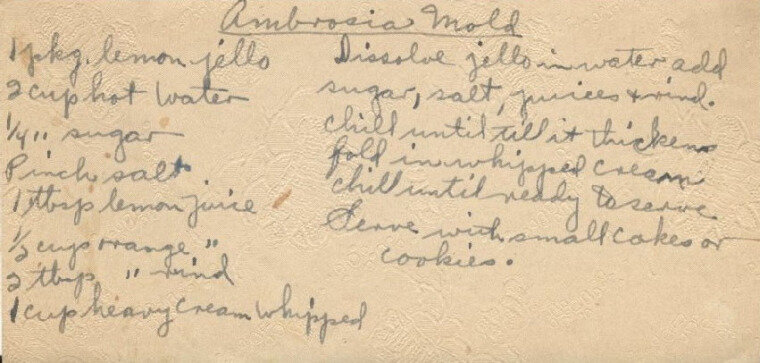
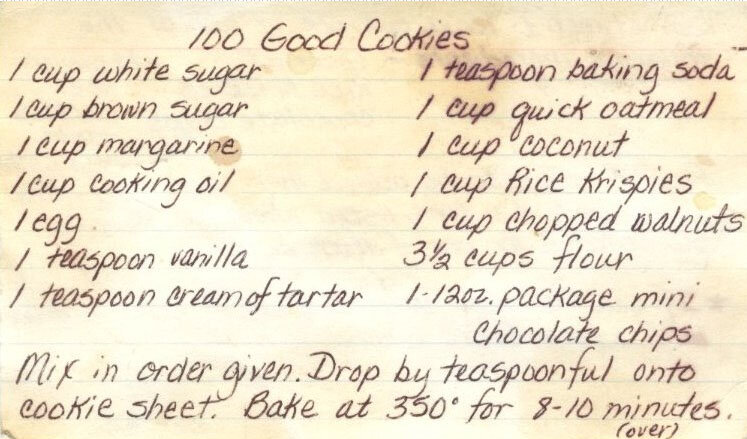
A recipe can tell you a lot about the people that used it. A recipe can give one hints of their heritage, pride, and interests. Specific ingredients in a handwritten recipe can also give us insight on the easy or difficult times individuals faced, depending on whether or not ingredients could be gathered. Unfortunately, due to their profound usage in a kitchen, many recipe cards may not live very long lives. Many get wet, torn, or perhaps just thrown away. Many do not get the chance to be preserved in a museum. Below are a handful of handwritten recipes that are being preserved here – for yourself, and for future generations to view. These recipes were all handwritten on some medium of paper, be it notebook paper, recipe cards, or other types of paper.  The most interesting handwritten recipes that I found, however, were written on wallpaper samples!

Please enjoy looking at the handwritten recipes below. The first recipe was most likely written between 1910-1940. The wallpaper sample recipes were most likely written between 1925 and 1935. The last recipe was written in 1985.

Take a look through your own collections and see what interesting recipes you can find! Try some out – particularly for a delicious Christmas dessert. Most of all, please do your best to preserve such lovely recipes. The future’s generations stomachs will thank you!
Holiday Shopping 100 Years Ago

Last week we celebrated Thanksgiving, but also Black Friday, Small Business Saturday, Cyber Monday, and Giving Tuesday. The holiday shopping season is here, and in this day and age, the options seem endless. But what about 100 years ago? Where did people do their holiday shopping back then, and what kinds of gifts did they buy?

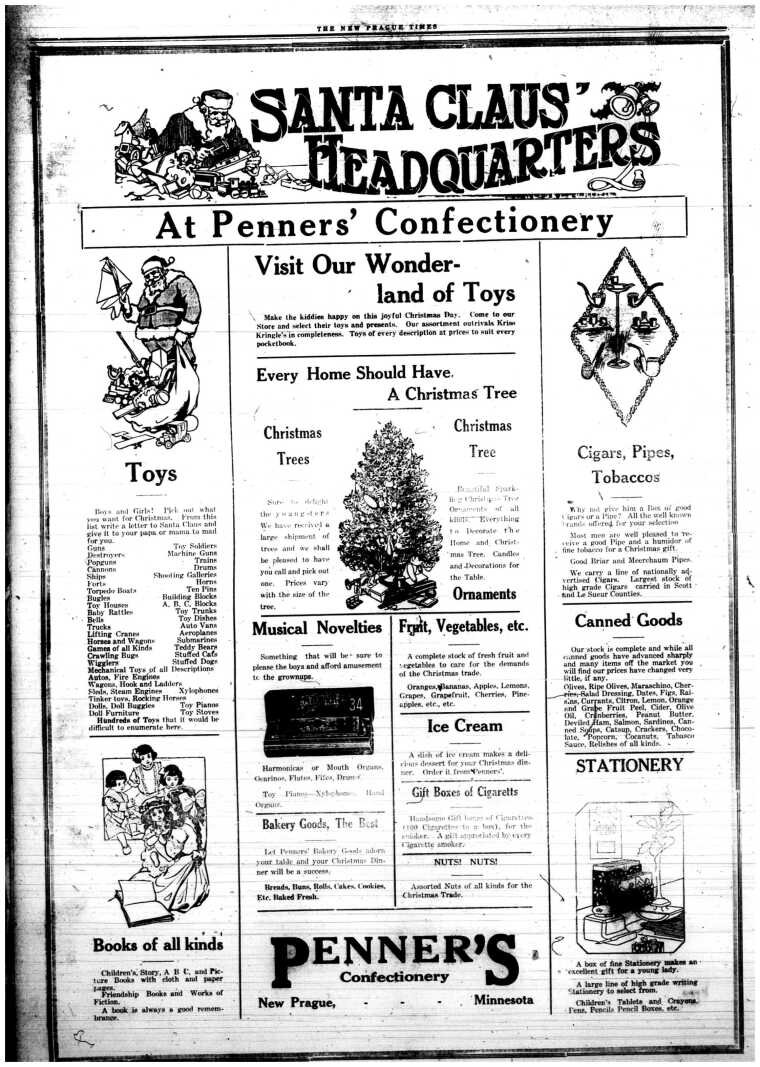
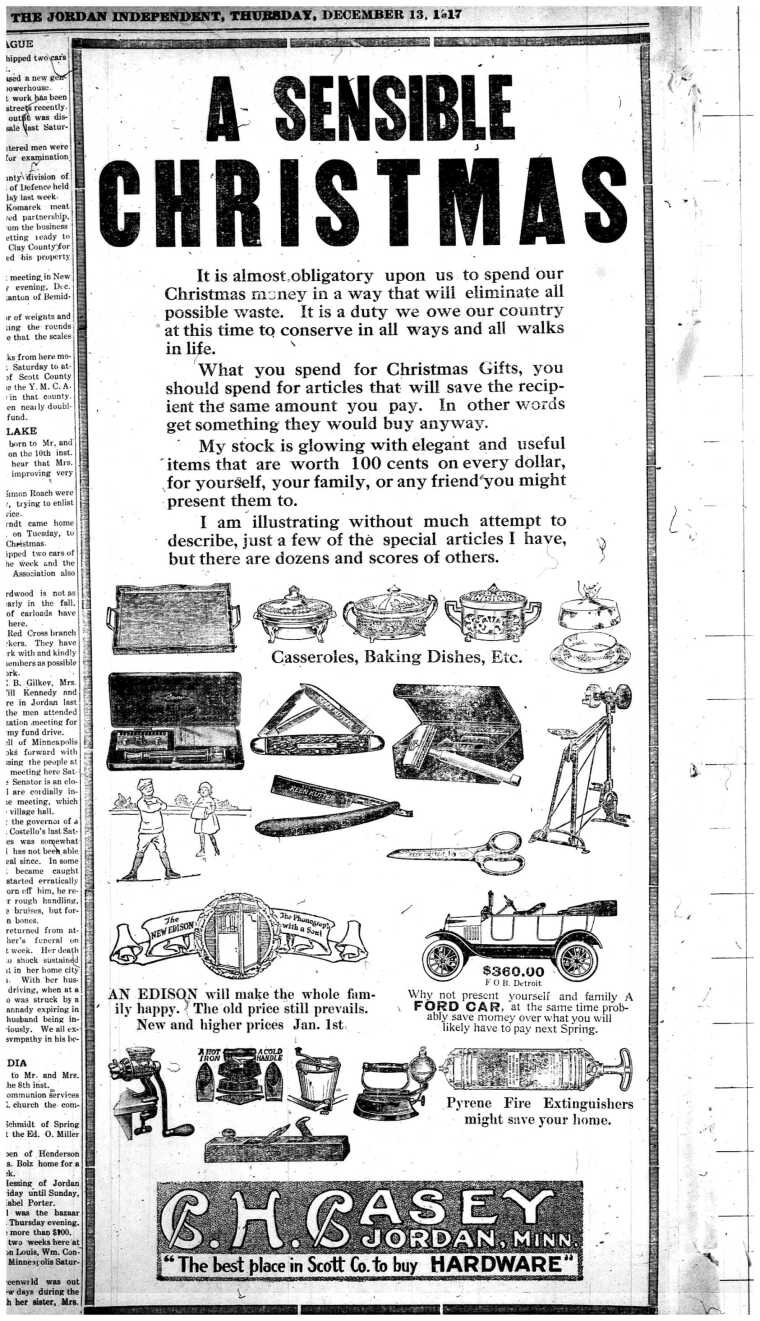
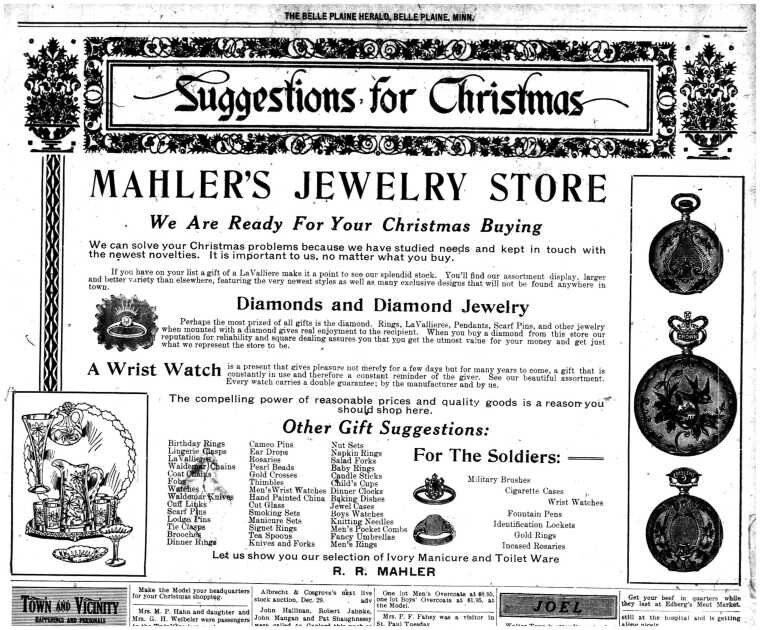
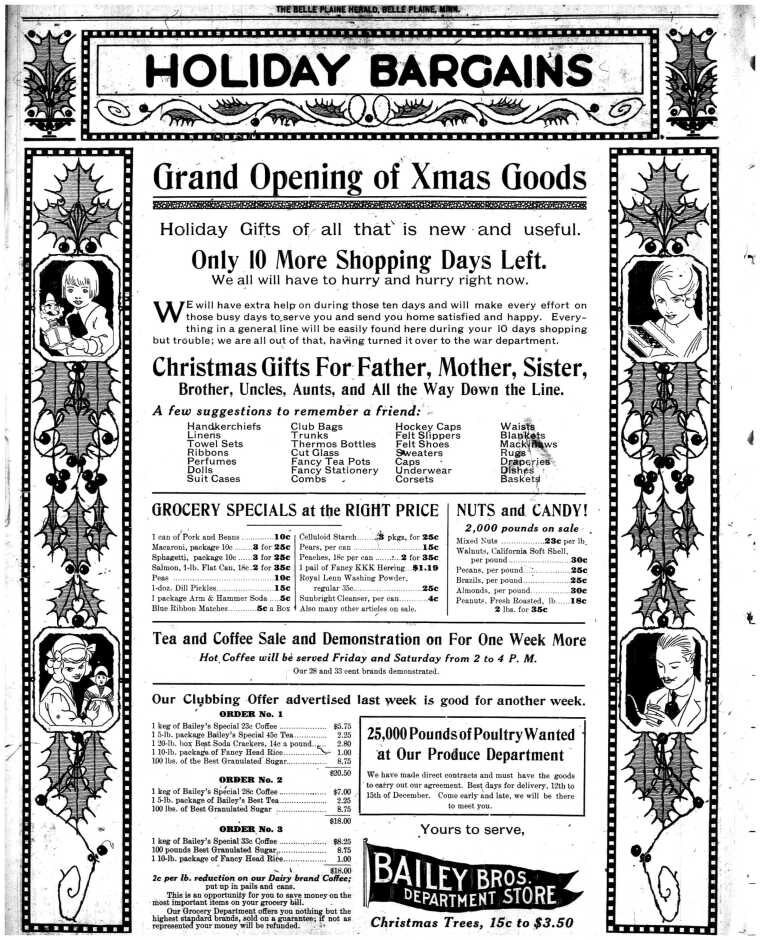
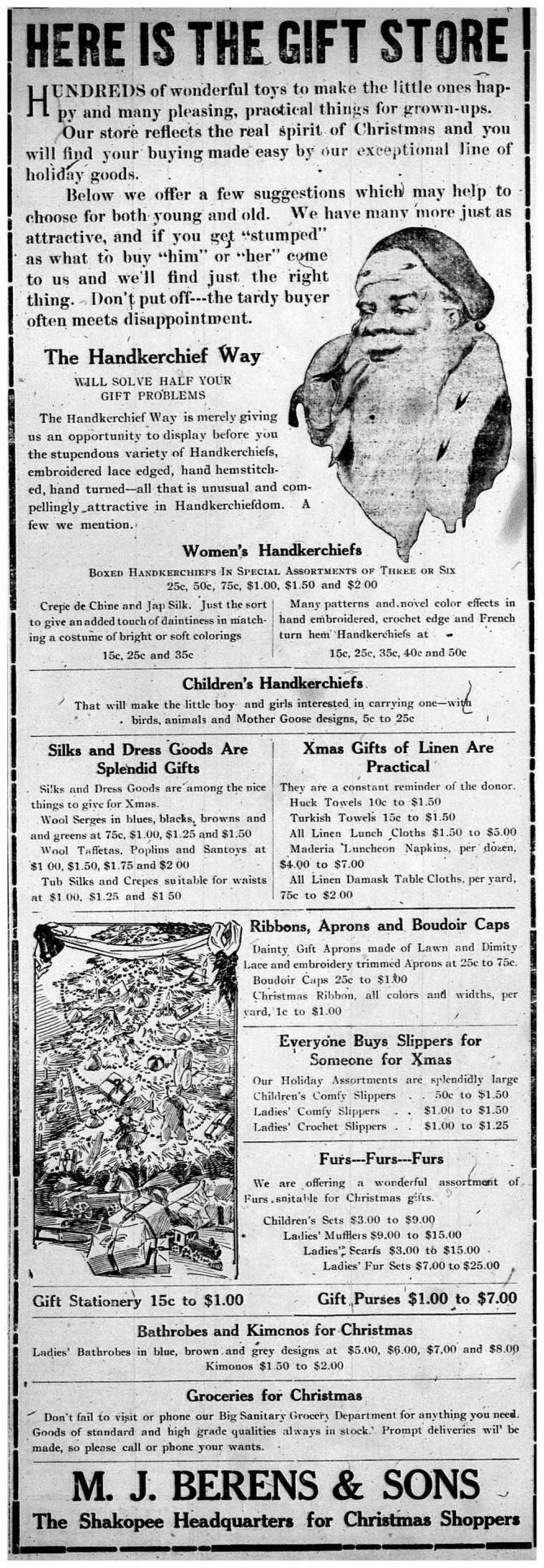
There was of course no online shopping in 1917, nor were there big-box stores. People shopped at local establishments; places like Moses Cash Bargain Store in Jordan, Bailey Bros. Department Store in Belle Plaine, M.J. Berens & Sons in Shakopee, and Piesinger’s Drug and Jewelry Store in New Prague. Store ads in the local newspapers featured lots of gift ideas. Holiday shoppers could buy baking dishes, ice skates, and tools at the hardware store; fountain pens, fancy stationery, perfume, cigars, candy, and nuts at the drug store; and slippers, combs, handkerchiefs, ribbons, toys, and clothes at the department store. Additionally, jewelry stores offered an array of fine jewelry and watches (along with items you probably wouldn’t see today like ivory sets and vest chains), and confectionery shops sold all manner of candy and treats.

Holiday shopping ads were plastered throughout Scott County newspapers in 1917, yet the holiday season that year was a somber one. The United States was in the midst of World War I, so any celebrations were tempered by the thought of loved ones far away fighting in the war. The war affected holiday shopping and gift-giving in a few important ways. First, in keeping with the wartime spirit of saving and rationing, there was a strong emphasis on practical gifts. Shoppers were encouraged to buy items that were useful – something the recipient may have planned to purchase anyway. Ads were peppered with phrases like “sensible giving” and stores promised merchandise that was useful and necessary (while still sentimental). WWI also meant that holiday shopping ads featured gift ideas for soldiers, items like trench mirrors, cigarette cases, wrist watches, rosaries, wool socks, writing sets, and toiletry bags. The war’s influence even filtered down to children’s toys. For instance, an ad for Penner’s Confectionery in New Prague listed the following toys for sale in 1917: guns, toy soldiers, destroyers, machine guns, cannons, and torpedo boats.

Below are some examples of holiday shopping ads published in Scott County newspapers 100 years ago, in December 1917. To check out more of these ads, visit the SCHS Research Library, and be sure to check out our WWI exhibit, “The Great War in Scott County”, currently on display. Happy Holidays and happy shopping!

Learning To Do More With Less: Thanksgiving During the Great War

4-p-49_2007_001_ac.jpg

Thanksgiving is perhaps the most quintessentially American holiday. It offers us a time to gather with family and friends to reflect on things that we are thankful for and to feast on the year’s bounty. Typically, celebrated with tables full of as much food as they can hold: turkey, ham, gravy, potatoes, stuffing, cranberries, pies and cakes. However, in 1917 America was forced to face Thanksgiving in an entirely new way, as they found themselves part of the largest war yet fought, World War I. How would America celebrate with demand for food in Europe at an all-time high and millions of men away from home? The celebration would still occur, just with less.

Outside of physically joining the fight, there were few things more important one could do on the home front during the war than produce and conserve more food for export to Europe. It would’ve been nearly impossible to escape the propaganda that “food will win the war”, particularly in rural areas like Scott County. During his 1917 Thanksgiving Proclamation, President Wilson made clear that the United States was in a special position to help:

“We have been brought to one mind and purpose. A new vigor of common counsel and common action has been revealed in us. We should especially thank God that in such circumstances, in the midst of the greatest enterprise the spirits of men have ever entered upon, we have, if we but observe a reasonable and practicable economy, abundance with which to supply the needs of those associated with us as well as our own.”

         Every citizen was told they needed to do their part on the home front in three critical areas: increasing production, limiting consumption, and shifting eating habits. Increasing production meant farmers planting more wheat, over other staple crops, and every citizen growing their own small gardens and canning the produce to ease the burden on the commercial food markets which could then sell more directly to the government. Limiting consumption and shifting eating habits often went hand-in-hand as they required citizens to eat less than many had been used to and involved what were often known as “-less” days, where depending on the day of the week a family would have meatless or wheatless meals and instead substitute them for foods like corn, rice, oats, potatoes, fish, or chicken. The reason for using these other staples was that wheat was desperately needed in Europe and foods like corn and potatoes didn’t transport overseas well and most European mills weren’t equipped to process other grains like oats, on top of the fact that European tastes weren’t accustomed to the different grains. To aid in the effort the government, businesses, and newspapers offered an abundance of recipes and cooking-aids which enabled families to make wheatless or meatless foods or better use of left-overs and ingredients which many had never used.

picture5.png

                These conservation efforts had an impact on how the average American family celebrated Thanksgiving. Rather than a table filled to the brim with food, a sparser offering was the norm. For example, cranberries and cranberry sauce may have been noticeably absent from many tables as they required far too much sugar to prepare or pies and breads made with no flour or fat. The President and his family tried to set an example with their White House dinner: cream of oyster soup with slices of hot buttered toast, turkey with trimmings, garden vegetables (sans cranberries), and pumpkin pie.

Despite the conservation going on at home, a special effort was made so that the fighting men and women, most of whom were experiencing their first holiday away from family, received a full Thanksgiving meal. Whether training at camps throughout the nation, on a ship in the mid-Atlantic, or in the fields of France, they were to receive a full hot meal that could have been expected before the war. Efforts were taken to ensure they got the items that people at home were doing without, like cranberry sauce and ice cream. The meal had by the soldiers at Camp Dodge, Iowa serves as a good example of what the troops enjoyed:

Appetizer: Grapefruit Cocktail and Cream of Celery Soup with Croutons and Olives

Main Course: Roast Turkey, Chestnuts Dressing, Cranberry Sauce, Giblet Sauce, Baked Ham, Sweet Potatoes, Baked Potatoes, Green Peas and Fruit Salad

Dessert: Mince Pie, Ice Cream, and Cake

After Dinner: Cheese, Nuts, Candy, Coffee and Cider

According to the Jordan Independent, letters home indicated great satisfaction with the meals from the soldiers in service.

The Thanksgiving of 1917 was the only Thanksgiving which America had during World War I, as by the time it rolled around again in 1918, an armistice had been declared. November 11, 1918 saw the cessation of hostilities and the bringing of peace to a war-torn Europe. “Victory,” as General Pershing said, “was the Thanksgiving gift to the American Nation,” and that was something everyone could be thankful for.

Food Will Win The War

Capture.JPG

After nearly three years of war, by 1917 Europe was facing starvation.  Farms were transformed into battlefields or left un-planted as workers were forced into service.  Transportation routes were disrupted, making access to food challenging to say the least.

On August 10, 1917, congress passed a controversial piece of legislation:  “An Act to Provide Further for the National Security and Defense by Encouraging the Production, Conserving the Supply, and Controlling the Distribution of Food Products and Fuel.”  It also banned the production of “distilled spirits” from any produce that was used for food. This Act created the Food Administration and the Fuel Administration; President Wilson appointed Herbert Hoover to head the Food Administration.  This gave Mr. Hoover authority to fix food prices, license distributors, coordinate purchases, oversee exports, act against hoarding and profiteering, and encourage farmers to grow more crops.

World War I came to the United States in the midst of the Progressive Era – when efficiency and expertise were highly valued.  This mindset provided a platform for the government to establish agencies to address issues of economy, society, and production for the war effort, and avenues to motivate people.

In January 1918, President Wilson issued a proclamation calling upon Americans to demonstrate their patriotism by following Hoover’s guidelines.  Hoover did not want to impose rationing, so he pushed compassion and patriotism to encourage volunteerism for food programs.

Hoover introduced “Meatless Tuesdays”, “Wheatless Mondays”, and “Sweetless and Porkless Saturdays”.  Local food boards offered guidance to comply with these programs by demonstrating how to prepare meals, alter recipes, and preserve food, such as canning.  They also encouraged development of  “Liberty Gardens” where people could grow their own food.  Homeowners were urged to sign and publicly display pledge cards that testified to their efforts to conserve food.  As a result of these efforts, food shipments doubled within a year, while consumption in the US was reduced by 15% between 1918 and 1919.  This continued after the end of the war as an effort to feed millions of displaced people in Europe.  Hoover earned the nickname “Great Humanitarian” for his efforts. (He insisted on no salary – arguing it would give him the moral authority he needed to ask Americans to sacrifice to support the war effort.)

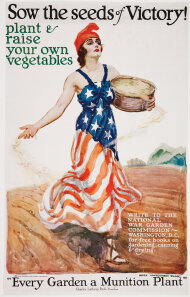
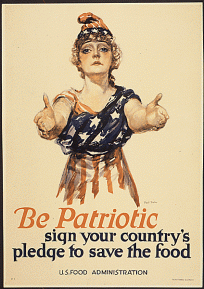
To provide adequate nourishment to troops and allies, a series of posters were created to encourage reducing consumption on the home-front to secure food needed for troops – such as meat, wheat, fats and sugar.  Slogans like “Food Will Win The War” and “Sow The Seeds of Victory” encouraged people to eat locally, reduce waste, and alter eating habits to allow for increased food shipments to soldiers.


All of these posters testify to the intent of the government to mobilize the food effort during World War I. As much as possible, it did so under a banner of volunteerism, rather than coercion. In doing so, the Wilson administration created a program that affected the everyday lives of Americans during World War I.  These programs also paved the way for future home-economics!

Local Scott County Newspapers:
January 1917: “Would you help a starving child?.. Thousands of babies in war-torn Europe are starving this winter.  The Children’s of America’s Fund is rushing aid as fast as possible.  Ten cents will give a starving child a day’s life, three dollars a month’s life.”

“Government Fixes Wheat, Flour Prices.  For the first time in U.S. history, the government has taken a hand in price-fixing of farm products and food products.  The first items being regulated are wheat and flour.  Since August, prices in local markets have been governed buy the National Food Control Board.”

“With cream $.46 pound, live hogs $14.80 per hundred weight, wheat $2.37 and beef on the hoof $.11/pound in local markets, it is apparent that the farmer is getting war-time prices for his products.  One way to fight the high cost of living is to either plant a garden and take care of it or increase the garden you already have.”

April 1917: “There will be little or no waste land in Jordan this season.  The high cost of every kind of food causes people to think.  Every available bit of vegetable garden land will be put to use.”

“Meatless days are being observed by millions of Americans on Tuesdays, and Wednesdays are being observed as wheatless days, thereby helping conserve the food supply.”

May 1918: “Don’t forget to provide against possible sugar shortage by planting some sorghum.  It can be planted until May 10. An experience farmer suggests breaking up a corner of pasture land and fencing it off, then planting the tract to sorghum.”

November 1918:  “The world is hungry.  America now plans on relieving the distress in Austria, Russia…in addition to what it had been doing before the Armistice.  We must all co-operate to eliminate waste, to save our of our abundance in order that the needy of other lands may have food.  Food won the war.  Food will save humanity.”

Paintings from Scott County Residents

Halloween has come and gone, and so November follows quickly behind. The first snowfall has already occurred, but luckily for us, it hasn’t been able to stick around. Before we know it, though, snow will be piled up around us.

Instead of focusing on the cold and dreary colors that will come soon, I feel it important to take a look at some colorful paintings that have been done by wonderful Scott County artists. Their bright and beautiful colors will surely amaze, whether they were done with oil, watercolor, or acrylic paint. We have many paintings, several from the same artists,  but I have chosen to pick a variety of paintings to show the diversity of the painters and their skills throughout the county.

I like to think that pictures – or paintings, in this case, are worth a thousand words, so without much more to say about these paintings, I leave you to take a look at them below and enjoy.

I hope that these paintings brighten your day. Thank you to the artists who have taken their time to paint such wonderful images that are close to their hearts, as well as donating them to SCHS so we may preserve them for future generations. Feel free to visit SCHS to see these paintings in person, or donate paintings of your own.

Oil painting of the Moses Starr Titus residence in Shakopee, 1868. Artist unknown.

Oil painting of the Moses Starr Titus residence in Shakopee, 1868. Artist unknown.

Painting of a street scene in Prior Lake 1965. Artist: John McGuire.

Painting of a street scene in Prior Lake 1965. Artist: John McGuire.

Pastel and acrylic painting of Joan of Arc, undated. Artist: Lorraine Coller.

Pastel and acrylic painting of Joan of Arc, undated. Artist: Lorraine Coller.

Painting of St. Paul House, 1971. Artist: LeRoy Lebens.

Painting of St. Paul House, 1971. Artist: LeRoy Lebens.

Painting of Dallas Cowboy Tony Dorsett, date unknown. Artist: Dave Tommy (a Shakopee HS student)

Painting of Dallas Cowboy Tony Dorsett, date unknown. Artist: Dave Tommy (a Shakopee HS student)

Oil painting of Josephine Sand Grommesch. Artist: Patricia Kness, great-granddaughter,

Oil painting of Josephine Sand Grommesch. Artist: Patricia Kness, great-granddaughter,

Watercolor painting of Dr. Nevin’s House in Shakopee, 1993. Artist: Susan Melchior.

Watercolor painting of Dr. Nevin’s House in Shakopee, 1993. Artist: Susan Melchior.

Watercolor painting of Murphy’s Landing, 1993. Artist: Susan Melchior.

Watercolor painting of Murphy’s Landing, 1993. Artist: Susan Melchior.

Watercolor painting of the Old Monnens Farm in Shakopee, 1992. Artist: Lila Greenwood

Watercolor painting of the Old Monnens Farm in Shakopee, 1992. Artist: Lila Greenwood