Half the World at Rest

May 9th was the 74th anniversary of V-E Day, the end of hostilities on the European front of World War II. V-E Day recognizes the surrender of Nazi Forces to the Allied Forces, and despite the name, fighting stopped in several places around the world. World War II is unique in that it has two different victory days. While we often think of World War II in the context of Europe and the Pacific, it was also fought across Africa in many European colonies. So while we call it V-E Day, we should recognize that nearly half of the world saw the end of the war. Here at home in Scott County, like many places around the world, the Nazi surrender was the main headline. Men from Scott County were still stationed abroad, but this day signified a closing of a major chapter in the county. Its sons would be coming home, at least from Europe.

sharg-1.jpg

The front page of the New Prague Times echoes an important thought that was in the minds of many “How long before Japan surrenders?” When the Nazi’s surrendered, their allies in Japan continued to fight on and there was no sign that the fighting in the Pacific would end soon. V-J Day didn’t come until August, but the newspapers of the county show the relief that people felt to see at least half of the world at rest.

npt-1.jpg

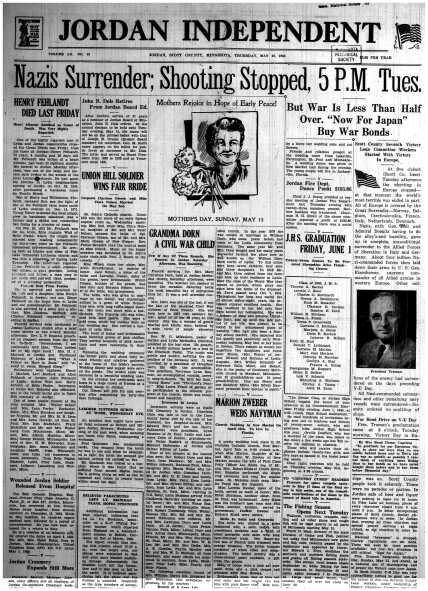
Jordan’s newspaper followed suit, acknowledging the victory in Europe and turning its gaze to Japan. It is a strange thing to consider that the war is over and yet still in full swing. America didn’t join the war until the bombing of Pearl Harbor, and it one could argue that Japanese victory was more important in many people’s eyes. While the victory overseas can in May, many in America were saving their cheers for V-J Day. As the Jordan paper said, “But War is Less Than Half Over.” a good indication that people in Scott County, the war was mostly with Japan.
jor-1.jpg

Bike Season!

It’s the time of year when Minnesotans emerge from their winter hibernation and everyone wants to be outdoors! Scott County boasts an excellent biking trail system, and opportunities abound to ditch your four wheeled vehicle and head out on two wheels. Biking has long been a popular form of transportation for Scott County residents. Check out some bicycle gems from the SCHS collections below, and learn a bit more about Scott County’s cycling history in this blog post. 

Children on bicycles join a parade at Holmes Avenue and Third Street in Shakopee. 1945. Photo from the SCHS Collections.

Children on bicycles join a parade at Holmes Avenue and Third Street in Shakopee. 1945. Photo from the SCHS Collections.

Studio portrait of three cyclists. Handwritten on the back is “Uncle Walter Adams. He rode this bicycle from Sioux City, Iowa to Shakopee and back to Sioux City Iowa” Walter Adams is the man on the left. 1885. Photo from the SCHS Collections

Studio portrait of three cyclists. Handwritten on the back is “Uncle Walter Adams. He rode this bicycle from Sioux City, Iowa to Shakopee and back to Sioux City Iowa” Walter Adams is the man on the left. 1885. Photo from the SCHS Collections

Studio portrait of Fritz Kahle of Belle Plaine with a bicycle. 1890. Photo from the SCHS Collections

Studio portrait of Fritz Kahle of Belle Plaine with a bicycle. 1890. Photo from the SCHS Collections

Performer at Valley Fair, 1978. Photo from the SCHS Collections.

Performer at Valley Fair, 1978. Photo from the SCHS Collections.

Steve Lebens of Shakopee, 1965. Photo from the SCHS Collections

Steve Lebens of Shakopee, 1965. Photo from the SCHS Collections

Enjoy the summer sun and join us for our annual series of Pedaling the Past history bike tours! Each tour focuses on the unique environmental history of a Scott County community. Tours span between 2 and 5 miles and last approximately 2 hours with frequent stops for discussion and to look at photographs!

Participants must bring their own bikes and all participants MUST wear helmets (no exceptions!). This tour is open to participants ages 10 and up; participants under age 18 must be accompanied by an adult.

$5.00, SCHS members FREE

Registration Links:
New Prague Tour, Sat. June 8th, 10am-12pm: https://bit.ly/2V8e5Ro
Jordan Tour: Sat, July 13th, 10am-12pm: https://bit.ly/2ZT1GPV
Prior Lake Tour: Sat, Aug 10th, 10am-12pm: https://bit.ly/2VHEJjE
Shakopee Tour: Sat, Sept 14th, 10am-12pm: https://bit.ly/2Vc9Wf6

The Flood Waters of Scott County

One of great advantages that Scott County has is being bordered by the Minnesota River, but this boon comes with a drawback, floods. Since the earliest settlers came to this area flooding has been a problem. This year in particular the county was hit hard, the February snow swelled the rivers and creeks around the county. Jordan had to shut down roads and evacuate people due to the overwhelming waters. Since this is the season for high water, which will lead to hopefully a peaceful summer, it seemed an appropriate time to share some of our collection’s history on floods.

The Shakopee Baseball park in 1960, you can just barely see the dugout to the right.

The Shakopee Baseball park in 1960, you can just barely see the dugout to the right.

The Jordan brewery during the flood of 1960

The Jordan brewery during the flood of 1960

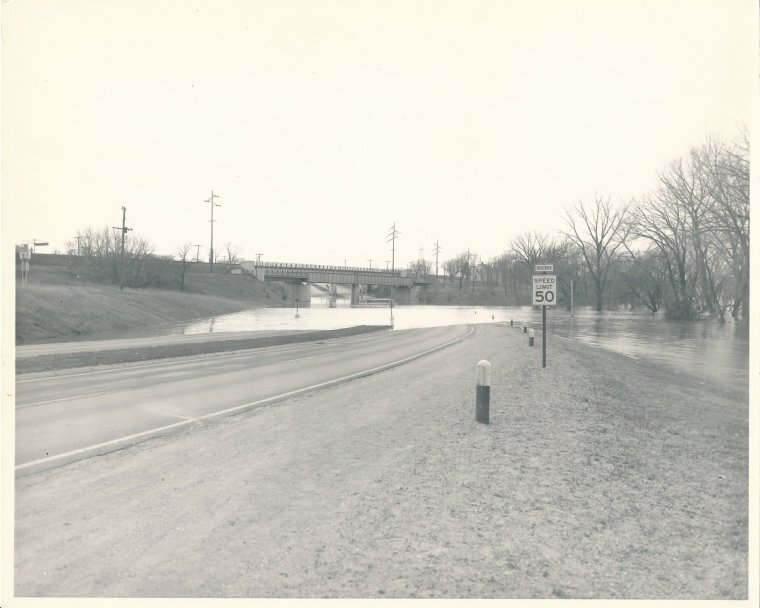
Highway 61 underwater during the 1955 flooding season

Highway 61 underwater during the 1955 flooding season


A picture of the building materials on the shore of the Minnesota River in Savage during the flooding in the 1960s.

A picture of the building materials on the shore of the Minnesota River in Savage during the flooding in the 1960s.


Dangerfield’s, pictured during the flooding of 1993 on the Minnesota river.

Dangerfield’s, pictured during the flooding of 1993 on the Minnesota river.

If these pictures prove anything it is that Scott County is no stranger to flooding and high waters. However, the recent efforts in Jordan, and those shown in the pictures go to prove that this county has a long history of coming together in times of need. Flooding is as much a part of our county as winter or the county fair. If you happen to have any pictures of the flooding from across the county, we would love to take a look at them and please consider donating. Everyone at SCHS is eager for the waters to recede and summer to arrive.


Written by Dave Nichols, Curator of Collections

Two Musical Legends from Scott County’s Past.

Music has a knack for bringing people together. It can connect immigrants to families across the globe, connect different generations, and create a cozy gathering during cold winters. Highlighted below are the stories of two men who were prominent musical leaders in Scott County communities- J.W. Komarek and Al Hagie.

J. W. Komarek

J.W. Komarek was born in Chicago on July 25th, 1871, but his family relocated to New Prague soon after his birth. Komarek showed an early aptitude for music, and as a youth received lessons from prominent local musician John Sery. At age 14 Komarek moved to Minneapolis and was employed by a painting contractor with the hope of learning the trade. After a few years in the city, he returned to New Prague and started up a business painting commercial and residential buildings. Soon after he was wed to John Sery’s daughter Mary.

J. W. Komarek. Photo from the New Prague Times, May 3, 1945

J. W. Komarek. Photo from the New Prague Times, May 3, 1945

In 1893, Komarek founded the Bohemian Brass Band of New Prague. Brass bands were very popular in the late 1800s. They played at town gatherings, parades and festivals and were even used to advertise products. These bands were a source of civic pride, and traveled throughout the region representing their community at fairs and musical competitions.

Like many other brass bands of the time,  Bohemian Brass Band featured drums, trumpet and cornet. Komarek’s group also added a local flair with the fiddle and bohemian bagpipes that nodded to the Czech ancestry of many of New Prague’s residents.

Over time, Komarek’s musical work took precedence over painting, and he moved full time into his role as a music teacher and band leader. He recalled as one of his proudest moments when he was presented with a recording of music played for him by some of his students- a rare treat in the early 1900s.

The prominence of Komarek’s musical career eventually pushed him into public service. He was elected council-man at large and later served as New Prague’s Mayor. After retirement, Komarek was a trustee of New Prague Community Hospital

picture2.jpg

W. Komarek passed away in May of  1945. He was survived by his 5 children, including two step-children from his second marriage to Anna Remes. On the day of his funeral, the town of New Prague decreed that all business should be closed from 1:30-3pm, allowing all community members to attend the service.

The Bohemian Brass band lives on through a mural that still graces Main Street in downtown New Prague.

Al Hagie

John Nicolin was a prominent member of one of Jordan’s most prominent families. The Nicolin house is still well known for it’s wealth and majesty, and  in the late 1800s John Nicolin owned numerous area business, including the musical Nicolin Opera House.  The story goes that Nicolin had a desire for more musical talent in the Jordan community and, in a testament to his local power, plucked Al Hagie from a group of traveling musicians and convinced him to stay.

Al Hagie and the Jordon Cornet Band. Hagie is a short man in white shirt and suspenders to the right of the frame. He his standing next to his young son. Photo from the SCHS collections.

Al Hagie and the Jordon Cornet Band. Hagie is a short man in white shirt and suspenders to the right of the frame. He his standing next to his young son. Photo from the SCHS collections.

In fact, Hagie had spent great deal of time in Jordan before finally settling in the town in his mid-twenties. Albert Hagie was born in Switzerland in 1862. His family immigrated to the United States when Hagie was 8, settling in St. Joesph Illinois. Al’s father was employed as a taylor and passed the trade on to his son. Al Hagie was also known in his youth as a talented musician, and by his early teens was skilled in several instruments, most prominently the cornet and the violin.

At 16, Hagie accepted employment with the Davern and Hopper shows as a musician. For the next 10 years he traveled with the troupe throughout the Midwest.  This journeying included long stays in Jordan, Minnesota. Hagie was said to have attended every 4th of July celebration in Jordan for all of those 10 years, and, later, every Scott County Fair after it’s beginning in 1914. During these visits, Hagie met Theresa Meyer of Jordan. She, and the insistence by Nicolin that Hagie lead a Cornet band in Jordan, convinced him to settle down. Al Hagie and Theresa Meyer were married on April 29, 1892. The Jordan Cornet Band was officially formed the same year.

Along with his skill as a bandleader, Al Hagie followed in his footsteps and started a taylor shop of his own. For nearly 4 decades he plied his trade. He was described as “a careful and thorough taylor, taking great pride in his work”.

His time with the band was not without stories. The Jordan Cornet Band would travel between local communities for performances and competitions. In the summer the journeys were undertaken by wagon, and in winter the band traveled in horse drawn sleighs. On one particularly icy winter day, the sleigh overturned, spilling band members and instruments into the drifts. Their trip was delayed as the men had to find and dig their trumpets, cornets and drums out of the snow.

It was well known that Al Hagie and his band were favorites of John Nicolin. Like any prominent family, there were those who were frustrated with what they saw as John Nicolin’s hold on the town of Jordan. Once, a competing band was formed for a town festival, just to provide and alternative for Hagie’s group and thereby spite Nicolin. The legend is that the second band only had time to learn a single song, but they played it on repeat all day long in an act of protest.

Hagie led the Jordan Cornet Band for nearly four decades, from 1892 until his death in November of 1930. In his obituary, Al Hagie was remembered as having “loved the simple life. There was no vain show, n ostentation about him”. He was also described as “a bluff, hearty, convivial, optimistic, forthright man”. During his funeral celebrations, 30 band-men from the Jordan Cornet Band, and brass bands from surrounding communities gathered to honor his musical career, playing marches and dirges throughout the event. The service ended with a rendition of “Abide by Me” played at Al Hagie’s grave-site.

Written by Rose James, SCHS Program Manager

How to Make a Brick

Looking around Shakopee, you see many buildings made of an iconic reddish brick. These structures were made from bricks manufactured at Schroeder Brickyard. The Schroeder Brick and Lime Manufacturing Company was founded in 1876 by Herman Schroeder, a German immigrant. The business stayed in the family until it ceased operation in 1941. Shakopee and neighboring communities were adding buildings rapidly in the late 1800s. This coupled with the fact that shipping heavy brick was a costly endeavor guaranteed a steady demand for locally made bricks.

Canvas advertisement for Schroeder Brick Manufacturing. From the SCHS collections.

Canvas advertisement for Schroeder Brick Manufacturing. From the SCHS collections.

The Schroeder Brickyard was located just east of downtown Shakopee along the Minnesota River. The location possessed all the components needed for a successful brick-making operation- a large accessible supply of high quality clay, wood to fuel the kilns and steam engines, a willing workforce, and close proximity to a growing community. 

Brick-making was an outdoor activity, and was limited to warmer months of the year. When the temperature dropped below freezing, the bricks could not dry properly before firing. During the icy winters the workers at the brickyard were forced to find other employment, or were left without work during the hardest time of the year. Production at Schroeder Brickyard was labor intensive. Bricks were created using a five step process, and a mixture of human, equine and steam power.

Workers at Becker Brickworks in Belle Plaine, 1895. Photo from the SCHS collections.

Workers at Becker Brickworks in Belle Plaine, 1895. Photo from the SCHS collections.

1) Mining (Winning) the Clay
Workers excavated clay using shovels, buckets and a horse-drawn scraper. Large clay and sand deposits were essential for an successful brickyard. The clay and sands of the Minnesota River Valley were deposited here over 10,000 years ago during glaciation of the region. During glacial runoff, the heavy clay was left behind in depressions called kettle holes. 

2) Preparation of the Clay
Sometimes the clay was “weathered” or aged for a year before it was used. The seasonal process of freezing and thawing helped break up the clay, and rain washed salt and other impurities from the clay. After the weathering process, the clay was mixed with sand and water in a large circular open pit using a huge horse-driven wheel. The type of clay found in the area determined the color of the brick. 

3) Molding of the Bricks
Bricks were traditionally formed by hand by packing clay into wooden molds. By the 1870, brick-making machines had become more common. The machine used by the Schroeder Brickyard at its opening used steam to pack brick molds with tempered clay.

Photo of a Shakopee Brick, taken 1967. Photo from the SCHS collections.

This technology increased production from one to eighty bricks per minute. About one out of every 100 bricks that came from Schroeder Brickyard was stamped with the iconic “Shakopee”. 

4) Drying the Bricks
After the bricks were formed, they were stacked under roofed, open drying sheds for one to two weeks. Proper drying was needed to ensure a uniform shape and strength. There were ten rows of sheds on the Schroeder site able to hold approximately 100,000 bricks. The structure of the sheds provided both air circulation and rain protection. 

Ruins of a kiln, possibly for lime, at Schroeder Brickworks taken in 1967. Photo from the SCHS collections.

Ruins of a kiln, possibly for lime, at Schroeder Brickworks taken in 1967. Photo from the SCHS collections.

5) Firing the Bricks
A simple roofed updraft kiln was used to fire the bricks. Freshly dried bricks were  carefully stacked in the kiln so that small perpendicular tunnels ran through the rows of bricks. Fires were then set in these tunnel openings, curing the bricks as heat rose up through the stacks. Temperatures between 1600 degrees and 2000 degrees Fahrenheit needed to be maintained for seven to ten days to properly fire the bricks. Constantly tending the fires that heated these kilns was a tedious job. 

Today, we have a variety of bricks from the Schroeder brickyards, and other brick factories around the county in the SCHS collections. The processes and labor of brick making has changed throughout the years, but you can still see thousands of the iconic red Schroeder bricks making up the walls of Shakopee buildings. 

Written by Rose James, SCHS Program Manager