A Schoolhouse in Blakley

The following are the memories of Clara Simcox, who attended Salsbury School in Blakley in 1904. Her story was transcribed for the book “Blakley Township’s Walk Through History, published in 1976

One room schoolhouse outside Shakopee, early 1900s. Photo from the SCHS Collections.

One room schoolhouse outside Shakopee, early 1900s. Photo from the SCHS Collections.

The schoolhouse I remember was much like the others in the township. Some of the “seats” were double- a row of these along the east wall, and single seats otherwise. The teacher’s desk was at the south end of the room. On either side in the front there were book cases for the library books, of which there were quite a few. Also, a large dictionary had a special stand. The black boards were behind the teacher’s desk and one on each side wall. the room was lined with tin. A large stove with a tin jacket stood on the northwest corner. We carried the drinking water form the August Kahle well. There was no pump on the well, but the water was drawn with buckets. We had a pail and one dipper, which we all drank from. Later a crock fountain was installed where the water was emptied into. After recess or at noon when we all came in from playing, usually everyone had to have a drink, so one pail of water did not hold out for a day. I started school in October 1904. We only had 8 months of school in those days

My first teacher was Ms. Helen Theissen. At the time I thought she came as near to an ange as any human being could. She made my early recollections of school never to be forgotten. Ms Theissen taught all subjects in all eight grades. We always had a very large and good library and many books were read to us for our opening exercises. She also taught us songs which we sang during opening exercises when she did not read to us.

So many nice things happened in country school. Our holiday program was always a mountain-top experience. Several weeks before Christmas we were allowed to go along when the older pupils cut juniper branches in the coulee. We helped carry them to the schoolhouse and the teacher and older students decorated the schoolhouse with them. We also gathered “bittersweet” and “wahoo” to give the effect of the red and green Christmas colors.

Practicing for programs was always so much fun. Who dressing rooms were made with sheets for the boys and girls (Later we had curtains and did not have to bring the sheets from home). Members of the school board put up a stage at the front of the room. The teacher always trimmed the tree after we were excused for the day when the program was to be held in the evening. The first Christmas I was at school, Santa was late getting there after the program. He brought his wife along. He explained that he was late because one of the deer had fallen and broken its leg and they had to put splints on it. Of course, there was no doubt in our mind that this was the case.

In later years we drew names and Santa would distribute the gifts as well as the bags of nuts and candy. At that time we appreciated all we got and no one criticized the kind or amount. Out programs consisted of songs, recitations and dialogues.

In the spring of that year we always observed Arbor Day. Some of he older boys were dispatched to the nearby coulee to get a tree and we planted it with proper ceremony. Then, too, our annual trip to Salisbury’s hill to pick up Mayflowers or hepaticas which was another exciting experience. We gladly sacrificed our opening exercise and recess so we could have a longer noon hour for the trip.

We always played games during recess and the noon hour after we had our lunch. “Ball” was the most popular, but we also played “ante ante over”, “run sheep run”, “grey duck”, “stealing sticks”, and others. In winter we always had a “fox and goose” ring. We had an enrollment of at east 30 pupils.

Minnesota River Valley: The Beginnings

Excerpt From “Shakopee: An Environmental History” by Kathryn Cravens

The land features seen in the Minnesota River Valley today are largely the result of glaciers that moved across the landscape for millions of years. During the Ice Age, which began about 2 million years ago, large sheets of ice (sometimes up to a mile in thickness) moved across North America. As the glaciers traveled, they picked up and carried with them rocks and soil. During warmer periods, when the glaciers melted and receded, they left behind these rocks, or glacial till. In some places this till is so thick that it forms hills. In other places, the rocks scattered across the landscape are reminders of the glaciers’ former presence

The bulk of Lake Agassiz juxtaposed with the modern Great Lakes and state/national boarders 

The bulk of Lake Agassiz juxtaposed with the modern Great Lakes and state/national boarders 

Aside from the rocks left behind as glaciers melt, they also shaped the earth in other ways. The sheer weight and movement of the glaciers sculpts the earth into new land forms by creating hills and valleys. Minnesota, including Scott County, is a land of 10,00 lakes because of the glaciers. In many places, buried glacial ice eventually melted and left behind depressions in the earth that became filled with water to create the ponds, wetlands and lakes that define our state’s landscape.

Perhaps the most visible evidence of Scott County’s glacial heritage can be seen by drivers on Highway 169. In open areas, drivers can look to the north and see the bluff line on the other side of the river. Looking south they can see another bluff line. These bluffs mark the original banks of Glacial River Warren.

Glacial River Warren was a product of the last major era of glaciers, known as Wisconsinan Glaciation, which began about 100,000 years ago. About 12,000 years ago, the glaciers had melted significantly and this meltwater formed Lake Agassiz, an enormous body of water larger than all of today’s great lakes combined.

The Minnesota River- shown as a thin blue line above- inserted inside the approximate historical footprint of Glacial River Warren

The Minnesota River- shown as a thin blue line above- inserted inside the approximate historical footprint of Glacial River Warren

Beginning around 11,500 years ago, for a time Lake Agassiz drained south through Glacial River Warren. Not surprisingly, a lake the size of Agassiz required an equally impressive outlet river, which is why the banks of Glacial River Warren were so far apart. The Minnesota River is a tiny stream in comparison to what would have been the raging waters of the Warren.

Approximately 8,500 years ago, the drainage form Lake Agassiz shifted back north to Hudson Bay. Today, the north-flowing Red River on the border between Minnesota and North Dakota is all that remains of the large drainage basin that was Lake Agassiz.

Hikers on the MN River Valley State Trail will see many seeps and springs trickling out from the base of the bluff. These springs are important water sources that made settlement and industry possible throughout Scott County.

The Home of Memories

dsc02999.jpg

I had a professor in school who imparted an idea to me that strikes at the heart of what museums do. He said “Artifacts, books, papers, all of them are the home for memories. Like a character in a cartoon has a thought bubble, so too do objects. Their thoughts are of the stories they hold.” What a wonderful way to look at objects, and I have always continued to look at objects that way. Every item in our collection is “thinking” of its part, and the stories it can share. Our role as a museum and a keeper of these artifacts is to put those thoughts into view.

We recently held our first of what will hopefully be several History Story Shares. The goal of this program is two-fold: First, it allows people to share the stories of their treasures without having to say goodbye to them. Second, it allows us to hear, share, and collect more history about our county than we would through donated items alone. Everyone has something personal to them, an heirloom, a lucky pair of shoes, something; and each of those somethings have a story to them. We want those stories, its those pieces of the past that help us tell the future about today.

In thinking more and more about the stories within an item, I am reminded of the idea that where we have been tells us where we are going. Looking at a rotary phone and comparing it to a cell phone is a story in itself. Its a legacy, and that is what museums and history are meant to do, preserve the legacy of us, people. Our past, and future, are tied up in how we got from A to B and that journey is the story of history and it is contained in the old rocking chairs, heirloom lockets, and tiny keepsakes that many of us have but seldom reflect on.

We hope that in the coming months we can do more story shares across the county, and hope to see and hear stories from all over. If you have an item with a great story, consider stopping by the museum and sharing it with us.

It's All Fun and Games

legacylong-300x170.jpg

June 13th marked the launch of our summer 2019 series of free mini-camps and craft workshops at libraries throughout Scott County. This program, funded by the Minnesota Arts and Cultural Heritage (Legacy) Amendment, allows us to bring fun engaging history activities to the young people of Scott County during their summer vacation.

This year our theme is GAMES. Participants in our “I’m Game” craft program will learn a bit about how fun in the past differed from today, and then try their hand at making a kite, or a hoop and stick toy.

Capture.JPG

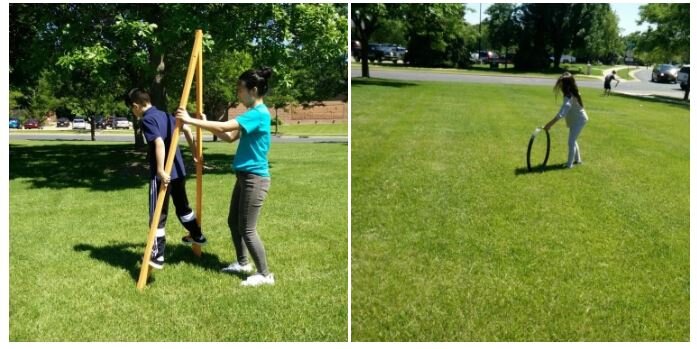
Older kids, up for a greater challenge, can register for a “Game On” mini-camp! There, they will get to make a hoop and stick toy, use scavenged materials to invent their own games, and try their hand at historic stilts, hoops and graces games outside.

Capture2.JPG

The kids who participate in these programs are quick to share their knowledge about how the lives of kids in Scott County 150 years ago were different from their lives today. They mention technology, a lack of video games, and the fact that houses didn’t have air conditioning (leading kids to want to play outside more). It was also a bit harder to get the variety of amusements in 1869 that are available today. Towns certainly had shops, and it was possible to order things by mail, but the selection was a bit different, and it took quite a bit longer for your packages to arrive. Children were likely encouraged to create their own toys and games.

That being said, kids still had fun, and, just like today’s big ticket items, there were games and toys that kids across the United States (and other nations) enjoyed. Three of those games- stilts, hoops and graces- are available to try by participants in our mini-camps. We will also be bringing them along with the Scott County Library Readmobile, and to fairs and festivals around the county this summer. Below, see what children’s literature of the past said about these three popular pastimes:

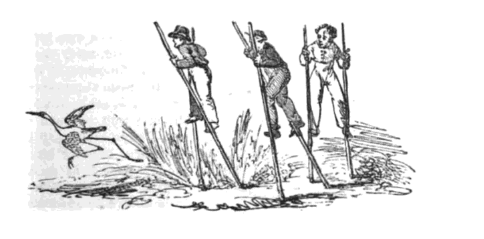
“Up In The Air On Stilts”, from The American Boy’s Book of Sport: Outdoor Games For All Seasons by Daniel Carter Beard  Published 1896

stilts.png

“According to the newspapers, walking on stilts is the very latest fashionable amusement for the ‘new woman’ in London. It is safe to say that before long you boys will be called on to make stilts for your sisters. There can be little doubt that a time is coming when a book written for boys will be the one girls will read, or rather, every book will be written for young people will be addressed to both boys and girls. Just why girls should not walk on stilts or engage in any similar sport no one has yet given a satisfactory answer. Twenty five years ago the boys used to make stilts with very low blocks for their sisters and the girls would seldom use them, but insisted on using their brothers’ high blocked stilts.

One bright boy on Fourth Avenue, New York City, has made a pair of stilts out of old laths from the ruins of some dismantled house. Three laths nailed together form each stilt pole, and the blocks are made of a graduated lot of lath pieces nailed together. Now, if a small boy in the tenement district can make himself a good serviceable pair of stilts out of some old laths, there can be no doubt that the boys who read this book will be able to find the material and tools to build themselves beautiful gadabouts”

“The Game of Graces”,  Lydia Marie Child’s The Girls Own Book, published 1838

game_of_graces_-_1831.jpg

“This is a new game, common in Germany, but introduced to this country from France. It derives its name from the graceful attitudes which it occasions. Two sticks are held in the hands, across each other, like open scissors: the object is to throw and catch a small hoop upon these sticks. The hoop to be bound with silk, or ribbon, according to fancy. The game is played by two persons. The sticks are held straight, about four inches apart, when trying to catch the hoop; and when the hoop is thrown, they are crossed like a pair of scissors. In this country it is called The Graces or The Flying Circle.”

A side note- author Lydia Marie Child is fascinating in her own right! Learn more about here here. 

“The Hoop”, from The American Boy’s Book of Sport: Outdoor Games For All Seasons by Daniel Carter Beard  Published 1896

“Everybody knows how to roll the hoop in the usual way. There is no horse, however trained, that obeys the hands of the rider with such precision. There is no ship, with the best pilot, which so correctly follows the guidance of its rudder. Here is a hoop, ruled by a stick, which maneuvers and drives it over the ground in all directions- to the right, to the left, straight on, backward, forward, describing a curve, a broken line, a triangle or, in a word, all the series of geometrical figures. Many players can contest with their hoops, and challenge each other, to know who shall drive his hoop the longest time without getting out of breath, or who shall be the first to reach a goal agreed on. In this latter case, all the players taking part in the contest should stand together on the same line, and start at a given signal… The hoop is like the skipping rope, one of the best exercises for giving strength and suppleness to the limbs.” 

hoop.png

Are you interested in joining us for any of our historic games programs? See the full schedule below, and contact your local library to register for mini-camps! All programs are free of charge.

 I’m Game! Library Crafts:Best for young people aged 6-10 and their families 
Shakopee Library: June 13th, 10:30am-11:00am
Prior Lake Library: June 15th, 12:00pm-12:30pm
Jordan Library: June 20th, 10:30am-11:00am
New Prague Library: July 2nd, 10:30am-11:00am
Elko New Market Library: July 3rd, 2:00pm-2:30pm
Savage Library: July 12th, 10:30am-11:00am
Belle Plaine Library: July 16th, 10:30-11:00am

 Game On! Library Camps:Best for young people aged 8-12
Savage Library: June 13th, 2:00pm-3:00pm
New Prague Library: Jume 18th, 2:00pm-3:00pm
Belle Plaine Library: June 20th, 2:00pm-3:00pm
Prior Lake Library: July 2nd, 2:00pm-3:00pm
Shakopee Library: July 12th, 2:00pm-3:00pm
Jordan Library: July 16th, 2:00pm-3:00pm
Elko New Market Libray: July 17th, 2:00pm-3:00pm

Written by Rose James, SCHS Program Manger

What's in our Collections?

Our collection has all manner of interesting items in it from flags, to jackets, to postcards. We collection items related to Scott County from all over the state. However, it’s important to be careful when taking things into the collection. I admit that I am a bit of a hoarder personally, and curators tend to be. I often have to fight my urge to accept everything that walks through the door, and ask myself some very basic questions. First of all, who is the item about and what is it, followed by when is it from and where in Scott County. The last question is the most important, and the one that is hardest to answer. Why? Why should we accept this item? What stories or insights into the people of Scott County can this item bring that we don’t already have?

collection-2.jpg

It seems important to share this aspect of what we do here. I have had to turn down donations recently because they would be duplicate items, or wouldn’t be usable for relating the county’s history. If you are interested in donating artifacts, documents, papers, anything really, we encourage you to do so. Our collection is far from complete, and honestly never can be. Should you have something in mind that you would like to donate, give us a call first and let us know what you have. We might not always accept donations into the collection, but it might go into our education collection, or we might know another organization that would be interested as well. Like you, we hate to see things thrown in the trash and we do what we can to ensure that history continues to live on, even if we can’t be the ones to give it a home.