Breweries of Scott County in Prohibition

Prohibition was no a surprise to those who owned breweries. The tide of “Drys” were growing for years before 1920. In Scott County, most towns had a brewery that had to decide how to handle this transition. That is what this post is about, the Shakopee Brewery, Jordan Brewery, and New Prague Bottling Works.

Shakopee Brewery, 1907

Shakopee Brewery, 1907

Firstly, the Shakopee Brewery was a long established business in Scott County. At the time the brewery was owned by M. J. Doherty. While most breweries began the process of switching to a different industry, the Shakopee Brewery instead closed its doors for 16 years. It wasn’t until repeal in 1933 that the brewery was bought and rebranded as Northwestern Distilleries, opening in 1936 but only last for about 4-5 years before closing for good.

The Jordan Brewery, 1940

The Jordan Brewery, 1940

The Jordan Brewery during Prohibition was called Schultz and Hilger’s Brewery, and like the Shakopee Brewery, it was closed during Prohibition. However, the building of Jordan Brewery was used as a chicken hatchery. The space was rented from the owners, and after repeal the business reopened and began producing Jordan Beer.

New Prague Bottling Works had its own brewery that it maintained, and by the late 1910s was a thriving business. When Prohibition came about, the business transitioned to soda production and closed down its brewery building. When repeal came about the company never reopened its brewing business, instead it became a distributor for Scheel’s Beer.

Prohibition had impacts that are still being felt today. If you found this little piece of history interesting, come visit our Prohibition exhibit opening in April to learn more about Scott County in Prohibition.

Written by Dave Nichols, Curator
John McConell: The Story of a Scott County Civil War Veteran.

John McConnell soon after leaving the Union Army in 1866

John McConnell soon after leaving the Union Army in 1866

John McConell was born in Ayr Scotland in 1846. In 1849, soon after John’s birth, the family decided to move to the United States.

Drawing of Fort Ridgley, 1862

Drawing of Fort Ridgley, 1862

Like many other immigrant families of the time, they initially settled on the East Coast, and then moved West, lured by the prospect of land ownership. The McConnells settled in Pennsylvania, then traveled to Iowa and Illinois, eventually coming to Minnesota in 1854.

When the family arrived in the area they settled at Fort Ridgley. The encampment had been built a year earlier in 1853, in response to the treaties of 1851 between the Dakota and the United States. Fort Ridgley’s goal was to ensure that Dakota lands became available for resettlement by Europeans and Americans.  John McConnell’s father was employed by the military to build boats and run the sawmill for the fort.

After two winters at Fort Ridgley, the family moved to Blakley Township with the goal of starting a farm. These plans were waylaid by the outbreak of the Civil War. In 1862, John McConnell’s father enlisted in the 8th Minnesota Regiment.  At age 17 in March of 1863, John McConnelll Enlisted in the Third Company of the Minnesota Volunteer Calvary, later known as Brackett’s Battalion. He served until the end of the war.

Brackett’s Batillion was made up of men from the First, Second and Third Companies of the Minnesota Volunteer Calvary. Alfred Brackett was the captain of the Third Company.

Brackett’s Battalion, 1864

Brackett’s Battalion, 1864

During their first winter of service, the companies were stationed at Benton Barracks near St Louis Missouri. Due to weather and poor sanitation, many of the men fell ill. In February of 1862, the struggling company was assigned to garrison duty in the hopes of improving their health and training. They garrisoned at Forts Henry and Heiman in Tennessee for over a year.

During this time, they were employed in riding to escort prisoners and deliver information. They also repaired telegraph lines, and scouted for opposing forces. There were occasional skirmishes with Confederate guerrillas.

In June and July of 1863, the regiment participated in the Tullahoma Campaign. In little more than a week the Army of the Cumberland drove Confederate forces out of middle Tennessee.

In January of 1864, the unit was sent home on a thirty day furlough. Because of on-going conflicts with the Dakota in the aftermath of the U.S.-Dakota War of 1862, Brackett and Governor Alexander Ramsey arranged for the cavalrymen to be reassigned to the Department of the Northwest. The veteran soldiers were reorganized into a new battalion. Major Brackett was given command, giving the unit the official name “Brackett’s Battalion.”

Brackett’s Battalion, 1864

Brackett’s Battalion, 1864

Brackett’s Battalion began the second chapter of its service in February of 1864. The unit joined General Alfred Sully’s army for the Northwestern Indian Expedition into Dakota Territory. The expedition was the continuation of a punitive campaign against the Dakota begun in 1863. It was also an effort to remove Dakota people who were living in areas that blocked access to gold that had recently been found at the Missouri headwaters. During this time John Mcconnall fought alongside his father who had also been stationed in the Western part of North America. The battalion spent the winter of 1865, ironically, at Fort Ridgley. In May and June of 1866, the men were finally mustered out.

John McConell returned to Minnesota where he lived out the remainder of his life as a farmer. He was active in the Grand Army of the Republic, or GAR, a nationwide veterans’ organization for Civil War soldiers.

Written by Rose James, SCHS Program Manager

What's It Worth?

20080050406.jpg

We received calls on a pretty frequent basis about the worth of certain items. It makes sense, if anyone would know the value of something historic it would be a historical society, right? We don’t necessarily know the value of things, more accurately; we are not allowed to give that information out even if we do. It might seem weird, but the value of items can get a historical society into some pretty tricky waters. If we assigned a value to something, and then let you write it off on taxes, we both get in trouble. Beyond that, it gives us a degree of power we just shouldn’t have.

Consider, for a moment, if you had a gold necklace and you brought it in for appraisal by a historical society. Well, if it had massive historical value, that organization could tell you it’s worth less than true value to try and convince you to donate it. This is highly unethical, and at the end of the day that’s the point. Historical societies, like ours, are guardians of the past. We hold everything in Public Trust, which is exactly what it sounds like, the Public trusts us to take care of these items. We want to honest and straight forward, and put forward the best ethical foot we can. This leads to the follow up question we always get asked, “Do you know someone who can tell me?”

We generally do not give out appraiser’s information for much the same reason that we do not give appraisals ourselves. It is easy for people to make deals and agreements to undervalue items to encourage their donation or sale. We do not want to appear to be making deals, and we always encourage donors to seek an appraiser on their own. If a donated item has an appraisal, we will honor that value, but we do not assign any value ourselves to items we take in.

Written by Dave Nichols, Curator of Collections
One Last Chance for The Old Ball Game!

19980450001.jpg

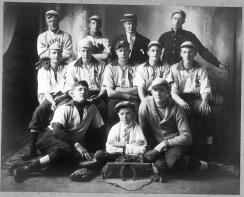
Baseball in Scott County is a tradition; nearly every town has or had a small town baseball team. Shakopee, Jordan, and New Prague all pride themselves on not only their teams, but the parks in which they play. Ross Bernstein is quoted as saying that “In small-town America, being on a team was like being royalty”. Some of the names of players like Joe Schleper and John Breimhorst became household names.

20020470001.jpg

Baseball in the County goes back as early as 1898, and even earlier by some other accounts. By the turn of the century the weekly game’s score were reported in every newspaper, and fans flocked to the stands. City built massive parks and competed to have the best facilities. Baseball in the towns of the county remained a main stay until the 1960s, when attentions turned toward more professional teams. The growth of major teams, the money they could spend, and possibly the rise of highways began to see small town ball die out in many towns.

 Today, many towns still have teams, and they compete in statewide amateur leagues. The history of baseball in Scott County is as much a part of this county as anything. While the history cannot be covered in one blog post, a much more expansive history can be found in our current exhibit, Play Ball: Sports in Scott County. The museum will be closing December 1st, and so will this exhibit, so be sure to come in before it closes and learn more about the celebrity players, ball parks, and general stories of sports in Scott County.


Written by Dave Nichols, Curator