Scott County Memories: How My Mother Made Soap Many Years Ago

These recollections were dictated by Anna Laabs of Belle Plaine in 1980 and originally shared in the collection “As I Remember Scott County”

First the wood ashes in wintertime were saved from the heating stove and kitchen range. When spring came, a waterproof barrel was put up behind the smoke house on a stand, with a big piece of tin put on the barrel so the lye water could run in the big black kettle which was hanging on a log held up by two charlie horses. The black pot was about a foot off the ground.

Ana Lebra with Chickens, around 1910. Photo from the SCHS collections.

Ana Lebra with Chickens, around 1910. Photo from the SCHS collections.

I was a little girl, eleven years old, so Mother said “now get your pail, go in the house, and pump your pail full of cistern water and pour it over the ashes until there are quite a few pails full”. Pretty soon a little stream of water was slowly going down the tin into the black kettle. It was the color of molasses and took quite some time to fill the black pot as the stream was very slow.

When the kettle filled up to a foot from the top, Mother took a raw chicken egg and put int in the kettle with the lye water. The egg did not sink to the bottom, so she new it was right for her to start soap cooking. I made a fire under the kettle. It took time before it was hot enough to put her clean lard and skins in. She had a long-handled wooden spoon to stir with. She always had a pail of cold water handy so when it boiled too fat she could pour could water in and it would settle. Some folks had trouble with it boiling over- what a mess!

When the cooking was done, I would scrape the fire from the pot and she would put a cover on it with a blg rock on top and some old coats. The next morning she and I would go out and she would cut a piece. It was ever so nice and clean and white.

Mother never had moldy lard, we took peach and pear boxes with clean cloth on the bottom of them and set the soap in there and put the boxes in the upstairs of the house to dry until ready to use.

The Baking Powder Wars

 It’s 7:30pm on a Thursday night, and your daughter just informed you that she needs 37 cupcakes for tomorrow’s class party. No problem! Just pull out a box of cake mix, add some oil and eggs, and voila! Some passable cupcakes.  

The ingredient that makes this kitchen magic possible is baking powder. In 1850, the relatively light and fluffy cake that we pour out of a box today would have been a laborious ordeal. Flour might have to be dried, grated or sifted depending on the season. Sugar needed to be ground, and even with these tasks you might still have a dense, flat desert.  

Advertisement for Royal baking powder warning about the dangerous use of alum by competitors. Published in the Scott County Argus, February 7th, 1908

Advertisement for Royal baking powder warning about the dangerous use of alum by competitors. Published in the Scott County Argus, February 7th, 1908

During this time the main leavening agent was yeast. Getting a proper rise out of those finicky little fungi could often be a multi-day process. Yeast “breathe” in oxygen and release carbon dioxide. Over time, and with constant heat, tiny yeast-breath bubbles of carbon dioxide build up in dough, causing it to “rise”. In order to have some fluff, the cake-baking process had to be scheduled with 12 to 24 hours of rising time.  

Even acquiring yeast could be difficult. The 1891 household guide “Buckeye Cookery and Practical Housekeeping” listed eight different recipes for making your own yeast. Unfortunately, all but one of these listed “Good Yeast” saved from your last batch of starter as one of the necessary ingredients. There was only one set of instructions for “Yeast without yeast”, and the process was lengthy. First, “On Monday morning” you were instructed to boil hops into water and drain the liquid into a ceramic crock. Once it has cooled to lukewarm, add “The best brown sugar” and flour to the mix. Two days later, add boiled and mashed potatoes and mix thoroughly. The next day, strain out the mix into stoneware jugs and set loosely with corks. Two days later the corks could be tightened. Then for the next two weeks, the mixture should be set near a stove (keeping it warm, but not too warm), and it needed to be stirred frequently. At the end of this process you would finally have yeast.  

It is very possible that the process of making yeast would have been relatively new to early European—American Scott County cooks. Until the 1860s, many housewives simply took leftover yeast from breweries. With its high German population, leftover brewers yeast might have been the norm for many Scott County residents. Unfortunately, in the late 1800s, most brewers switched from using primarily top-fermenting yeast to bottom-fermenting yeast. This new “lager” yeast ferments more slowly and at cooler temperatures, making it fairly useless in a home kitchen. Around this time, you also see a proliferation of cookbooks and household guides published explaining to frustrated housewives the process of creating yeast. Given the relative difficulty of obtaining good yeast, it is no surprise that people began looking for a substitute.  

The story goes that in the 1840s, an English chemist had a wife who was allergic to yeast and asked him to invent a substitute. He combined a few household items and presto! Baking powder. In reality, the mission to find an alternative leavening agent had been going on for centuries. In the late 1700s, early cookbooks mentioned using pearlash, or potash to create a rise. Made from lye, wood ashes, or baker's ammonia, pearlash consisted mainly of potassium carbonate. This produces carbon dioxide quickly and reliably, but was difficult to make, caustic, and often smelly, making it a less than ideal ingredient. By the early 1800s, cooks were using cream of tarter and baking soda, but tarter (a byproduct of winemaking) was too expensive for the average American household.  

In 1856 a chemist named Eben Norton Horsford officially patented the first baking powder. Rather then using ash, lye, or cream of tarter, Horsford’s invention was made from boiled down animal bones. This process extracted monocalcium phosphate, creating an acid that would react with baking soda to create CO2. He mixed the two in a container with a little cornstarch and baking powder was born. He started selling his product under the name “Rumford Baking Powder”.  

Baking powder soon became a pantry staple, and the competitors began to pop up. Royal Baking Powder used the classic cream of tartar in their powder, touting it as a higher quality, though slightly more expensive, product. Calmut and Clabber Girl used alum in place of monocalcium phosphate, making their powder slightly cheaper. This competition soon heated. The baking powder wars had begun.  

Advertisement for Royal baking powder warning about the dangerous use of alum by competitors. Published in the Scott County Argus, February 7th, 1908

Advertisement for Royal baking powder warning about the dangerous use of alum by competitors. Published in the Scott County Argus, February 7th, 1908

What makes the struggle between these companies so unique is the context in which their battle played out. The United States was changing rapidly at the turn of the century. The era of the “Wild West” was ending, and the nation was becoming urban. With this came changes in how people ate. More and more Americans were turning to pre-prepared foods, and increasingly, consumers did not know where the ingredients for their meals were sourced. Food safety laws had not caught up to these changes, and adulterated, spoiled, and downright poisonous ingredients became a real fear.  

Baking powder was one of the first popular “chemical” foods. There wasn’t a baking powder grain that it was ground from, or a baking powder plant. Instead, this ingredient was produced in a lab.  During an era of food uncertainty, this new chemical product became instantly suspect.  

You can see this play out on the pages of Scott County newspapers. During the first 10 years of 1900, competing baking powder advertisements grace almost every issue. Royal and Rumford baking powders pointed to the health concerns of the alum in cheaper brands. Calmut and Clabber insisted that their products were just as healthful, and cheaper than the competition. For such a low-profile food, baking powder dominated the advertising market.  

Eventually, cost won out. Royal and Rumford were acquired by Clabber Girl, leaving it and Calumet as the reigning American companies on the market. You don't have to look far to see baking powder's continued hegemony today: cooks around the world use it in everything from cupcakes to crepes, muffins to madeleines, danishes to doughnuts. The sheer lack of baking powder ads gracing our screens speaks to its ubiquitous nature- nobody has to be convinced to buy baking powder. 

Scott County Memories: Change of Times in the Farming Line

These recollections were dictated by Henry L Latzke of Belle Plaine in 1980 and originally shared in the collection “As I Remember Scott County”

Boys with horse. Photo taken around 1910. From the SCHS Collections.

Boys with horse. Photo taken around 1910. From the SCHS Collections.

I was born and grew up on the farm Dad owned, a 200 acre farm. At the age of six, Dad had me do all of the hoeing and at seven years of age I did the plowing with a bulky plow outfit that was drawn by three horses. The seeding was done with a seeder that spread the seed on top of the ground and it had eight shovels to cultivate the soil. Then it was harrowed twice, one crosswise and then across the corner to work the seed in. Corn was planted by a hand planter. The field was marked with a homemade marker made of wood, marked two ways, and the corn was planted in the mark so it could be cultivated lengthwise and crosswise.

In 1905, Dad and my uncle bought a fourteen she drill for seeding the small grain, and the next spring, Dad bought a 16 disk drill as it got seed in the ground better. In 1907, Dad bought a cornplanter, and the field was marked crosswise and planted the long way. the planter required two men and was drawn by two horses. One man drove the team, and the two men sat in front and dropped the corn on the cross mark. A lever had to be pulled to drop the seed corn.

The next year the same company that made the planter came out with a wire attachment that saved the time of marking the field.

I farmed on my own in the year of 1924; I bought a John Deere two-row grain drill. I used this until 1938, then I bought a 20 disk drill and used it until 1944. Then bought a 22 disk Moline tractor power lift. The corn was still being planted with horses, and I had four good work horses. The corn on the farm was planted with a two row horse planter, and the biggest part of the hay mowing and raking was also done with horses.

The chick corn with tractor planters did not work out as well as it should have. In 1954, my son bought a tow row mounted to help out. The grain was cut with a six foot Deering binder. There were only three binders at that time: Deering, McMorick and Plano. They shucked as a rule, nine or eleven bundles in a round shuck with some bundles broken and capped to get barley. Eleven bundles as a rule; it required two bundles for the cap. The cap bundle was to keep the wheat from blackening after 7-12 days of being dry. It was stacked with four stacks for a setting. The average stack was six to ten loads. I remember in the beginning of 1900, the separator was run by horse power called a sweep threshing.

Threshing crew near Shakopee, around 1910. Photo from the SCHS Collections.

Threshing crew near Shakopee, around 1910. Photo from the SCHS Collections.

Wood sawing and grinding were all horse powered and the separator had no blower to remover the straw as it was passed from man to man onto the stack. Bundles were cut and fed by man. The first steamer that threshed for us was moved from farm to farm by horses. Haas and Winterfeldt had the first completed steam power thresher in our neighborhood and they threshed our grain for quite a number of years. We were last at the very end of the run. John Haas was our neighbor, and our rig was shedded there. His first three boys and himself were with the outfit as the years went on. One year as we threshed, we had close to a foot of snow Dad raked it off the stacks to keep them from freezing.

In 1915 or 1916, Fred Blume ought a gas tractor. He owned a steamer also. In the winter or spring he sawed lumber. In 1917 he sawed lumber after Thanksgiving day for a barn on the farm that I farmed until I retired.

Frederick Bohnsack Sitting on a Tractor, 1952. Photo from the SCHS Collections.

Frederick Bohnsack Sitting on a Tractor, 1952. Photo from the SCHS Collections.

I lived on his farm to take care of the livestock and hauled cord wood to Belle Plaine for three years. Before that, we had a family to take care of the stock. The first year we had 76 head of cattle and over a dozen horses. We farmed in partnership, and we farmed three farms in 1920. I married and still farmed. In 1923 I bought a tractor. I used the tractor for power to fill the silo and it was used for belt work and plowing too. I still did some plowing with horses. In 1924, I traded the Fordson in on an 10-20 International as it was ma more powerful tractor, and in 1936 traded int in for an Allis and that was a three plow outfit.

In 1936, when I bought the Allis tractor it was on all steel wheels. In 1938 I assembled it on rubber. Te beginning of 1936 I did custom silo filling and filled in forty silos each fall. For grain threshing we had seven farmers, mostly neighbors, and they all had shares in the threshing machine. I used my tractor for power, and took care of the machine. The elevator, machine, and tractor were shedded on my farm.

In 1948 we went to combining the grain.

Under Construction

The windows and walls at SCHS are currently rattling with the new Scott County building construction going on down the street!

We have quite a few photos in our collections of iconic structures around Scott County as they were being built. Check out these construction images! See if you can guess what is being built before you read the caption!

Shakopee Ferry Crossing, 1879. In the background, you can see the supports for the Lewis Street Swing Bridge under construction. Photo from the SCHS Collections

Shakopee Ferry Crossing, 1879. In the background, you can see the supports for the Lewis Street Swing Bridge under construction. Photo from the SCHS Collections

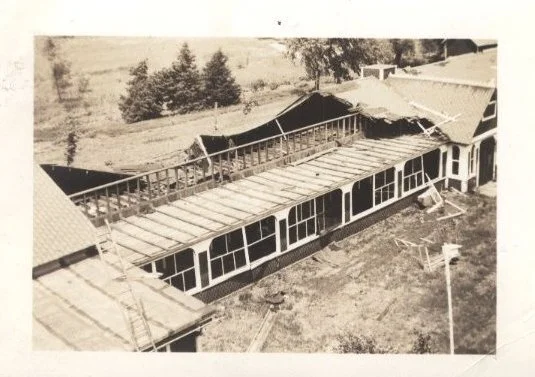
Addition to Mudbaden Health Spa in Jordan, around 1915. Photo from the SCHS Collections.

Addition to Mudbaden Health Spa in Jordan, around 1915. Photo from the SCHS Collections.

Building a barn in St Joe, around 1920. Photo from the SCHS collections.

Building a barn in St Joe, around 1920. Photo from the SCHS collections.

Construction of the Holmes Street Bridge in Shakopee, 1928. From the SCHS Collections.

Construction of the Holmes Street Bridge in Shakopee, 1928. From the SCHS Collections.

New addition to Mudbaden ouside of Jordan, around 1930. Photo from the SCHS Collections.

New addition to Mudbaden ouside of Jordan, around 1930. Photo from the SCHS Collections.

St Francis Hospital Shakopee, 1952. Photo from the SCHS Collections

St Francis Hospital Shakopee, 1952. Photo from the SCHS Collections

First National Bank in Shakopee, 1972. Photo from the SCHS Collections.

First National Bank in Shakopee, 1972. Photo from the SCHS Collections.


Historic Breweries of Scott County

Shakopee Brewery

The first brewery in the Minnesota River Valley, Shakopee Brewery opened in 1855. The facility was founded by H.H. Strunk (also the proprietor of Strunk Drug). Strunk owned Shakopee Brewery until, interested in other pursuits, he sold the business to Andrew Winkler in 1863, who retained ownership until his death in 1870.

After 1870, Winkler’s widow, Mary, continued to manage brewery operations. Five years later, she married a German Master Brewer named Hubert Nyssen and the two continued to run Shakopee Brewery together.

Unfortunately, the building was destroyed by fire in 1885. Fire was a huge concern in early brewing due to the dangerous combination of wood or coal heating and the dry, airborne dust produced when grain was industrially ground. Luckily, the family had enough capital to invest in rebuilding the facility. Shakopee brewery remained a fixture of the community until prohibition forced it to close in 1920.

You can still see the ruins of the brewery today, along the Minnesota River bike path, on the northwest edge of the city.

Shakopee Brewery, 1907. Photograph from the SCHS Collections

Shakopee Brewery, 1907. Photograph from the SCHS Collections

Hubert Nyssen, around 1920. Photo from the SCHS Collections.

Hubert Nyssen, around 1920. Photo from the SCHS Collections.

Schutz and Hilgers Jordan Brewery

The Jordan Brewery was founded in 1866. Like the Shakopee Brewery, it was started by a prominent local businessman – in this case Frank Nicolin. The structure of Jordan brewery was built to last with limestone and brick walls more then 3 feet thick. Nicolin sold the building soon after it’s opening, and in 1867 it took on the name Sand Creek Brewing, run by partners Sebastian Gehring and Frank Paier, who ran the business for almost 20 years. In 1885 they decided to sell to Peter Schutz and William Kaiser. Kaiser left the partnership, and by 1902 the facility was owned jointly by Peter Schultz and Peter Hilgers, whose names have remained with the brewery building ever since.

Like breweries around the country. Schutz and Hilgers closed in 1920, but reopened immediately upon prohibition’s repeal in 1933. At its height, Schutz and Hilgers brewed 40,000 barrels of beer annually and distributed to seven states.

In 1946 the brewery facilities were bought by Mankato Brewing Company, but they were soon forced to shut down due to financial difficulties. Finally, in 1954, the building caught fire during construction work, and nearly burned to the ground. The ruins were left vacant for many years until the city considered demolishing the property. Today, it is listed on the National Register of Historic Places, and has been refurbished into retail property.

Schutz and Hilgers Brewery, around 1940. Photograph from the SCHS Collections.

Schutz and Hilgers Brewery, around 1940. Photograph from the SCHS Collections.

Lable from Schutz and Hilgers, around 1940. From the SCHS Collections.

Lable from Schutz and Hilgers, around 1940. From the SCHS Collections.

Kokes Brewery, New Prague

Kokes Brewry was started by brothers-in-law Thomas Kokes and Albert Minars in 1884. Kokes, like many other early brewery owners, was a prominent local businessman who also owned a general store. Located at the corner of Second Avenue NW and Fifth Street N, the brewery advertised itself as “using clear hops and malts” and having a modern “steam operated” plant. Minars left the partnership in 1887, but Kokes remained an active owner for many years. The brewery was a prominent local employer, and delivered barrels to many small communities nearby New Prague.

When prohibition hit in 1920, the facility switched to selling soft drinks and malted non-alcoholic cereal beverages. Unfortunately, this new business model was not as profitable, and the business closed in 1931. Today, the historic building houses apartments.

1891 plat map of New Prague. Kokes Brewery is marked with a black square, in the upper right-hand corner.

1891 plat map of New Prague. Kokes Brewery is marked with a black square, in the upper right-hand corner.

Schmitt Brewery, Belle Plaine

Schmitt Brewery was opened by Albert Swinger in 1860. It cost $500.00 to build, and was located Northeast of town along what came to be known (aptly) as brewery creek. In 1866, Schmitt Brewery fell victim, like many other early breweries, to a fire, and Swinger was forced to rebuild.

Ownership of the brewery fluctuated after the fire. City records list B. Osterfeldt as proprietor in 1870, but Christian Schmitt purchased the brewery in 1871.

In 1877 the building burned down yet again and was rebuilt by Schmitt. For many years, Schmitt brewery was a local business, with a capacity of 10 barrels per day. Schmitt began to expand, increasing the capacity to 500 barrels per year and starting a bottling line, but his health was failing. In 1905, Schmitt passed away, leaving the brewery to his sons. It finally closed in 1916 after being outsold by competition from larger, regional brewing facilities.

Schmitt Brewery around 1900. Photograph from the SCHS Collections.

Schmitt Brewery around 1900. Photograph from the SCHS Collections.

Written by Rose James, SCHS Program Manager