History of Credit River Part 1: Beginning of the Township

he township of Credit River was platted in 1854. European American settlers arrived to the area later that year. The first of these was John Spratt, who came from Illinois. Second was William McQuestion. 

There are three different stories that describe how Credit River got its name, though none have been officially verified as fact. 

The first says that the town and river were named after a generous shopkeeper who used to give “down on their luck” Irish families credit. The second story is similar, stating that the French traders of Mendota used to give Irish immigrants credit on their way up the Mississippi to the Minnesota river as they traveled West. 

The third story is the most commonly told, and also the most dark. In this tale, Reverend Albert Ostet from Lakeville came to deliver mass at the Credit River settlement. On one of his trips the river was so swollen with floodwater that he couldn’t cross. He turned back towards home.  When he got back to Lakeville he found out his mother was dying. He gave the river “credit” because if it hadn’t been flooding he wouldn’t have been able to see his mother before she passed away. 

In 1855 many more families came to Credit River, with names that are still prominent in the area today: Cleary, Hough, Suel, White, Regan Reardon, Casey, Sherin, Flemming, Faricy. 

For the Hough (later spelled Haugh) family, this was their second time in America. When they first came across the Atlantic, they decided that they didn’t much like the United States, and turned around for Ireland. When they got home, they unfortunately discovered that their land had been sold, and felt they had no choice but to make the journey to America once again. When they arrived for the second time they decided to settle in Credit River. 

Some of the most well known of these early Credit River citizens was the family of Cornelius and Bridget Cleary. Cornelius came to the United States in 1850 from County Clare in Ireland to escape the potato famine. He lived in New York for five years and worked to pay for his family’s passage to the United States. After the entire family arrived they traveled to Dubuque, Iowa (a common waypoint for Irish families who were interested in homesteading in the West), and then claimed territorial land on the shores of the lake in Credit River. 

The original 1857 Cleary log home. Photo from the Prior Lake American, March 19, 2005

The original 1857 Cleary log home. Photo from the Prior Lake American, March 19, 2005

There they built a log cabin, and became known in the area for allowing passing missionaries to stay in their home. The first church services in the township were held in the Cleary cabin, along with the first Credit River municipal elections. 

In his 1875 obituary, Cornelius Cleary was described as “an excellent citizen and friend”, and “the real first settler of the town”. 

In an interesting side note, William McQuestion, the second European American to settle in Credit River, eventually moved on to Prior Lake. His descendant Cora McQuestion became the first female mayor of Prior Lake (and one of the first in the nation) during the 1920s. She was elected to the position after singlehandedly foiling a bank robbery with her shotgun. 

Scott County Memories: A New Market Hotel

These recollections were dictated by Helen Kaufenberg of New Market in 1980 and originally shared in the collection “As I Remember Scott County”


New Market MN around 1900. Photo from the SCHS Collections.

New Market MN around 1900. Photo from the SCHS Collections.

My earliest memories of my childhood are the first ten years of my life that I spent in the hotel that my parents operated. It was a busy little lace as very few people owned cars. The traveling salesman would come by train to the neighboring village of Elko. Then they would come to New Market. If they came in the evening, they would have to stay until the next day. Also the farmers from neighboring Cedar Lake Township had to haul their grai to the elevator at Elko by team, so many of them would stop at the hotel for a meal. They were charged twenty five cents. This was around 1910 to 1920. We had several girls who helped with the cooking and other chores.

I remember mother getting up some mornings at 3 o’clock to do the laundry. There was no electricity and it was a little scary to come downstairs alone. I laso recall that some of the laundry was sent to the cities by train. It was put in large canvas hampers around 4 feet long and 3 feet high.

There were dances held in the Village Hall and during intermission a supper was served at the hotel. On one particular night they served a turkey supper. They had everything waiting for the crowd when the stove pope in a the wood range fell down. It was really a disaster.

St. Nicholas Catholic Church of New Market, 1890. Photo from the SCHS Collections.

St. Nicholas Catholic Church of New Market, 1890. Photo from the SCHS Collections.

Another time, my folks told about a burglary at the Post Office next door. A salesman for the Schmidt Brewery had been on the train and got off at Elko. He had seen to suspicious men get of the train. He immediately walked around to the other side of the train and walked toward the train elevator. He called from the depot and alerted the people at New Market, so when the hotel closed at 11 o’clock, some of the people stayed up and watched through a window at the back of the hotel. They were watching the Post Office and also the bank which was next door. The salesman got ahold of a gun and opened the window just enough to put the gun through. When the burglars tried to get in the back door of the Post Office they were frightened away. There was evidence that the burglars had waited in the choir loft of the church as there were cigarettes and cigar stubs left behind.

The Butter Battle

On January 20th, 1930, the front page of the Shakopee Argus Tribune ran the headline: “Butterfat Prices Lowest in Years: Cause Is Too Much Oleo Say Men Who Have Studied the Question”. The article goes on to state that butter was selling for nearly ten cents per pound less than it had a year earlier, and that over 30,000,000 pounds of unsold butter currently sat in storage.  

This was of particular concern to Minnesota’s Farmers. At the time, Minnesota produced 276,000,000 pounds of butter annually.

Pride of Jordan Sweet Cream Butter Carton, Jordan Cooperative Creamery, 1957

Pride of Jordan Sweet Cream Butter Carton, Jordan Cooperative Creamery, 1957

To the modern reader, the date of this headline might ring a bell. Just a few months before, on October 29th 1929, the stock market had crashed. The decade that followed would come to be known as the Great Depression.  

But in January of 1930, the crash seemed more like an isolated incident. It was covered in Scott County newspapers. Concern was expressed for honest bankers who had lost their fortunes, but the November 7th, 1929 article in the Argus covering the Great Crash chastised “very little sympathy is had for the person who goes upon the stock exchange. It is a gamble pure and simple, and a precarious game”  

At the time, the butter surplus and falling dairy prices were not connected to the stock market crash. They were attributed to a new interloper on the market: Oleo, shorthand for Oleomargarine.  

Oleo was invented and patented in 1869 by a French Chemist, Hippolyte Mège-Mouriès, as a direct result of a challenge by Emperor Napoleon III of France who offered a prize to anyone who could produce a cheap butter alternative for use by the armed forces and lower classes. 

Originally oleo was made primarily of beef fat, but in the early 1870s, Henry W Bradley of New York received a patent for creating a margarine that replaced the beef fat with vegetable or coconut oil. Shortages of dairy during WW1 pushed the product into prominence and soon it was being sold nationwide as a cheaper alternative to butter.  

This was not met with cheers by the dairy industry. Increasingly, Oleo was blamed for falling dairy prices. Unfortunately, as money got tight, the very farmers that were suffering a shortfall began purchasing inexpensive oleo to make ends meet. The Shakopee Argus noted in their January 20th, 1929 article “I said once that any farmer who would cash a cream or milk check and purchase oleo with the money should be ashamed to look a cow in the face. If a dairy farmer won’t eat his own product and help his own business then he should and will be eventually driven out of business and a coconut cow from the tropical countries will be his ruination”. 

After the stock market crashed, economic instability increased in the United States, and butter prices continued to fall. Ten years previously, farmers had pushed themselves to meet the production demands of World War I. This rapid production increase had left many farmers with debts that they struggled to pay off. To offset debts, farmers continued to stretch the output of their farms to capacity, hoping to sell more and more for a profit. Unfortunately, this led to a surplus of goods on the market. Alongiside the mass layoffs and financial turmoil of the great depression, the cycle of surplus and debt was catastrophic.  

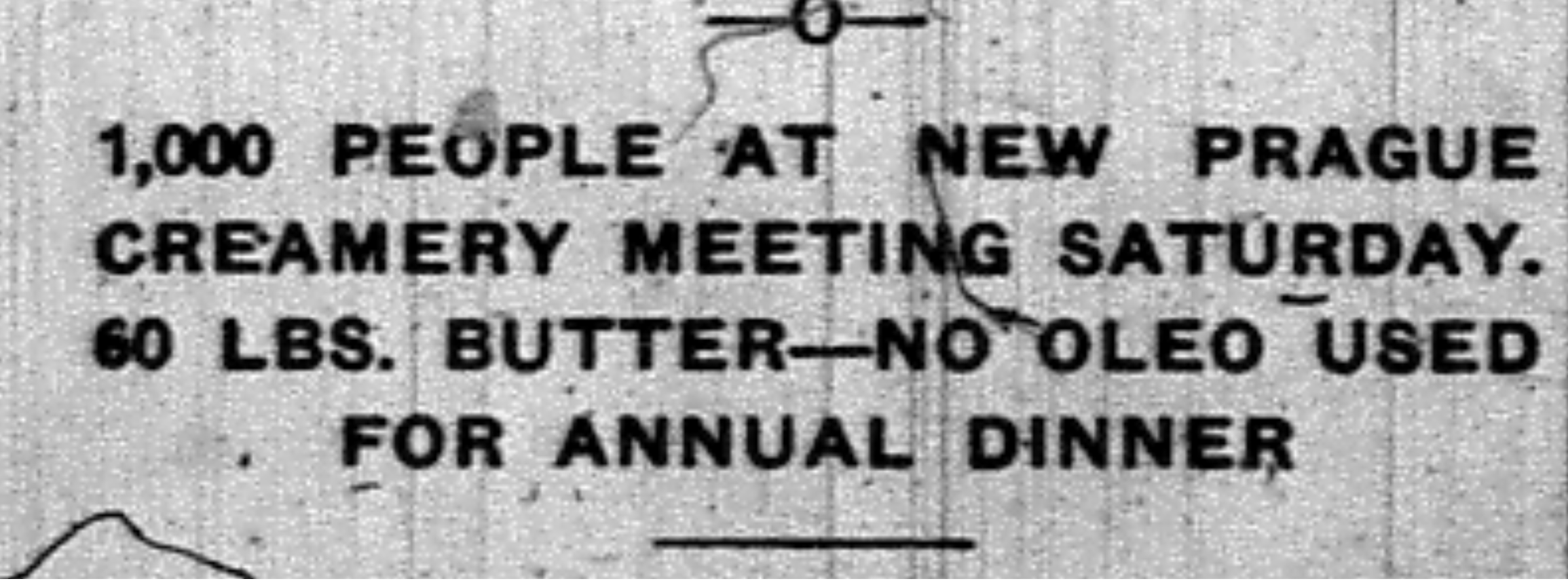
Headline from the Shakopee Argus Tribune, February 6th, 1930

Headline from the Shakopee Argus Tribune, February 6th, 1930

The Shakopee Argus Tribune addressed farming concerns in a Feb 6th, 1930 article: “The trouble with the butter price situation is not so much overproduction as it is underconsumption. Too much butter substitute, or oleo, is being used”.  On February 13th the editor of the Argus told the story of Welcome, Minnesota where merchants had agreed to refuse to stock oleo. He wrote “This is a good move and would, without question, bring definite results if it would become widespread. Oleo is simply a substitute for butter, the same as peanut butter or another spread, and does not provide the essential healthful qualities of butter”  

On February 20th, the Argus Tribune offered some advice to farmers wishing to combat the Oleo problem. “Advertising – advertise the use of butter and other dairy products” In fact, they confided, “there is no better medium in the world to advertise them then your local weekly newspaper, which in this case is the Shakpoee Argus- Tribune.”  

Headline from the Shakopee Argus Tribune, February 20th, 1930

Headline from the Shakopee Argus Tribune, February 20th, 1930

In March, Oleo was still enemy number one. On March 20th, the production of Oleo was broken down. It was noted that 1000 lbs of Oleo was comprised of coconut oil ($40.00), soy bean oil ($15.00), skimmed milk ($1.50), and salt (1.00). The author also lamented “Including labor and other overhead, this means a cost of only eight cents per pound of oleo. Where is there a dairyman in Scott County who can compete with it?”. It was instead put on local merchants to make the “right” choice and agree to “advertise butter only”.  

By March 27th, local dairy farmers had gotten their wish. According to the Argus Tribune “Shakopee merchants last week entered into an agreement with each other not to sell or handle any more oleo…that the dairy farmers will appreciate this voluntary action of our merchants goes without saying”.  

Dairy farmers had a hard road ahead. Scott County was not the only area where farmers were suffering during the Great Depression. The butter battle was national. Farmers pushed back through legislation, and bills were passed demanding that word “butter” not be used in any oleo advertising. It was also illegal to dye oleo a pale yellow to match butter. Instead, oleo was packaged with a small baggie of dye, allowing housewives to change the color of their spread at home. The last of these dye laws was on the books until 1976.  In Wisconsin the battle against oleo became violent. In 1933 the state was home to series of dairy strikes where farmers refused to sell their butterfat for less than $1.50 per 100 lbs. Eventually the state brought in armed guards and used tear gas to martial dairy trucks through the farmers’ blockade to market.  

Unfortunately, margarine was on the market to stay. By the 1950s, Americans became concerned about fat. Margarine, which had been lambasted for its “dangerous chemical properties” began to be marked as a healthful alternative to butter. By the mid 1960s, Margarine was outselling Butter. The reign of Oleo did not last though- today, amid concerns about trans fats, butter is on the rise. For the first time in 50 years the dairy farmers are getting their wish and butter once again outselling Margarine.  

Scott County Memories: How My Mother Made Soap Many Years Ago

These recollections were dictated by Anna Laabs of Belle Plaine in 1980 and originally shared in the collection “As I Remember Scott County”

First the wood ashes in wintertime were saved from the heating stove and kitchen range. When spring came, a waterproof barrel was put up behind the smoke house on a stand, with a big piece of tin put on the barrel so the lye water could run in the big black kettle which was hanging on a log held up by two charlie horses. The black pot was about a foot off the ground.

Ana Lebra with Chickens, around 1910. Photo from the SCHS collections.

Ana Lebra with Chickens, around 1910. Photo from the SCHS collections.

I was a little girl, eleven years old, so Mother said “now get your pail, go in the house, and pump your pail full of cistern water and pour it over the ashes until there are quite a few pails full”. Pretty soon a little stream of water was slowly going down the tin into the black kettle. It was the color of molasses and took quite some time to fill the black pot as the stream was very slow.

When the kettle filled up to a foot from the top, Mother took a raw chicken egg and put int in the kettle with the lye water. The egg did not sink to the bottom, so she new it was right for her to start soap cooking. I made a fire under the kettle. It took time before it was hot enough to put her clean lard and skins in. She had a long-handled wooden spoon to stir with. She always had a pail of cold water handy so when it boiled too fat she could pour could water in and it would settle. Some folks had trouble with it boiling over- what a mess!

When the cooking was done, I would scrape the fire from the pot and she would put a cover on it with a blg rock on top and some old coats. The next morning she and I would go out and she would cut a piece. It was ever so nice and clean and white.

Mother never had moldy lard, we took peach and pear boxes with clean cloth on the bottom of them and set the soap in there and put the boxes in the upstairs of the house to dry until ready to use.

The Baking Powder Wars

 It’s 7:30pm on a Thursday night, and your daughter just informed you that she needs 37 cupcakes for tomorrow’s class party. No problem! Just pull out a box of cake mix, add some oil and eggs, and voila! Some passable cupcakes.  

The ingredient that makes this kitchen magic possible is baking powder. In 1850, the relatively light and fluffy cake that we pour out of a box today would have been a laborious ordeal. Flour might have to be dried, grated or sifted depending on the season. Sugar needed to be ground, and even with these tasks you might still have a dense, flat desert.  

Advertisement for Royal baking powder warning about the dangerous use of alum by competitors. Published in the Scott County Argus, February 7th, 1908

Advertisement for Royal baking powder warning about the dangerous use of alum by competitors. Published in the Scott County Argus, February 7th, 1908

During this time the main leavening agent was yeast. Getting a proper rise out of those finicky little fungi could often be a multi-day process. Yeast “breathe” in oxygen and release carbon dioxide. Over time, and with constant heat, tiny yeast-breath bubbles of carbon dioxide build up in dough, causing it to “rise”. In order to have some fluff, the cake-baking process had to be scheduled with 12 to 24 hours of rising time.  

Even acquiring yeast could be difficult. The 1891 household guide “Buckeye Cookery and Practical Housekeeping” listed eight different recipes for making your own yeast. Unfortunately, all but one of these listed “Good Yeast” saved from your last batch of starter as one of the necessary ingredients. There was only one set of instructions for “Yeast without yeast”, and the process was lengthy. First, “On Monday morning” you were instructed to boil hops into water and drain the liquid into a ceramic crock. Once it has cooled to lukewarm, add “The best brown sugar” and flour to the mix. Two days later, add boiled and mashed potatoes and mix thoroughly. The next day, strain out the mix into stoneware jugs and set loosely with corks. Two days later the corks could be tightened. Then for the next two weeks, the mixture should be set near a stove (keeping it warm, but not too warm), and it needed to be stirred frequently. At the end of this process you would finally have yeast.  

It is very possible that the process of making yeast would have been relatively new to early European—American Scott County cooks. Until the 1860s, many housewives simply took leftover yeast from breweries. With its high German population, leftover brewers yeast might have been the norm for many Scott County residents. Unfortunately, in the late 1800s, most brewers switched from using primarily top-fermenting yeast to bottom-fermenting yeast. This new “lager” yeast ferments more slowly and at cooler temperatures, making it fairly useless in a home kitchen. Around this time, you also see a proliferation of cookbooks and household guides published explaining to frustrated housewives the process of creating yeast. Given the relative difficulty of obtaining good yeast, it is no surprise that people began looking for a substitute.  

The story goes that in the 1840s, an English chemist had a wife who was allergic to yeast and asked him to invent a substitute. He combined a few household items and presto! Baking powder. In reality, the mission to find an alternative leavening agent had been going on for centuries. In the late 1700s, early cookbooks mentioned using pearlash, or potash to create a rise. Made from lye, wood ashes, or baker's ammonia, pearlash consisted mainly of potassium carbonate. This produces carbon dioxide quickly and reliably, but was difficult to make, caustic, and often smelly, making it a less than ideal ingredient. By the early 1800s, cooks were using cream of tarter and baking soda, but tarter (a byproduct of winemaking) was too expensive for the average American household.  

In 1856 a chemist named Eben Norton Horsford officially patented the first baking powder. Rather then using ash, lye, or cream of tarter, Horsford’s invention was made from boiled down animal bones. This process extracted monocalcium phosphate, creating an acid that would react with baking soda to create CO2. He mixed the two in a container with a little cornstarch and baking powder was born. He started selling his product under the name “Rumford Baking Powder”.  

Baking powder soon became a pantry staple, and the competitors began to pop up. Royal Baking Powder used the classic cream of tartar in their powder, touting it as a higher quality, though slightly more expensive, product. Calmut and Clabber Girl used alum in place of monocalcium phosphate, making their powder slightly cheaper. This competition soon heated. The baking powder wars had begun.  

Advertisement for Royal baking powder warning about the dangerous use of alum by competitors. Published in the Scott County Argus, February 7th, 1908

Advertisement for Royal baking powder warning about the dangerous use of alum by competitors. Published in the Scott County Argus, February 7th, 1908

What makes the struggle between these companies so unique is the context in which their battle played out. The United States was changing rapidly at the turn of the century. The era of the “Wild West” was ending, and the nation was becoming urban. With this came changes in how people ate. More and more Americans were turning to pre-prepared foods, and increasingly, consumers did not know where the ingredients for their meals were sourced. Food safety laws had not caught up to these changes, and adulterated, spoiled, and downright poisonous ingredients became a real fear.  

Baking powder was one of the first popular “chemical” foods. There wasn’t a baking powder grain that it was ground from, or a baking powder plant. Instead, this ingredient was produced in a lab.  During an era of food uncertainty, this new chemical product became instantly suspect.  

You can see this play out on the pages of Scott County newspapers. During the first 10 years of 1900, competing baking powder advertisements grace almost every issue. Royal and Rumford baking powders pointed to the health concerns of the alum in cheaper brands. Calmut and Clabber insisted that their products were just as healthful, and cheaper than the competition. For such a low-profile food, baking powder dominated the advertising market.  

Eventually, cost won out. Royal and Rumford were acquired by Clabber Girl, leaving it and Calumet as the reigning American companies on the market. You don't have to look far to see baking powder's continued hegemony today: cooks around the world use it in everything from cupcakes to crepes, muffins to madeleines, danishes to doughnuts. The sheer lack of baking powder ads gracing our screens speaks to its ubiquitous nature- nobody has to be convinced to buy baking powder.