The History of Jackson Township Part 2: The Early Township

The New Township 

At the founding of Jackson Township, there were already many people living in the area. Because of the small size of the township, and its proximity to Shakopee, Jackson remained connected to the larger town. In spite of this, residents of the township quickly moved to establish their own governing body. The first official meeting of the township occurred in the home of W. F. Weiser in Shakopee in 1870. By 1872, residents had formed their own elected governing group. Joseph Graffentadt was elected Chairman, Franz Baumhoefer and John Thul were supervisors, and Hubert Rohel became clerk. 

The first school in Jackson had been built in 1868, before Jackson separated from Shakopee. It was a small, frame building and 43 students were enrolled. A few years later, a larger brick building was built to replace it. After the Jackson district officially merged with Shakopee Schools, the brick building became the township hall. It remained in service until 1981. 

Early Business

There were several prominent early businesses in the township. The Jackson Mill was built by the Ries brothers in the early 1860s. It was a small, water powered mill with one grinding stone. In 1870, the mill was sold to Franz Baumhoefer. He increased the capacity, adding a second grinding stone and converting the mill to steam power. At its height, the mill was producing 40 barrels of flour per day. 

J. B. Conter’s lime kiln opened in 1858. At the time there were four lime kilns in the area, but Conter’s was the largest. In 1858, Conter’s kiln produced 16000 barrels of lime, while its next closest competitor produced 14,000.

Lime had a number of important uses in 19 th century America. It served the construction industry as a key ingredient in mortar, plaster, and whitewash. Lime mortar was vital for brick construction because it held the bricks together. Lime mixed with milk and salt created whitewash, an early form of paint. Regardless of which material was used to build a home’s exterior, the interior walls could be plastered with whitewash to create a smooth surface.

Lime also had agricultural uses. It was added as a soil additive to neutralize the acids in highly acidic soils, and it was added to heavily clay soils to help break them down. 

Lime was created by burning limestone. Chunks of limestone were dropped into a lime kiln from above. For this reason, the river bluffs of Jackson were prime for the building of lime kiln, allowing easy high access to the kiln’s tall chimney. After it was loaded in to the kiln, the limestone would be heated to around 1650 degrees fahrenheit, which caused the stone to break down, forming a powder. This powder would be scooped out of the kiln, and loaded into barrels for sale. At the time, lime sold for around ninety cents per barrel. 

Invoice from J. B. Conter, 1894. From the SCHS Collections.

Invoice from J. B. Conter, 1894. From the SCHS Collections.

A later focal point in the township was Valley Ballroom. It was built in 1933, and hosted performers such as Lawrence Welk, Polka Master Whoopie John Wilfahrt and Guy DiLeo. Norbert (Nubby) Thies, a former town supervisor who grew up in the area said “I remember that people from all over the area would come to the dance hall for an evening of fun and entertainment. Every Christmas and New Years they would have a big dance.” Valley Ballroom closed its doors in 1959. The building was condemned and demolished to make way for the construction of the County Road 41 bridge.
The History of Jackson Township Part 1: The Creation of the Township

The Railroad

The history of Jackson Township is closely intertwined with the history of the railroad in Scott County. The process of bringing the railroad to the county began with a series of stops and starts. The Minnesota Territory first received federal land grants to provide for railroad construction in 1857. Unfortunately, the next decade was noted for a series of tumultuous events that delayed construction. First, there was “the panic of 1857”, an economic depression in the United States and England characterized by the declining international economy and over-expansion of the domestic economy. During this time, rail companies were reluctant to add to their lines. Next were two concurrent wars- the US Dakota war of 1862 and the Civil war that lasted from 1861 - 1865. Because of this, rail did not actually come to Shakopee (the first stop in Scott County) until 1865. 

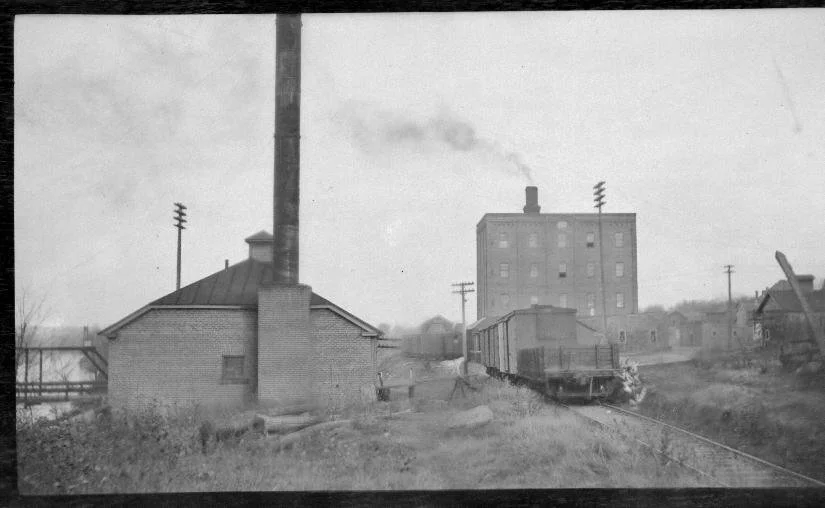
Train and tracks by the Shakopee Powerhouse, 1905. Photo from the SCHS Collections.

Train and tracks by the Shakopee Powerhouse, 1905. Photo from the SCHS Collections.

Rail could make or break a fledgling town. Rail brought goods and supplies, and allowed local manufacturers and farmers  to conveniently ship their products. It also brought new people to settle and expand local communities. 

Similarly, the location of a railroad shaped a community. Business corridors sprang up or moved in order to be near the rail line. Often the homes of wealthy citizens would follow, wanting to be near places of work or convenient shopping. By the time rail planning began for Shakopee, local policy-makers were well aware of the impact rail could have on a town. 

The Creation of Jackson Township 

Jackson Township was explicitly created in order to control the path of rail lines. The township is the smallest in the county, and lies directly west of Shakopee. In 1869 surveyors from the Hastings and Dakota Railroad were given the task of planning a route through Shakopee. There was a surprising amount of negotiation involved in this process. The railroad charter stipulated that the route had to go within the city limits of the town, but not how centrally it had to be located. Surveyors were tasked with finding the best location for the lowest land cost. 

City officials wanted the railroad to be centrally located in order to benefit the business district, but this land often sold at a premium, leading railroad surveyors to look towards less expensive land on the outskirts of town. Because of this, the surveyors were initially planning to route the rail line on the western end of town. 

Rather than negotiating to make centrally located land less expensive to the rail company, and therefore more appealing, Shakopee officials at the time decided to force the surveyors to buy downtown land at a higher price. They applied for a completely new city charter, excluding the nine miles on the western side of town which had been of interest to the rail companies. This land was designated “Jackson Township”, making it no longer technically a part of Shakopee, and therefore not a permissible location for new lines under the terms of the rail charter. 

The New Township 

At the founding of Jackson Township, there were already many people living in the area. Because of the small size of the township, and its proximity to Shakopee, Jackson remained connected to the larger town. In spite of this, residents of the township quickly moved to establish their own governing body. The first official meeting of the township occurred in the home of W. F. Weiser in Shakopee in 1870. By 1872, residents had formed their own elected governing group. Joseph Graffentadt was elected Chairman, Franz Baumhoefer and John Thul were supervisors, and Hubert Rohel became clerk. 

The first school in Jackson had been built in 1868, before Jackson separated from Shakopee. It was a small, frame building and 43 students were enrolled. A few years later, a larger brick building was built to replace it. After the Jackson district officially merged with Shakopee Schools, the brick building became the township hall. It remained in service until 1981.

St Joe's Church, Sand Creek

The St Joseph Catholic Church was said to have been the focal point of the community of St Joe. Jeanette Robling, a lifelong resident of Sand Creek Township, said in 1887, “It was really the church that made the community. There never was a business district. All community centered around the church.”

St Joe’s Church was located at the intersection of county roads 71 and 10 in Sand Creek. The story goes that a group of early settlers wrote to the Bishop in St Paul to request permission to build a local church. They heard that their request might be refused because of their proximity to Jordan which was also building a Catholic church at the time. Supposedly, a farmer came out with his wagon to meet the Bishop when he came to inspect the area. Instead of taking a direct route back to the community of St Joe, the farmer drove the Bishop along a circuitous and bumpy back route. St Joe seemed farther from Jordan then it actually was, and the Bishop gave permission for the church to be built. 

St Joe’s Church was established in 1858, with the first day of work on January 11th. It was built entirely by community volunteers and, due to farming and family obligations, was not finished until the following October. The original building was a 24’x35’ log cabin, not dissimilar to the residences in St Joe at the time. The first priest was Father Eberhard. In 1860 a bell, cast in St Louis, was purchased for the church by the local Young Men’s Society

In 1873, this cabin was replaced by a sandstone church building. For the next two years the priest was Father Duestermann. After that the Franciscan Order took over church management.

Exterior of St Joe’s Church. From the Prior Lake American, September 7th, 1987

Exterior of St Joe’s Church. From the Prior Lake American, September 7th, 1987

In 1874 a school opened on site, run by an order of nuns, with 60 students in attendance. The school consisted of only two rooms, with two teachers on staff. Attendance for each student averaged only 50-60 days per year due to farm work, illness and weather. By 1883, 106 children were enrolled. Unfortunately, this proved to be a difficult year for the school. Several students died in an epidemic, and the school closed for a large portion of the year as a protective measure. In 1884, the nuns retired and the building became the District 22 public school. The building was still shared with the church for religious instruction until 1947. It remained in operation until 1960, when the district combined with Jordan. 


A tower was added to St Joe’s Church in 1925, and electric lights were installed in 1938. The church held its first “annual bazaar” in celebration. 


St Joe’s Church stood for over 100 years. The last mass in the building was held in June of 1971, and officiated by Father Rogers. Many in the congregation were sad to see the church go. There was actually a lawsuit around the decision, based on the fact that the original donors of the land had given it for “church, charitable and educational purposes.” The final ruling was that when the deed was turned over to the Franciscan Order in 1875, this original intent was voided, and the church could be closed and the land sold. 

Items from inside the church were auctioned off in February of 1972, and the resulting funds were put into place to preserve the church cemetery. The old teachers residence was torn down to provide parking. Finally, the church itself was removed in 1988. 

In June of 1989 a memorial to the church was dedicated on site featuring the old church bell. The inscription reads “St Joseph's Catholic Church. On this spot stood St Joseph's Catholic Church. This monument is dedicated in memory of those who worshiped here and supported the church for 113 years. The bell is original. The stone and brick are from the church.” 

The end of the church also marked the end of St Joe. Never a large community, it began to disperse after the church closed. Today it is considered a ghost town. 

Early Sand Creek Township

The Landscape of Sand Creek

Like most parts of Scott County, the Sand Creek Township area was originally settled by the Dakota, thousands of years before European Americans came to the area. We don’t know many details of this Dakota Settlement, but early European Americans in the area commented on Dakota communities on the bluffs along the Minnesota River in the township. The area was home to the Eastern Wahpeton band of the Dakota. Given the landscape of the area, it is believed that there were likely seasonal hunting villages in what is now Sand Creek Township. 

Sand Creek was originally part of the Big Woods. This landscape was made up of heavy oak, basswood and elm. In fact, the forested area in Sand Creek was described by early European Americans as “impenetrable”. The thick trees made traditional European farming methods challenging. 

Early European American presence in the area was tied to milling. The nearby community of Jordan sprang up for this reason as well. The first European American structure we know of in the area was a sawmill built by William Holmes in 1853. William was the brother of Thomas Holmes, a land speculator known as the “Father of Shakopee”. Thomas Holmes eventually left the county, but William stayed on and settled in Jordan. After the mill was constructed, a few homes sprang up in the area, owned by men named John Smith and Comfort Baines. In 1854 a second mill was built, this one a grist mill operated by William Varner. In 1855 the first frame house was built. This small community in Sand Creek Township came to be known as St Joe. 

At this time, Sand Creek was known as Douglas Township, and was officially organized in 1858. Several months later, it was renamed St Mary Township. In 1859 the name was finally hanged to Sand Creek.

Early European American Settlers of Sand Creek Township

On January 20, 1927 the Shakopee Argus Tribune ran a piece profiling the early settlers of St Joe.

W. B. Baudy was born in Indiana in 1822, and came to Minnesota in 1857. While in Indiana he listed his profession as “hired man”. After arriving in Minnesota, he spent several years working in Scott County’s brick industry, and in various pineries. Finally, he was able to purchase 77 acres in section 4 of Sand Creek Township. He didn’t remain on the land long, but enlisted in 1862 and served for two years in the Union army. His first wife, “Miss Springer” passed away while he was at war. After he returned, he married “Miss Barrisford”, and they had two children. 

Frank Matchett was born in Ohio, and studied journalism at the Hiram Institute. After graduating, he worked as printer for the Elmira Eagle for several years, then became a typesetter in Cleveland. He came to Minnesota after accepting a position to work at the St Paul Press in 1874. He did not stay there long, choosing instead to move around the state, helping to start small newspapers including the Wright County Eagle and Howard Lake People’s Advocate. In 1878 he came to Scott County and settled in Sand Creek Township, starting the Scott County Advocate newspaper. He married Sarah Reed of Jordan in 1879. 

Eli Palmer was born in Syracuse, New York in 1818. He soon moved to Illinois where he remained for 37 years. In 1855 he agreed to captain a wagon train to California, where he built a trading post and remained for two years. After this time, he sold his property in Illinois and bought land in Sand Creek township. Eli Palmer enlisted in the Union Army in 1861 and served for three years. 

Henry and Francis Eckman came to the United States from Germany in 1850. They originally moved to St Louis where Henry drove a butcher’s wagon. After saving up money for several years, they came to Sand Creek Township and claimed a homestead. Henry built a small log cabin with a bark roof. For their first year, they had no oxen to help with breaking the ground. They used horses to “scratch the surface” of the land and planted a few crops among trees and stumps. The next year they bought oxen. Over time, they were able to plow the land and eventually built a barn and upgraded from a log cabin to a brick house. Eventually they focused on dairy cattle and sold butter and cheese. Henry and Francis had seven children. One started a sawmill, one a furniture store in Jordan, and three joined forces to open a brewery in Glencoe. 

History of St Lawrence Township Part 4: The Township Continues

Rip Van Winkle

In 1987, the Prior Lake American described St Lawrence Township as “Rip Van Winkle”. While the Village of St Lawrence had floundered due to transportation concerns, the construction of Highway 169 during the 1950s brought new people and businesses to the quiet farm-focused area. Soon several restaurants sprang up along the highway, as well as some attractions. One of the early attractions, Jim’s Apple Farm, now dominates the highway as Minnesota’s Largest Candy Store. Along with these new businesses and attractions, the population of the township began to increase. 

Another prominent feature in the area is the Minnesota Valley State Recreation Area. The scenic and recreational potential of the area was recognized early on, and the first park was suggested in 1939. In 1967, a bill proposing an 18,000-acre state park along the river in St Lawrence went before the Minnesota Legislature, but it failed to pass. However a bill creating the Minnesota Valley State Trail did pass in 1969. The trail was to run from Fort Snelling State Park to the town of Le Sueur and include six waysides totaling over 5,000 acres. In this roundabout way, portions of the valley were added to the state park system. The Minnesota Valley National Wildlife Refuge was authorized in 1976 and additional lands originally desired for the state park received federal protection.

Minnesota Valley State Recreation Area

Minnesota Valley State Recreation Area

Today the Minnesota Valley State Trail runs through the recreation area with both paved and natural sections. Trails are also in place for hiking, biking, cross-country skiing, horseback riding, mountain biking, and snowmobiling. The landscape of the park includes wetlands, floodplain forest and blufftop oak savanna. The park also provides a home for raccoons, mink, muskrat, wood duck, beaver, white-tail deer, rabbits, squirrels, or red and grey fox. 

The Fair and the Threshers

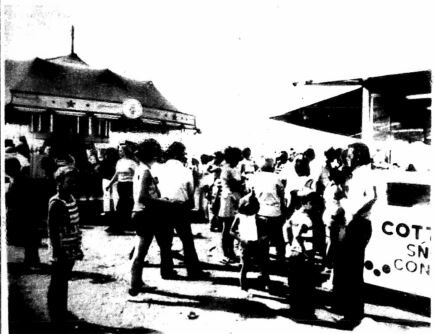
Sunday afternoon at the 1973 Scott County Fair. Photo from the Belle Plaine Herald, August 2 1973

Sunday afternoon at the 1973 Scott County Fair. Photo from the Belle Plaine Herald, August 2 1973

Scott County has hosted a fair since the early days of European American residents. The first fair was held in 1857 with the goal of showcasing the agricultural possibilities of the county and encouraging immigrants to move to the area. Until 1885 the fair was held piecemeal, in the buildings and streets of downtown Shakopee. Then land was purchased just outside of Shakopee, allowing the fair to expand and have a permanent home. In 1915, the fair was held in Jordan for the first time. 

In the early 1970s, the Scott County Fair Board purchased 80 acres in St Lawrence Township to be the new home of the Scott County Fair. Ground was broken, and the fair was held in its new home for the first time in 1973. 

A new cattle barn, horse barn, 4-H building, sanitation facility, and concessions stand were built on site. Four other fair buildings were moved from the old fairgrounds in Jordan. The Fair Board also chartered busses that ran from the fairgrounds to neighboring communities for a cost of forty cents per passenger. 

The big events that year were the horse show, horse pulling contest, 4H auction, demolition derby, tractor pull and chuck wagon races. 

St Lawrence Township is also home to the Scott Carver Threshers and the grounds of their annual Harvest Festival. The first threshing festival held by the group was in 1964, after Ernie Morrell suggested to his nephew Ken Scott that they fire up their grandfather’s engine, hook it to the separator, and see if they could thresh some grain. 

Today, the mission of the group is “to preserve the agricultural and industrial history from the past for the enjoyment and education of the future generations.”  Their annual festival includes displays and demonstrations of steam tractors, engines, threshing, milling, printing, blacksmithing and rug making. 

Gravestones and Ghost Stories 

St Lawrence has a few unusual gravesites. A single headstone is located in Lawrence Wayside, part the Minnesota Valley State Recreation Area. Before becoming park land, the property was part of the Henry Barlage Farm. The grave is for Frances N Strait who died at age 19 on Dec 21 1860. She was the first wife of George Strait, of milling fame, and the two married when she was only 16. It is unknown why she was buried at a remote, isolated location. 

There are also two gravesites on the property of railroad magnate turned farmer Frank Erikson. They are from children who died during the diphtheria epidemic that tore through the county in the 1870s. Clara Frank recalls spending time on the property with her friends in the early 1900s: “I remember when we were children we used to run and play there, but we were always careful not to step on the graves. You never knew what would happen if you stepped on the graves.”

In 2007 a ghost hunter named Kathy visited the Strait house along with a reporter from the Jordan Independent. Kathy asked some questions to any spirits that might be present, including “Are you angry that your house is now a museum”. She thought that she heard a negative response, but the reporter with her didn’t hear anything. She did leave some tape recorders running at the site, and claimed later to have picked up some “evp” or electronic voice phenomena. To ghost hunters, EVP are otherwise inaudible communications from spirits that can be picked up with a tape recorder. The messages were “Repent!”, and the names “Elizabeth” and “Andy Taylor”.

St Lawrence Township Today

Today St Lawrence Township covers 14.9 square miles and has a population approximately 550 people. The township’s board meetings are typically held on the second Thursday of the month at 7 p.m. at the St. Lawrence Town Hall, 7500 Old Highway 169 Boulevard. While the area is still home to farmland, it also has become a place for homeowners who want to live in a rural area and don’t mind having a commute to neighboring towns or the Twin Cities.