The History of Jackson Township Part 4: Early Residents of Jackson Township

Early Residents of Jackson Township

The first European American to establish a claim in the area that would become Jackson was Daniel Apgar. He came to Scott County from St Paul, but had family on the east coast. Soon after staking his claim in 1851, Daniel returned east, and brought his father Samuel Apgar, brother Ai G Apgar, and their wives and families. Ten people in total arrived in 1852. Daniel only lived on his claim for a short while, soon selling it and resettling in Stearns County. He died in an accident in 1870. 

Samuel Apgar remained in the township, living there until his wife passed away in 1875. He then moved into Shakopee to stay with his daughter Mrs. Cogswell. Ai G Apgar staked a claim in sections 12 and 13 of Jackson Township. When Scott County was officially formed, he was elected sheriff and served for three years. In 1866 he sold his claim and moved into Minneapolis. 

J. B. Conter owned Jackson County’s lime kiln. He was born in Mondorf, Grand Duche, Luxembourg, Aug 17 1832. In 1847 he immigrated with his parents to the United States. The family settled in Port Washington Wisconsin. Conter came to Scott County in 1854, and worked as a plasterer and bricklayer. In 1866 he claimed land in Jackson Township and started Shakopee Cement and Lime Manufacturing Company, which he ran until his death. Conter also served as president of the Merchants and Farmers National Bank of Shakopee. In 1959 he married Barbara Wagner and had nine children, six of whom survived to adulthood. 

Hubert Rohel was Jackson Township’s first County Clerk. He was born in Honsfeld Achen, Prussia, June 17, 1818. When he was 35 he immigrated to the United States and moved to St Paul where he married Mary Wagner. In 1854 he came to the Shakopee area and worked as a surveyor, until one day his employer informed Rohel that he could not longer pay him. Rohel claimed land in a forested area of Jackson Township and built a log cabin. He spent the rest of his life creating and maintaining a farm on this land which, according to his obituary, brought him “great wealth”. He had five children, and passed away in 1897. His obituary stated that “his robust constitution stood him in good stead until his time came to die, and then he ceased to breathe as the pendulum of a clock run down ceases to swing.” 

Herman Strunk was a prominent local businessman, and the first owner of Shakopee Brewery in Jackson Township. Strunk was born in Germany at Grossherzugthun, Oldenburg on May 14, 1818. Both of his parents died while he was young, and he decided to immigrate to the US in 1835. He worked in shipping on steamboats that ran between St Louis and Memphis for several years before deciding to settle in St Louis in the early 1840s where he married and had 4 children. Unfortunately, St Louis was swept by a Cholera epidemic in the early 1850s, and three of his children were killed by the disease. Seeking a healthier climate, the family decided to move north in 1854. He claimed land in Jackson Township and built a brewery which he ran until the early 1860s. 

Strunk Drug around 1890. Photo from the SCHS Collections.

Strunk Drug around 1890. Photo from the SCHS Collections.

When the Civil War broke out, Strunk wanted to enlist, but was denied entry into the service because he was missing his two front teeth. At the time, many muskets used cartridges wrapped in paper which required the owner to bite off a twist at the end and release gunpowder. It was thought that, without teeth, Strunk would be unable to perform this task. 

Soon after, Strunk was elected County Commissioner, and then County Coroner. He served in this role for two years. In 1871, Strunk moved into Shakopee and opened Strunk Drug- the establishment which he is perhaps best known for today. It was said that from then on, he walked to the store every day until his death to check on the business. He was elected mayor of Shakopee in 1877, and as Alderman in 1880. 

Herman Strunk passed away in 1905. His obituary stated “One of Shakopee’s venerable and most highly respected citizens passed away, another of the little band of her remaining pioneer settlers was called home, and with more than a passing feeling of sorrow the death of H Strunk was received by the community with which the greater part of his long life has been closely interwoven and upon which during all those years was shed the benign influence of his upright life and sterling character.”

Hubert Nyssen at Shakopee Brewery around 1920. Photo from the SCHS Collections.

Hubert Nyssen at Shakopee Brewery around 1920. Photo from the SCHS Collections.

Hubert Nyssen owned Shakopee Brewery from 1875 until the facility was closed by prohibition. He immigrated from Belgium, and came to the Shakopee area in 1869 when it was “very much part of the big woods”. He initially worked as hired help and as a farm laborer. He said “You know, there was lots of hard work on the farm then. Everything was done by hand and everybody put in long hours. But I was young and healthy and able to do whatever was expected of me… I didn’t always get good wages though. I worked at whatever I could get to do and sometimes only received 50 cents a day. I remember working on the railroad grade one summer. It seems amusing to me now when I look back. We were doing some excavating work by hand. There were two crews and each tried to outdo the other.” 

Nyssen began working at Shakopee Brewery in 1873. At some point, he also attended a brewing school in Milwaukee. In 1875, he married brewery owner Mary Winkler, and took over brewery operations. When prohibition closed Shakopee Brewery, Nyssen owned the St Paul Hotel in Shakopee. Nyssen also served on the elected board of Jackson Township for eighteen years. 

Hubert’s wife, Mary Nyssen  was born Mary Johnson in Weckway Sweden on February 5th, 1843. She immigrated to the United States with her brothers at age 14, initially settling in Stillwater. On June 16th, 1863 she married Andrew Winkler and moved with him to Scott County. Winkler eventually purchased Shakopee Brewery, but his ownership was short-lived. He passed away from typhoid in 1871. At the time, it was theorized that he had caught the illness from the chill of spending too much time in the brewery ice house. Mary took over management of the brewery, and ran it until she married Hubert Nyssen in 1875. 

The History of Jackson Township Part 3: Shakopee Brewery

Shakopee Brewery 

Shakopee Brewery* was one of the most prominent early businesses in Jackson Township. The brewery was built by German immigrant Herman Strunk and opened in 1856. With its opening, the Shakopee Valley Herald ran the following statement ““We understand that the Brewery of Mr. H. H. Strunk will soon be in operation. Our citizens will then be able to procure a pleasant and healthy drink without much trouble” 

It was the first brewery in Scott County, and remained one of its largest until the doors were closed by prohibition. In 1860, Strunk opened a distillery nearby, and then sold both to F. H. Franz. Franz, in turn. Sold to Andrew Winkler in 1863 who retained ownership until his death in 1870. After Andrew Winkler’s death, his widow Mary Winkler took over brewery operations. She ran the facility independently for 5 years until she married German brewer Hubert Nyssen. The two continued to manage operations until prohibition. 

Herman Strunk had built a hunting lodge next to the brewery, and the Nyssen family added to the building and turned it into a residence. It was built out of both limestone and brick- likely the limestone that was quarried in order to build the storage cellar for the brewing facility. The first floor of the house was a family residence, while the second was reserved for lodging for farmers and salespeople who came to deliver brewery supplies. The Nyssens also operated a large farm on the brewery land which grew barley for beer production. In 1987, the Shakopee Valley News interviewed Leo McGovern who worked on the farm and at the brewery when he was 12. He recalled “They had about 80 acres there and they had stock, chickens, pigs and horses. When I worked in the brewery, I helped hand pump the beer out of the vat and into kegs.”

1897 was a difficult year for Shakopee Brewery. On October 28th, a fire started in the brewery’s ventilator system, located under the roof. Fire teams were dispatched from Shakopee, and eventually got the blaze under control using water from the facility’s cistern system, but there was a great deal of damage. Offices, staff quarters, and the entire cooling system for the brewery were destroyed. 

Luckily the brewery was insured, and Nysssen received $3925 in insurance money to help repair the damage. Nyssen stated at the time that the money was not enough to completely cover the damage (at the time the brewery was valued at $14,000.000) but it was enough that the building could be repaired and production would continue. 

Shakopee Brewery, 1912. From the SCHS Collections.

Shakopee Brewery, 1912. From the SCHS Collections.

Less than a month earlier, in a slightly more farcical story, one of the brewery’s wagon teams was lost. The Shakopee Argus reported on September 30, 1897 that a delivery team from Shakopee Brewery met with a toy balloon salesman on the road. The balloons spooked the horses, and the driver lost control. In the ensuing scuffle, the horses were lost, and both drivers were injured. 

Production at Shakopee Brewery 

In August of 1903, a reporter from the Shakopee Tribune spent the day at Shakopee Brewery getting instruction on brewing “as practiced in the big stone building where the amber liquid comes foaming forth to make Shakopee famous.”  

First he wrote about the barley that was used in production of beer at the facility. “Barley is the first requisite after the brewery is equipped, Mr Nyssen raises considerable of this grain, and buys a whole lot more from farmers every fall...The barley is soaked in an immense tank for 60 hours, about a hundred bushels at a time and then spread out on cement floors in the malt cellar and kept at a temperature of 54 degrees.” After this, the barley was turned every day for six days in order to sprout the grain. Next, it was loaded into “a room high up and just beneath the tall cupola which is a feature architecturally in nearly every brewery.” The floor of this room was made of sheet iron, perforated with holes. The barley was heated from below up to 212 degrees in order to remove moisture. During the heating and cooling process  “It is necessary for a man with a long shovel to dash around the heated inferno and turn the grain repeatedly. It takes no imagination to picture it a hot job and the man who can stay in the room for fifteen or twenty minutes at a time is in the line for a job at fire-eating at a circus sideshow” 

After cooling, the grain was ground in a mill, then mashed into a large vat of water that was accessible only by ladders. This process was fairly specific. First, the water was heated to 122 degrees, then held at 154 degrees. When it “gives off no color”, it was raised to 166 degrees and left to stand for an hour. The wort (liquid) was then drawn off int a vat, and the soaked grain was fed to hogs and cattle. This heating process supposedly took half a cord of firewood. The end result was then tasted to ensure it resembled “sweet water” 

After this the liquid was once again boiled, and divided into barrels. Three quarters of a pound of hops was put into each barrel in lots- the first when two hours before the boiling is done, and the second a half hour after the first. When this process is complete, the beer was taken to the cellar and cooled to forty two degrees using an open vat and coiled brass tubing. After this, yeast was added to the brew. 

Shakopee Brewery, 1907.  Photo from the SCHS Collections.

Shakopee Brewery, 1907. Photo from the SCHS Collections.

The reporter asked Nyssen where brewing yeast came from. He learned, “One brewery gets its start from another. It is passed from brew to brew in a brewery, and has been at Nyssen’s for half a century nearly, and the supply has never given out. One thing is sure, the beer would not be beer without yeast”

After the yeast was added, the beer was transferred to fermenting tubs to be turned into alcohol. The brewery chalked the date on the side, and allowed each tub to sit for two weeks. After this, the beer was transferred into storage vets for another 6 weeks. Next, it was transferred once again into “chip casks”, where shaved beech chips were added to give it color. Then “kreusen” was mixed in to cause the beer to foam. 

Finally the beer was pressurized, and racked into kegs in the brewery cellar. The cellar was a vaulted space, running underground in the hill for one hundred feet. It was only lit with candlelight, and blocked by a series of doors in order to keep a constant temperature. 

* Note- Shakopee Brewery was known by several different names as ownership changed. For the sake of readability, we have consistently referred to the facility as “Shakopee Brewery”

The History of Jackson Township Part 2: The Early Township

The New Township 

At the founding of Jackson Township, there were already many people living in the area. Because of the small size of the township, and its proximity to Shakopee, Jackson remained connected to the larger town. In spite of this, residents of the township quickly moved to establish their own governing body. The first official meeting of the township occurred in the home of W. F. Weiser in Shakopee in 1870. By 1872, residents had formed their own elected governing group. Joseph Graffentadt was elected Chairman, Franz Baumhoefer and John Thul were supervisors, and Hubert Rohel became clerk. 

The first school in Jackson had been built in 1868, before Jackson separated from Shakopee. It was a small, frame building and 43 students were enrolled. A few years later, a larger brick building was built to replace it. After the Jackson district officially merged with Shakopee Schools, the brick building became the township hall. It remained in service until 1981. 

Early Business

There were several prominent early businesses in the township. The Jackson Mill was built by the Ries brothers in the early 1860s. It was a small, water powered mill with one grinding stone. In 1870, the mill was sold to Franz Baumhoefer. He increased the capacity, adding a second grinding stone and converting the mill to steam power. At its height, the mill was producing 40 barrels of flour per day. 

J. B. Conter’s lime kiln opened in 1858. At the time there were four lime kilns in the area, but Conter’s was the largest. In 1858, Conter’s kiln produced 16000 barrels of lime, while its next closest competitor produced 14,000.

Lime had a number of important uses in 19 th century America. It served the construction industry as a key ingredient in mortar, plaster, and whitewash. Lime mortar was vital for brick construction because it held the bricks together. Lime mixed with milk and salt created whitewash, an early form of paint. Regardless of which material was used to build a home’s exterior, the interior walls could be plastered with whitewash to create a smooth surface.

Lime also had agricultural uses. It was added as a soil additive to neutralize the acids in highly acidic soils, and it was added to heavily clay soils to help break them down. 

Lime was created by burning limestone. Chunks of limestone were dropped into a lime kiln from above. For this reason, the river bluffs of Jackson were prime for the building of lime kiln, allowing easy high access to the kiln’s tall chimney. After it was loaded in to the kiln, the limestone would be heated to around 1650 degrees fahrenheit, which caused the stone to break down, forming a powder. This powder would be scooped out of the kiln, and loaded into barrels for sale. At the time, lime sold for around ninety cents per barrel. 

Invoice from J. B. Conter, 1894. From the SCHS Collections.

Invoice from J. B. Conter, 1894. From the SCHS Collections.

A later focal point in the township was Valley Ballroom. It was built in 1933, and hosted performers such as Lawrence Welk, Polka Master Whoopie John Wilfahrt and Guy DiLeo. Norbert (Nubby) Thies, a former town supervisor who grew up in the area said “I remember that people from all over the area would come to the dance hall for an evening of fun and entertainment. Every Christmas and New Years they would have a big dance.” Valley Ballroom closed its doors in 1959. The building was condemned and demolished to make way for the construction of the County Road 41 bridge.

The History of Jackson Township Part 1: The Creation of the Township

The Railroad

The history of Jackson Township is closely intertwined with the history of the railroad in Scott County. The process of bringing the railroad to the county began with a series of stops and starts. The Minnesota Territory first received federal land grants to provide for railroad construction in 1857. Unfortunately, the next decade was noted for a series of tumultuous events that delayed construction. First, there was “the panic of 1857”, an economic depression in the United States and England characterized by the declining international economy and over-expansion of the domestic economy. During this time, rail companies were reluctant to add to their lines. Next were two concurrent wars- the US Dakota war of 1862 and the Civil war that lasted from 1861 - 1865. Because of this, rail did not actually come to Shakopee (the first stop in Scott County) until 1865. 

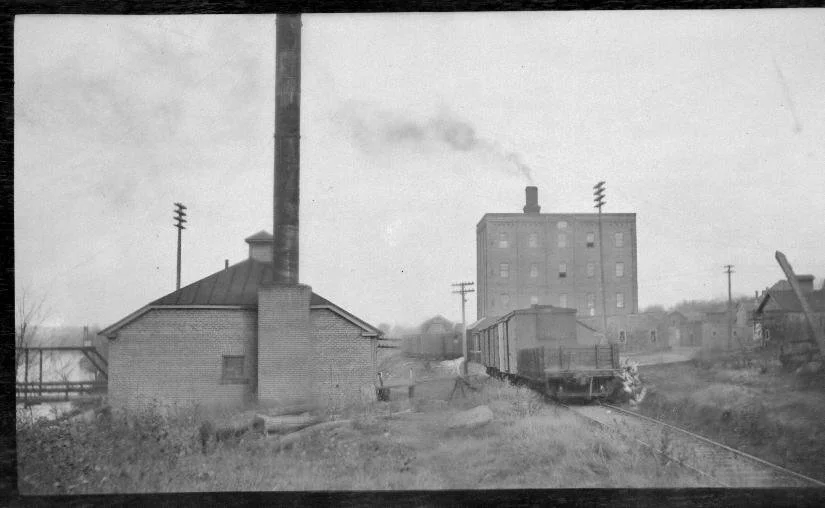
Train and tracks by the Shakopee Powerhouse, 1905. Photo from the SCHS Collections.

Train and tracks by the Shakopee Powerhouse, 1905. Photo from the SCHS Collections.

Rail could make or break a fledgling town. Rail brought goods and supplies, and allowed local manufacturers and farmers  to conveniently ship their products. It also brought new people to settle and expand local communities. 

Similarly, the location of a railroad shaped a community. Business corridors sprang up or moved in order to be near the rail line. Often the homes of wealthy citizens would follow, wanting to be near places of work or convenient shopping. By the time rail planning began for Shakopee, local policy-makers were well aware of the impact rail could have on a town. 

The Creation of Jackson Township 

Jackson Township was explicitly created in order to control the path of rail lines. The township is the smallest in the county, and lies directly west of Shakopee. In 1869 surveyors from the Hastings and Dakota Railroad were given the task of planning a route through Shakopee. There was a surprising amount of negotiation involved in this process. The railroad charter stipulated that the route had to go within the city limits of the town, but not how centrally it had to be located. Surveyors were tasked with finding the best location for the lowest land cost. 

City officials wanted the railroad to be centrally located in order to benefit the business district, but this land often sold at a premium, leading railroad surveyors to look towards less expensive land on the outskirts of town. Because of this, the surveyors were initially planning to route the rail line on the western end of town. 

Rather than negotiating to make centrally located land less expensive to the rail company, and therefore more appealing, Shakopee officials at the time decided to force the surveyors to buy downtown land at a higher price. They applied for a completely new city charter, excluding the nine miles on the western side of town which had been of interest to the rail companies. This land was designated “Jackson Township”, making it no longer technically a part of Shakopee, and therefore not a permissible location for new lines under the terms of the rail charter. 

The New Township 

At the founding of Jackson Township, there were already many people living in the area. Because of the small size of the township, and its proximity to Shakopee, Jackson remained connected to the larger town. In spite of this, residents of the township quickly moved to establish their own governing body. The first official meeting of the township occurred in the home of W. F. Weiser in Shakopee in 1870. By 1872, residents had formed their own elected governing group. Joseph Graffentadt was elected Chairman, Franz Baumhoefer and John Thul were supervisors, and Hubert Rohel became clerk. 

The first school in Jackson had been built in 1868, before Jackson separated from Shakopee. It was a small, frame building and 43 students were enrolled. A few years later, a larger brick building was built to replace it. After the Jackson district officially merged with Shakopee Schools, the brick building became the township hall. It remained in service until 1981.

St Joe's Church, Sand Creek

The St Joseph Catholic Church was said to have been the focal point of the community of St Joe. Jeanette Robling, a lifelong resident of Sand Creek Township, said in 1887, “It was really the church that made the community. There never was a business district. All community centered around the church.”

St Joe’s Church was located at the intersection of county roads 71 and 10 in Sand Creek. The story goes that a group of early settlers wrote to the Bishop in St Paul to request permission to build a local church. They heard that their request might be refused because of their proximity to Jordan which was also building a Catholic church at the time. Supposedly, a farmer came out with his wagon to meet the Bishop when he came to inspect the area. Instead of taking a direct route back to the community of St Joe, the farmer drove the Bishop along a circuitous and bumpy back route. St Joe seemed farther from Jordan then it actually was, and the Bishop gave permission for the church to be built. 

St Joe’s Church was established in 1858, with the first day of work on January 11th. It was built entirely by community volunteers and, due to farming and family obligations, was not finished until the following October. The original building was a 24’x35’ log cabin, not dissimilar to the residences in St Joe at the time. The first priest was Father Eberhard. In 1860 a bell, cast in St Louis, was purchased for the church by the local Young Men’s Society

In 1873, this cabin was replaced by a sandstone church building. For the next two years the priest was Father Duestermann. After that the Franciscan Order took over church management.

Exterior of St Joe’s Church. From the Prior Lake American, September 7th, 1987

Exterior of St Joe’s Church. From the Prior Lake American, September 7th, 1987

In 1874 a school opened on site, run by an order of nuns, with 60 students in attendance. The school consisted of only two rooms, with two teachers on staff. Attendance for each student averaged only 50-60 days per year due to farm work, illness and weather. By 1883, 106 children were enrolled. Unfortunately, this proved to be a difficult year for the school. Several students died in an epidemic, and the school closed for a large portion of the year as a protective measure. In 1884, the nuns retired and the building became the District 22 public school. The building was still shared with the church for religious instruction until 1947. It remained in operation until 1960, when the district combined with Jordan. 


A tower was added to St Joe’s Church in 1925, and electric lights were installed in 1938. The church held its first “annual bazaar” in celebration. 


St Joe’s Church stood for over 100 years. The last mass in the building was held in June of 1971, and officiated by Father Rogers. Many in the congregation were sad to see the church go. There was actually a lawsuit around the decision, based on the fact that the original donors of the land had given it for “church, charitable and educational purposes.” The final ruling was that when the deed was turned over to the Franciscan Order in 1875, this original intent was voided, and the church could be closed and the land sold. 

Items from inside the church were auctioned off in February of 1972, and the resulting funds were put into place to preserve the church cemetery. The old teachers residence was torn down to provide parking. Finally, the church itself was removed in 1988. 

In June of 1989 a memorial to the church was dedicated on site featuring the old church bell. The inscription reads “St Joseph's Catholic Church. On this spot stood St Joseph's Catholic Church. This monument is dedicated in memory of those who worshiped here and supported the church for 113 years. The bell is original. The stone and brick are from the church.” 

The end of the church also marked the end of St Joe. Never a large community, it began to disperse after the church closed. Today it is considered a ghost town.