The History of Louisville Township Part 1: Louisville Then and Now

Map showing Louisville Township, including Louisville Swamp.

Map showing Louisville Township, including Louisville Swamp.

Beginnings of Louisville Township

Louisville Township is located in the northwestern corner of Scott County, boarded by the twists and turns of the Minnesota River. The natural landscape is varied, including prairies, forest, marsh and swampland, an oak savanna. Like most parts of Scott County, the Louisville Township area was originally settled by the Dakota, thousands of years before European Americans came to the area. The area was home to the Eastern Wahpeton band of the Dakota. 

In 1930, a priest named Father Klien wrote a lengthy and detailed history of his church in Marystown in Louisville Township and the surrounding area. In his discussion of early census attempts, he wrote “The reported census did not measure up to the actual number of people”, and that “The territory was recognized as the legitimate domain of the Dakota”.

He goes on to describe the rapid change brought to Louisville Township by the 1851 Treaty of Traverse De Sioux. Like in other parts of Scott County, “settlers began to pour in from the Midwest, East, Germany, Ireland...drawn here by the chance to get good farms with what little money they possessed”

The history of Louisville Township is intertwined with the history of transportation in the region. Along with connections to Shakopee and Jordan due to proximity, the township was home to three European American towns. Two of these, Louisville and and Merriam Junction, grew and died along with transportation changes. 

Louisville was planned as a port city along the Minnesota River, taking advantage of steam travel. Merriam Junction was placed at the crossing of two major railroads, hoping to benefit from rail travelers. A third community, Marystown, sprung up around one of the oldest catholic churches in the region. 

Newspaper article showing the H.H. Spencer home which was the only structure still standing. “Spencer used it as living quarters, store and inn.” The man in the photo is August Holm who was one of the last Scott County residents who could remember going to Louisville. Jordan Independent July 8, 1937

Newspaper article showing the H.H. Spencer home which was the only structure still standing. “Spencer used it as living quarters, store and inn.” The man in the photo is August Holm who was one of the last Scott County residents who could remember going to Louisville. Jordan Independent July 8, 1937

Louisville Township Today

One of the most well-known yearly events in Louisville Township is the Minnesota Renaissance Festival. 

The first Renaissance Festival was held in Laurel Canyon, California in 1963. It was started by a local teacher who wanted to create an experience to share history with adults, modeled after the medieval fairs she would put on with her students each year. As the years progressed, the fair attracted members of the 1960s counterculture movement, and became less about historical authenticity and more about theater and community. 

As the Renaissance Festival expanded, people in other states began to take interest. Minnesota was home to the first festival outside of California, which took place in September of 1971 on a 22-acre field in Jonathan, Minnesota. It billed itself as “A Celebration of Nature, Art and Life,” and brought in over 25,000 people. 

The Renaissance Festival moved to its current location in Louisville Township in 1973. Today, it is the largest Renaissance Festival in the United States, attracting over 300,000 visitors yearly. It has launched the acts of nationally known performers, including Penn and Teller and the Flying Karamazov brothers. Singer Jason Mraz also had his first job at the Minnesota Renaissance Festival, selling pickles.

Another Louisville Township attraction is Louisville Swamp. Louisville Swamp is currently part of the Minnesota Valley National Wildlife Refuge, located between the Minnesota River and Highway 169. It was purchased by the US Fish and Wildlife Service in 1979 from Northern States Power Company. 

Newspaper article quoting Ranger McDonald on the attraction of the wildlife refuge at Louisville Swamp. Savage Pacer, October 31, 1998.

Newspaper article quoting Ranger McDonald on the attraction of the wildlife refuge at Louisville Swamp. Savage Pacer, October 31, 1998.

The title of “Swamp” is actually a misnomer, as the land includes prairies, forest, marshland, and oak savanna. The oak savanna is especially important. There were once an estimated 300 million acres of oak savannah in the United States. As of 1998, only 6500 acres remained. The area is important for local wildlife. It is a prime spot for birders, with sightings of hawks, kestrels and woodpeckers. Deer, raccoon, coyotes and walleye live in the park, and in the fall it is a resting place for migrating monarch butterflies. There has been an active effort to preserve native plants and reduce invasive species in Louisville Swamp, making it a home for flowers including the lady slipper and the nut rush. 

The area that is now Louisville Swamp includes parts of the ghost town of Louisville, and you can still see the foundations of several homesteads in the swamp. Hiking paths are open year round - visit the Minnesota Valley National Wildlife Refuge for details. 

Alphonse Kubat, A Priest With a Past

By Charles Pederson

Father Alphonse Kubat, in retirement in St. Paul, MN. Photo provided by Fr. Michael Miller.

Father Alphonse Kubat, in retirement in St. Paul, MN. Photo provided by Fr. Michael Miller.

The path to priesthood is often preordained: go to school, enter seminary, become ordained, start serving as an ordinary priest. But even an ordinary priest may harbor hidden depths. Take Alphonse Kubat, priest of the Catholic Church and humble servant at churches in Scott County and surrounding areas. During his long life, Father Kubat was pressed into manual labor by the Nazi regime, struggled for religious freedom in Communist Czechoslovakia and finally found a new home in the United States, at Saint Wenceslaus Catholic Church in New Prague, Minnesota. Fellow priest Michael Miller said of his mentor, Fr. Kubat, “You’d never know he’d been through such terrible things in his life.” [1]

Growing Up Between the Wars

Born in August 1916 to Frank and Anna Kubat, Alphonse came of age during the period between world wars. He grew up in Frydlant, a town in northeast Czechoslovakia. The area had long been part of the double monarchy of Austria-Hungary. The monarchy controlled vast acreage throughout Europe. To maintain territorial integrity, the crown had kept its ethnic minorities under strict control. However, the assassination of the Austrian-Hungarian crown prince by an ethnic minority Serb lit the flame of world war. It also heralded the end of Austria-Hungary. And with the empire’s collapse after World War I, many new countries gained the freedom to emerge. Czechoslovakia, a new democracy, was one of these new countries.

One wonders what led Alphonse to the priesthood. Perhaps he was affected by people’s stories of the war or the presence of hundreds of thousands of Czech war wounded. In the devastation of World War I, as many as 150,000 Czechs had fought and died for the Austrian-Hungarian Emperor Franz Josef. [2] This was about 10% of the entire Czech military contingent. Perhaps Alphonse was influenced by the example of his uncle Alphonse Kotouc, an ordained priest who served in Minnesota. Whatever the reason, young Alphonse determined to become a priest himself and enrolled in the regional seminary in the town of Hradec Kralove.

The Insanity of World War II

In Czechoslovakia, the insanity of the next war began in 1938. That year the German Nazi military annexed the Sudetenland. This border region of Czechoslovakia contained a majority of ethnic Germans. Adolf Hitler argued they were endangered and needed protection. Negotiating the Munich Pact with Britain, France, and Italy, Germany was allowed to occupy the Sudetenland unopposed. [3]

Only months later, in March 1939, Nazi armies invaded the remainder of Czechoslovakia to “restore order”[4] and make it part of so-called greater Germany. Czechoslovakia as a separate country ceased to exist.

Catholics became a special target of the Nazis. Many Catholic institutions were shuttered. Between 350 and 500 priests were arrested, of whom numerous were executed or died in prison or concentration camps.

New anti-Catholic laws forced Alphonse to end his theological studies. The Nazis instead pressed him into manual labor. When injured in a woodworking accident, he was released from the work gang. Despite Nazi oppression, Alphonse completed his religious training. He was ordained in June 1942, at age 25. The newly minted Father Kubat was installed as assistant pastor in a town an hour southeast of Prague. The war ended in two years later.

Postwar Religious Oppression

The vagaries of war left Czechoslovakia in the Soviet zone of influence. By the late 1940s, Soviet-supported communists controlled the Czech government. Official relations with the Vatican broke off in 1950, and the persecution of Catholics that had already begun accelerated.

Fr. Kubat was one of the many priests who suffered directly under the communist regime. Along with many other religious persons—both male and female—Fr. Kubat in 1953 received a prison sentence. He was housed  for two years in a “concentration monastery” in Valdice, Czechoslovakia. [5] Ironically the prison was in a former monastery that had been established in 1627. In 1857, the grounds had been converted into a prison for convicts with terms of 10 years to life. [6]

Catholic practice was officially allowed only by “licensed” priests, [7] who were considered state employees. Any other practice of the religion had to be conducted secretly. During the time of Fr. Kubat’s incarceration, communion (or the Eucharist) was secretly offered only five times because of the difficulty of obtaining the elements. Raisins picked from bread were soaked in water to create a “wine,” and a spoon was used as the “chalice.” [8] Bread serving as a communion wafer might be wrapped in cigarette paper for concealment. If a fellow prisoner informed on the priests, or if guards discovered that religious rites were being performed, their belongings might be taken away. Fr. Kubat himself was punished once with six weeks of solitary confinement. Fortunately, not all guards were equally zealous in their duties. Through lingering loyalty to the church or perhaps through bribery or sheer laziness, they might look the other way. [9]

Fr. Kubat was freed from prison in 1955. Because the government considered him unreliable at best—and certainly not a good communist—he still could not publicly perform his priestly duties. Instead, he was assigned to a construction crew and worked in a steel factory for nearly 15 years. [10] Any religious activities had to remain secret. As he already knew, priests performing their duties risked potentially severe punishment.

Prague Spring and What Followed

Early 1968 was a time of social ferment in Europe. In Czechoslovakia, widespread public demonstrations led to the fall of a hardline communist government. This left room for the reformer-socialist Alexander Dubcek. He took leadership of the government in April. Dubcek advocated for “socialism with a human face”: an opening of the tightly controlled economy and expansion of freedom of speech. Initially, Czechs feared that the Soviet Union would react angrily to a reform government. The worst did not happen, and  the Soviets remained on the sidelines. The period was optimistically known as Prague Spring.

Finally, the Dubcek government crossed a line. It expressed interest in possibly leaving the Soviet-controlled military alliance known as the Warsaw Pact. This was unacceptable to Soviet leader Leonid Brezhnev. In August, Brezhnev ordered 500,000 Warsaw Pact troops to invade and occupy Czechoslovakia. Dubcek was arrested, and his brief experiment in a less repressive socialism ended. [11]

Leaving an Old Home, Finding a New One

Seeing a lack of world reaction to the Soviet crackdown in his homeland, Fr. Kubat believed that things would not improve for the Czech religious community. In the chaos of the end of Prague Spring, he, along with several hundred thousand others, left Czechoslovakia. Fr. Kubat landed in neutral Vienna, Austria.

Fr. Kubat’s new religious home was a beautiful neoclassical church, Saint Nicholas. The building was located in Inzersdorf, on the southwest edge of Vienna. The bright white exterior of the compact building was beautiful. The celestial architecture echoed the inscription above the church’s entry: “Domus Dei Porta Coeli” (“God’s House, Gate of Heaven”). [12] Fr. Kubat must have felt inspired. Inspiration alone, however, was not enough to bind him to Europe.

About a year later, Fr. Kubat applied to emigrate from Austria into the United States. His application was approved, and Fr. Kubat arrived in New York City in mid-1969. After serving briefly at a church in North Dakota and for 15 years in Veseli, Minnesota, he was sent to the nearby Saint Wenceslaus parish in New Prague, Minnesota.

Aerial view of St. Wenceslaus Catholic Church, New Prague, circa 1935. Image in the SCHS Collection.

Aerial view of St. Wenceslaus Catholic Church, New Prague, circa 1935. Image in the SCHS Collection.

Czechs had settled parts of LeSueur, Scott, and Rice Counties, in southern Minnesota, in the 1850s. New Prague, the oldest Czech colony in Minnesota (founded 1856), [13] was the approximate center of the area. [14] Fr. Kubat’s uncle Alphonse Kotouc had overseen the erection of Most Holy Trinity Catholic Church in Veseli. [15] That family connection, along with the area’s strong Czech background, must have helped Fr. Kubat settle in to his position.

The final step in Fr. Kubat’s Europe-to-Minnesota odyssey occurred in July 1974. He was naturalized as a U.S. citizen, proudly displaying the certificate on his wall.

A Humble Servant’s Life

Having served in several other parishes, Fr. Kubat retired to Saint Paul in 1991 and died of cancer in January 2006. It had been a long journey from the upheaval and destruction of the first half of his life. But he was so happy to be able to be a priest.

Fr. Kubat showed real heroism and unshakable optimism in overcoming so many barriers to practice his faith. Fr. Michael Miller, however, quoted his friend’s modesty: “‘Do not say that I was a saint or a great priest.’ . . . His greatest joy was finally being able to act as a priest freely and without fear. . . . Having been deprived of exercising his priesthood for most of his life gave him an appreciation of it from which we can all learn.  Perhaps that is why he was so joyful.” [16] Fr. Kubat is buried at Saint Scholastica Cemetery in Heidelberg, Minnesota.

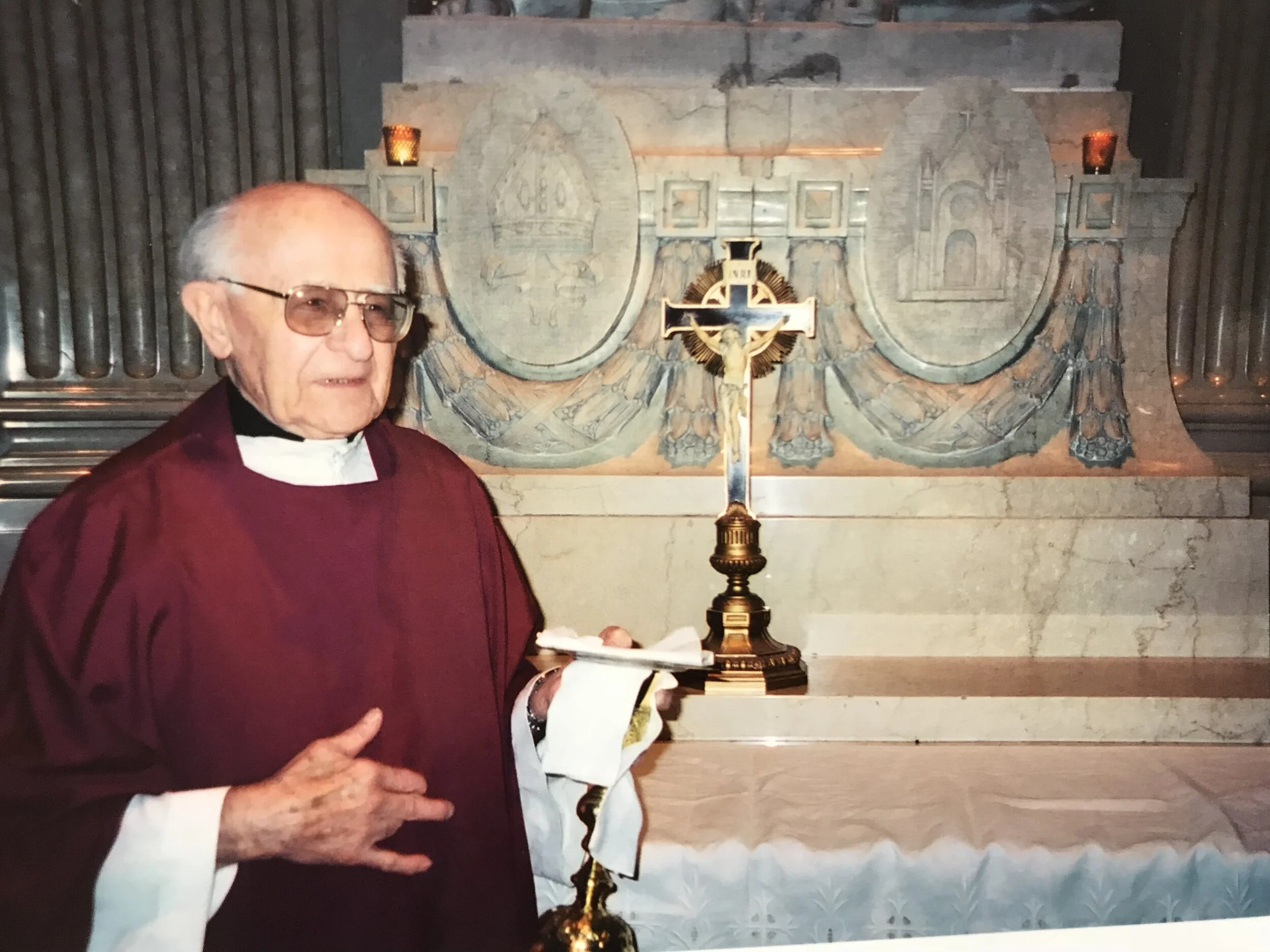
Fr. Kubat celebrates Mass.  Photo provided by Fr. Michael Miller.

Fr. Kubat celebrates Mass. Photo provided by Fr. Michael Miller.


End Notes

[1] Scott, S. (2006, January 4). Priest Endured Europe’s Worst: Czech Nazi, Communist Imprisonments Preceded His Flight to Freedom in America. St. Paul Pioneer Press, n.p., para. 2.

[2] Many Czech WWI Graves Neglected, Says Member of History Buffs’ Group. (2014, June 21). Radio Prague International. https://english.radio.cz/many-czech-wwi-graves-neglected-says-member-history-buffs-group-8292384

[3] BBC Bitesize. (n.d.) Hitler’s Foreign Policy, “Key Events,: para. 6. https://www.bbc.co.uk/bitesize/guides/z92hw6f/revision/4

[4] BBC Bitesize. (n.d.). Hitler’s Foreign Policy, “The Final Destruction of Czechoslovakia—1939,” para. 3. https://www.bbc.co.uk/bitesize/guides/z92hw6f/revision/4

[5] Fiala, M. (Ed.). (n.d.). Czech Republic, the Catholic Church in the, “The Church Since 1945,” para. 7. Encyclopedia.com. https://www.encyclopedia.com/religion/encyclopedias-almanacs-transcripts-and-maps/czech-republic-catholic-church.

[6] Correctional Facility Valdice (Kartouzy). (2009). Wikimapia. http://wikimapia.org/11412690/Correctional-facility-Valdice-Kartouzy

[7] Fiala, M. (Ed.). (n.d.). Czech Republic, the Catholic Church in the, “The Church Since 1945,” para. 7. Encyclopedia.com. https://www.encyclopedia.com/religion/encyclopedias-almanacs-transcripts-and-maps/czech-republic-catholic-church.

[8] Miller, M. (2006, January 7). Funeral Homily for Father Alphonse M. Kubat (August 3, 1916 – January 2, 2006) St. Wenceslaus Church, New Prague, Minnesota. January 7, 2006, para. 3. https://www.stpandc.mn.org/Kubat.pdf

[9] Valdice Prison. (n.d.). A Communion Wafer Was a Piece of a Bun Wrapped in Cigarette Paper (Hostie, to byl kousek housky v cigaretovém papírku), para. 1. https://www.mistapametinaroda.cz/?lc=en&id=413

[10] Miller, M. (2006, January 7). Funeral Homily for Father Alphonse M. Kubat (August 3, 1916 – January 2, 2006) St. Wenceslaus Church, New Prague, Minnesota. January 7, 2006, para. 3. https://www.stpandc.mn.org/Kubat.pdf.

[11] BBC Bitesize. (n.d.) The Cold War, 1961-1972, “Events of the Prague Spring,” paras. 1-3. https://www.bbc.co.uk/bitesize/guides/zsfwhv4/revision/5 

[12] Pfarre St. Nikolaus. (n.d.) Kirchengebaeude, para. 1. https://www.pfarresanktnikolaus.at/wp/?page_id=26

[13] Landsberger, J. D. (n.d.). Gateway to a New World: Building Czech and Slovak Communities in the West End, p. 19. https://www.google.com/url?sa=t&rct=j&q=&esrc=s&source=web&cd=&cad=rja&uact=8&ved=2ahUKEwjmg975ibjxAhUBVc0KHRVFBH4QFjAQegQICxAD&url=http%3A%2F%2Fwww.josfland.com%2Fgardens%2Fgateway%2520small.pdf&usg=AOvVaw2KgbGOo32e53XOd8iRKWAL

[14] U.S. Department of the Interior. (1997, October). Church of the Most Holy Trinity (Catholic) [National Register of Historic Places Application Form]. https://www.google.com/url?sa=t&rct=j&q=&esrc=s&source=web&cd=&cad=rja&uact=8&ved=2ahUKEwiK14m-krjxAhXVU80KHf5GB5QQFjACegQIBBAD&url=https%3A%2F%2Fnpgallery.nps.gov%2FGetAsset%2F9aac0eb3-afc6-4804-a109-1ae4c9e578f7&usg=AOvVaw1YVGi_tbOdFndEZD9JIiLq

[15] Scott, S. (2006, January 4). Priest Endured Europe’s Worst: Czech Nazi, Communist Imprisonments Preceded His Flight to Freedom in America. St. Paul Pioneer Press, n.p., para. 2.

[16] Miller, M. (2006, January 7). Funeral Homily for Father Alphonse M. Kubat (August 3, 1916 – January 2, 2006) St. Wenceslaus Church, New Prague, Minnesota. January 7, 2006, para. 3. https://www.stpandc.mn.org/Kubat.pdf

Camp Savage, WW II Asset for Victory in the Pacific

by Charles Pederson

Every day, thousands of cars pass through the Minnesota city of Savage on state Highway 13. Drivers and passengers are intent on the traffic or on making good time. Not one in a thousand glances at the south frontage road at Xenwood Avenue. Why would they? They’d see only some scrubland, neat commercial buildings, a modest park, a historical marker. They might never suspect that those few humdrum acres had been a vital cog in the Pacific Theater war effort during World War II.

Wanted: Speakers of Japanese

In the late 1930s and early 1940s, Japan had steadily expanded its empire in southeast Asia. It needed raw materials for its industry. As punishment, the United States began to refuse to export especially oil to Japan. As pressure mounted, Japan decided it had to attack the United States before it declared war.

Negotiations were attempted, but by 1941, they broke off. The U.S. military began a search for qualified speakers of Japanese who could clarify enemy intentions. Surprisingly, a survey of 3,700 second-generation Japanese Americans (known as Nisei) found that only 3% were fluent, 4% proficient, and 3% could be made proficient with enough training. A further barrier was military leadership’s deep distrust about where the loyalty of ethnic Japanese lay.

Despite these handicaps, far-sighted officers in early November 1941 established an intensive Japanese language school on the Presidio military base in San Francisco. It came to be known as the Military Intelligence Service Language School (MISLS). To fill the ranks, MISLS recruited Nisei, Issei (immigrants from Japan), and Kibei (American-born Japanese who had been educated in Japan).

A scant $2,000 budget for the school was used to gather 60 students (58 Nisei Americans and two European Americans), along with 18 instructors in an unused hangar. English was the first language for many, but they volunteered anyway. Clearly, these patriots loved their country.

Panic Leads to Internment

A month later, on December 7, 1941, airplanes of the empire of Japan bombed Pearl Harbor. The anticipated war had begun.

Panic swept the nation as worries mounted about the loyalty of ethnic Japanese in America. In February 1942, President Franklin D. Roosevelt issued Executive Order 9066. It initiated the evacuation of all Japanese Americans and resident aliens of Japanese descent from the West Coast. About 120,000 U.S. citizens or resident aliens were abruptly imprisoned in 10 concentration camps in seven Western states.

Clearly, the government had overreacted. A 1982 U.S. government report noted: “Not a single documented act of [Japanese] espionage, sabotage or fifth column activity was committed” on the West Coast. Despite their treatment, many MISLS volunteers came from the camps and Hawaii.

Because of the ethnic makeup of students and instructors at the MISLS camp, Roosevelt’s evacuation order applied to them. The school had to move from the so-called exclusion zone. A new school was needed.

Minnesota or Bust

Several Midwest states refused to host the new camp, because of anti-Japanese feelings. Minnesota Governor Harold Stassen, however, offered a plot of land in Savage to house the school. The school commandant, Colonel Kai Rasmussen, believed that Minnesota would be more accepting of this ethnic group than some of its neighbors. He agreed to the move. In June 1942, Camp Savage was established.

Built in the 1930s, several buildings stood on 132 acres just west of downtown Savage. It had originally been constructed during the Great Depression to house workers in Roosevelt’s Civilian Conservation Corps (CCC). Later, the campus had been converted to use for men who were poor and elderly.

Now, the buildings were repurposed to train the men whom President Harry Truman later called “our human secret weapons.”

Camp and Coursework

The first class at Camp Savage had 200 students and 18 instructors. Students occupied about 15 to 20 barracks, each with cots and three coal-fired potbelly stoves for winter heating. Administration and other buildings also stood on the site. From the beginning, the wooden camp buildings seemed destined to be temporary. Larger buildings for social events were particularly scarce. In fact, an early camp dance took place in a dairy barn after the cows had been milked and sent out to pasture. Continually increasing numbers of students and instructors ratcheted the pressure on facilities.

Coursework was rigorous, with classes from 8:00 a.m. to 4:30 p.m., and again from 7:00 until 9:00 p.m. Students learned not only conversational Japanese but also Japanese military codes and terminology, army slang, and battle tactics and techniques. They learned to listen in on communications, interrogate prisoners, and understand several literary and handwriting styles. It was intensive work with only a few months to master it all.

Most students had to study hard not to wash out of the program. As diligent learners who wanted to serve the United States, they took sometimes extraordinary measures to pass the language course. Student Saburo Watanabe said that, after lights out, “you hardly saw anybody in their cots because they were all out in the toilet [where there was light]. They were seated in the toilet seats,” studying for Saturday exams. Those in their cots often studied by flashlight. This was such a common occurrence that officers had to keep an eye on students and make sure lights out meant lights out.

Still, there were simple pleasures. One student, Takejiro Higa, learning his brother’s military experiences in Mississippi, appreciated the fresh food, including milk and eggs. His brother got powdered eggs. In Minnesota, “summer months were nice and green,” added Higa. “You can roll around in the grass. Whereas Mississippi, hell, it’s sandy, it’s a dusty place.” On weekends, students might visit Fort Snelling, in Saint Paul, or downtown Minneapolis. One student remembered enjoying food at a Chinese restaurant near the Minneapolis bus station.

End of Camp Savage

Each new class of students was larger than the previous. For the final class, 100 instructors graduated 1,100 students. Finally, Camp Savage exceeded capacity. In August 1944, MISLS was moved to quarters on the military base at Fort Snelling. Two years after that, the school returned to California, with additional languages taught. A total of more than 6,000 students had graduated from MISLS.

MISLS linguists helped translate more than 20 million pages of documents and assisted at postwar war crimes trials. U.S. military officers stated that the students’ efforts shortened the Asian war by at least two years. The military’s tune had certainly changed from the mistrust and suspicion of the early years and Executive Order 9066.

The remains of Camp Savage are sparse—a small park with a historical marker commemorating the little-known history of WWII’s human secret weapons. A single camp building used by the Minnesota Department of Transportation (MNDOT). A city dog park, where visitors may have no idea of the history beneath their feet. But this unassuming landscape bore abundant fruit throughout WW II and beyond.


President Taft Visits Shakopee

Written by guest blogger, Charles Pederson

1911 was a quiet year, with low-key world and U.S. events. The Spanish-American War had been over for more than 10 years, and the storm clouds of World War I were likewise years in the future. The Computing-Tabulating-Recording Company (later known as IBM) was incorporated that year. Ground was broken for construction on Fenway Park, the modern baseball stadium for the Boston Red Sox.

A quiet year, but by October 1911, Scott County was abuzz with talk about a coming earth-shaking event. Or at least, there was mild interest. William Howard Taft, once Teddy Roosevelt’s vice president and now himself a candidate for reelection as U.S. president, planned to pass through Minnesota on a reelection campaign tour. One of his planned stops was the railway station in Shakopee, Minnesota.

President Taft speaks at the Shakopee Depot, October 24th, 1911. Photo from the SCHS Collections.

President Taft speaks at the Shakopee Depot, October 24th, 1911. Photo from the SCHS Collections.

In the spring of 1911, a bitter personal feud between Taft and Roosevelt had culminated in Roosevelt’s challenging Taft for the Republican nomination. Historian Peri Arnold noted that “the resulting campaign . . . was the first in which a sitting President campaigned in state primaries.” Taft won the nomination, though consequently, a resentful Roosevelt started his own new, competing party, the Bull Moose Party.

Because campaigning in individual states had worked well for the primaries, Taft continued the practice into October for the 1911 general election. He included a train journey through southern Minnesota, and on the schedule for October 24 were stops in Shakopee and other nearby towns.

Before the visit, the Scott County Argus reported on the preparations being made. These included, of course, local and state politicians, as well as dozens of sheriff’s deputies who would constitute a protective cordon around the train station and a town band that would serenade the president into and back out of town. An Argus reporter breathlessly explained that “the highest official in the world” would receive the respects of his fellow citizens. “It may well be said, ‘the president’s position is greater than a king’s,’ for he holds the place not by accident of birth but by the suffrage” of U.S. voters.

A few days after the event, on October 27, the Argus reported the results of the visit. A respectably sized crowd of about 2,000 people came from the county and neighboring municipalities to hear the president speak. The speaking platform had been prepared for the august visitor. It was decked out with U.S. flags and with local products, including locally grown corn, Shakopee bricks, and beverages from the Jacob Ries Bottling Works, which produced ginger ale and sparkling water right there in Shakopee.

In Mankato during the same campaign tour, Taft received a raucous welcome, according to the Blue Earth County Historical Society. “People arrived in every kind of vehicle from one-horse chaises to automobiles.” In contrast, the Argus reported that among the Shakopee citizens gathered at the local train station, “there was no show of enthusiasm,” though the crowd did listen carefully to what Taft had to say. After a brief 15-minute speech, according to the Argus, Taft boarded his train and left for other stops in Minnesota.

Crowd gathered to hear President Taft speak in Shakopee on October 24th, 1911. Photo from the SCHS Collections

Crowd gathered to hear President Taft speak in Shakopee on October 24th, 1911. Photo from the SCHS Collections

Taft no doubt had held out great hope for his strategy of barnstorming personal appearances. The effort, however, seems to have fizzled. The very popular Roosevelt and his Bull Moose Party clawed away most of Taft’s Republican support. At least partly because of the split, neither man carried the election. Instead the Democrat, Woodrow Wilson, won by a landslide. His 435 electoral votes crushed Taft’s third-place votes, four each from Vermont and Utah. Shakopee’s voters mirrored the national vote. Out of 450-some voters, almost 290 voted for Wilson and 89 for Roosevelt. Taft trailed third with about 75 votes.

Taft in some ways may have been fortunate not to regain the White House. World War I began only three short years later, and as the editor of the Scott County Argus presciently wrote in 1911, “To be President of the United States for the next four years will be no easy job for there is much to be done and it must be done in the right way.”

Union Hill Baseball

According to a 1996 New Prague Times article “When Union Hill comes up in conversation of area residents several things come to mind. There’s the church, a bar, a few houses and oh yes! The ballpark! Union Hill and baseball have become nearly synonymous” 

Don Giesen was 16 when that first team was formed. He said “It seems we’ve always had a big baseball tradition. The kids used to play ball in cow pastures and backyards”. Don’s uncle and father decided to build a baseball field the field was “tiled, well kept, and in immaculate shape” 

In 1956 Union Hill first fielded a team in the Dakota-Rice-Scott baseball league. That team, The Indians, played their home games in that brand new ballpark, West of County Road 7, across from the bar

As Don Giesen remembers, the original board of directors for the Union Hill ballclub were Frank Giesen, Jake Giesen, Cletus Witt, Bill Giesen and Edward Pint. 

Early star players of Union Hill baseball included Dennis and Pat Sharkey, Jin Walker, Pat Halloran, Tom Ruhland, Albert Ruhland Jr, Don and Bob Giesen, Bill Witt, and Ron and Jerry Pint.