
History of Elko New Market, Part 1

Aerial view of New Market, ca 1958. SCHS Collection.

Early Elko and New Market

Rail access could make or break a fledgling town. Trains brought goods and supplies and allowed local manufacturers and farmers to conveniently ship their products. It also brought new people to settle and expand local communities.

The process of bringing the railroad to Scott County began with a series of stops and starts. The Minnesota Territory first received federal land grants to provide for railroad construction in 1857. Unfortunately, the next decade contained a series of tumultuous events that delayed construction. First, there was “the panic of 1857,” an economic depression in the United States characterized by a declining international economy and overexpansion of the domestic economy. During this time, rail companies were reluctant to add to their lines. Next came two concurrent wars—the US-Dakota War of 1862 and the Civil War (1861–1865)—that disrupted lives and businesses throughout the country. Rail finally came to Scott County in 1865.

The settlement that would become New Market was formed before the railroad came to the area. The first known European Americans living in the settlement were Patrick White and his wife, who moved to the area in 1855. They were soon followed by others, including John Mahowold, who broke ground for the township’s first European American farm in 1857. This event was rapidly followed by many more recorded firsts. The first religious meeting happened in 1858—a German Catholic service held in Martin Eishen’s farmhouse. The first church was built on the property of Peter J. Baltes in 1861. The first school was built on land donated by Peter Wagner in 1865, and the first post office, which was simply the living room of Peter J. Baltes, opened on April 7, 1867.


An 1876 article in the Scott County Argus described the area thus: “Fourteen families. Their nationality was as follows: one Irish family, three Yankee families from the state of Maryland, nine German and two Norwegian families. Their buildings were all log houses with elm bark covering the roof, and the windows mostly one light 8x10, and no floor and no furniture.”
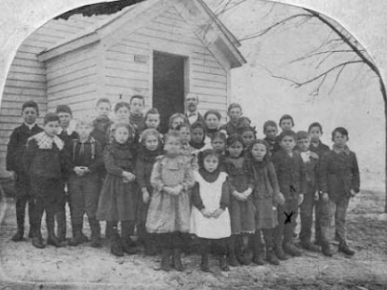
Schoolchildren and their teacher outside a schoolhouse near Elko. The boy with the X on him is Michael Schneider, ca 1910. SCHS Collection.

The same Scott County Argus article described another local first: “The first teamster in New Market was Peter Hoffelt. He made a small hand sleigh, loaded it with seventeen rabbits, and went to St. Paul to sell the rabbits and to buy a sack of cornmeal. He procured the meal and started for home, his wife in the meantime feeling very uneasy about him. On the second day about nine o’clock in the evening he arrived in New Market. He stopped at the house of Martin Eishen about bedtime and cried out three or four times: ‘Woah! Woah! Them d--d cattle never would stand.’ Mr. Eishen opened the door and said, ‘Where is your team Mr. Hoffelt?’ He laughed and replied, ‘I am the team and the driver too!’ and then started forward, reaching home about 11 o’clock that night. His wife met him on the road and assisted him in drawing the sled home. This is the story of the first teamster in New Market.”

In 1895 the area was officially incorporated as New Market. They built a hotel and school and continued to grow through the turn of the century, supported by the train station at nearby Elko. 

When the Chicago-St. Paul Railroad mapped out the area of Elko as a stop on their expanding rail lines in 1902, new businesses grew up around the railroad and existing businesses in New Market prospered. The town of Elko was officially incorporated in 1949 after a conflict with the township over liquor licenses. 62 of the 114 residents had petitioned to the Scott County Board of Commissioners requesting to become a village. The Board approved the petition and then the citizens of Elko voted on the measure. 

Advent of the Interstate

Use of railroads declined as automobiles became more popular and interstate highways popped up across America. Interstate 35 was constructed in the 1960s and the railroad left Elko a decade later. With these changes, business declined in both towns but housing construction boomed. 

As housing exploded, concerns grew surrounding the capacity of the existing sewer system. Housing construction stopped in the 1980s and a new sewer system was built─shared between Elko and New Market. 

Merger 

In 2004, the city councils of Elko and New Market began to consider the possibility of a merger.  Together, the two towns drafted a Cooperation and Combination Plan, which laid out the steps they would have to take for the approval and implementation of a merger. This plan was completed and approved by both city councils in January 2006.

Even before the merger, Elko and New Market shared several services in addition to the shared sewer system. Elko contracted with New Market’s fire department, and New Market borrowed Elko’s police department.

A public merger vote, open to all citizens of Elko and New Market, was held on March 21, 2006.  The merger passed with resounding success. In Elko, 213 people voted for the merger, while only 38 voted against, and in New Market the score stood at 224 to 47.

Sign for the merger between Elko and New Market, 2006. SCHS Collection.

The new Elko New Market was honored with two awards for the successful unification: an Excellence Award for Municipal Consolidation from the League of Minnesota Cities and an Innovation Award from the Humphrey Institute of Public Affairs. 

Today, the unified town of Elko New Market is home to more than 4,500 people, longtime natives and new arrivals alike. While distinct from New Market Township, the town of Elko New Market remains the commercial hub for township residents.

35-Day Crime Spree Capped by a Hail of Bullets, Part 2

By Charles Pederson

Picking up the story from Part 1, read on to find out how the Shakopee bank robbery of December 9, 1929, turned out.

A parade in downtown Shakopee, 1927. First National Bank is believed to be the third building from the right. SCHS Collection.

A parade in downtown Shakopee, 1927. First National Bank is believed to be the third building from the right. SCHS Collection.

Contemporary newspaper stories about the 1929 Shakopee robbery gleefully threw around hard-boiled turns of phrase that are nearly cinematic: “bandit trio,” “loot,” and “rattle of machine guns, crack of rifles and roar of shotguns”; the robbers were “mowed down.” Yet even this exaggerated language hardly does the scene justice.

Charles Brown, of the Minnesota Bankers Protective Association, described the intensity of the action:

“I turned my machine gun on them. At the same time, Sheriff Weckman opened up and so did Lester Brown, one of his deputies. Gregory Hartman, who operates a butcher shop across the street from the bank, then started firing with a rifle from an upstairs window.

One of the robbers tried to run down the street, but fell in front of a drug store next to the bank.

The third bandit ran inside the bank. I ran after him with the machine gun. He kept on going and went out the back door [where Tiedt filled him with hot lead].”

The Midday Ride of “Paul Revere”

Meanwhile, C. A. Manaige, age 82, veteran of the Civil War, gained his 15 minutes of fame as the “Paul Revere” of the day. Manaige happened to be driving his horse and buggy down a Shakopee street. Hearing gunshots, he realized what was happening. One newspaper writer had him “swinging his whip over his mare’s flank, . . . and beard flying in the wind, he shouted as he went, ‘Hey—the bank is being held up. Everybody out, get out your guns.’”

Another account, playing up the “Paul Revere” angle, stated, “The horse reared and galloped down the street, with Mr. Manaige shouting: ‘The bank’s being robbed! The bank’s being robbed!’”

What Happened Afterward

The three robbers had been wounded numerous times. Or as news reports put it, they were “riddled from head to foot” with bullets. The robbers were taken to nearby locations to have their wounds tended. Despite their wounds, all three survived. Accounts stated that the entire encounter took five minutes. But in that brief time, “the windows of the [escape vehicle] were shot away, the bank windows were broken, as were the windows of several neighboring stores, and bullets were lodged in walls and doorways for more than 100 feet.” Although a crowd had gathered at the sound of gunfire, amazingly—and despite the sheer poundage of the rain of lead—only the robbers were injured.

Sheriff Weckman stated he would file charges against the three men, needlessly adding that only two would be charged if the seriously injured McNearney died. In fact, McNearney did not die, but one of McKusick’s legs was so badly shot up that it had to be amputated. The third robber, George Larkin, was moved from the jail to the sheriff’s house for additional medical help. Later at trial, all three were given life sentences.

It is even possible that the men had additional mayhem in mind. The December 9, 1929, St. Paul Dispatch reported that, in the trunk of the getaway vehicle, authorities discovered hundreds of rounds of additional ammunition, bottles of illegal alcohol, and a new clothesline, “believed to be for the purpose of binding victims in case this became necessary.”

The Minnesota Bankers Association showed their gratitude for the efforts to protect their investments. They rewarded Weckman and Brown with $500 each; Tiedt and Hartman each received $250.

Screenshot (51).png

Unexpected Fame

The robbery garnered state, national, and even international attention. Contemporary news outlets placed Shakopee squarely in the world spotlight.

  • The Northfield News congratulated the foiling of the robbery. The citizens of Northfield—site of the famous James-Younger gang’s bank robbery of September 1876—had repelled the gang in a similar shootout 50 years earlier. The News, a local Northfield newspaper, alluded to the gunplay: “‘Say it with bullets’ is the motto every city should adopt when staging a reception” for bank robbers.

  • The New York Times produced a map under the heading “Interesting Places in News of the World.” Shakopee was highlighted, along with information about the “daring bank robbery” and its link to the Northfield gunfight.

  • The story reached as far as New Zealand. An Associated Press story in the Christchurch Star described the action in “the quiet village of Shakopee, Minnesota.” No doubt part of such foreign fascination lay in the fact that “more than 100 shots were fired,” playing into people’s views of the United States as the rough and unsettled Wild West.

And coming full circle, employees of the Belle Plaine First National Bank later identified McNearney, McKusick, and Larkin as the December 5 robbers of that institution.

Truly, the 35-day crime spree of 1929 left its stunning mark on Scott County. But time heals all wounds, and today, only faint echoes remain of  those violent events of 90 years ago.

First National Bank of Shakopee, 1958. SCHS Collection.

First National Bank of Shakopee, 1958. SCHS Collection.

35-Day Crime Spree Capped by a Hail of Bullets, Part 1

By Charles Pederson

In 1929, a massive gunfight between lawmen and the bad guys ripped through downtown. Was it in Chicago or New York City? No. It was Shakopee! 

People often associate the Great Depression (October 24, 1929–1939) with crime throughout the United States. Even Scott County had its share of illicit activity: throughout the county, gambling, illegal liquour clubs called speakeasies, and unlawful stills could be found.

Bank robbery was also on the agenda, including 35 days of robberies that rocked the county.

The Roaring 20s had seen a steep rise in bank robberies throughout the United States, and Minnesota bankers were not happy with government response. Rather than wait, the Minnesota Bankers Association organized groups of citizens called rangers (essentially, these were posses) to be deputized by county sheriffs in case of robbery. Additionally, rewards (“dead or alive”) of up to $5,000 ($80,000 today—multiply 1929 money amounts by 16 to get the estimated 2021 equivalent) were offered at each bank in the association for the capture or killing of any robbers. “‘Shoot to kill’ will be the instructions,” warned the Minneapolis Journal newspaper. Satisfied with their preparations, Minnesota’s bankers went about their business.


The Crime Spree Begins—First Robbery

On November 5, 1929, the Depression was less than two weeks old. In late 1929 and 1930, the unemployment rate jumped from 3.2% to 8.7% (still far below the 1933 high of nearly 25%). The U.S. economy had been weak during the summer of 1929, but it simply collapsed around people’s lives in October, robbing them of jobs, dignity, and future security. It may not be a surprise that ordinary folk felt pushed into crime to earn a living, or that those already in crimes stepped up their activities in an environment ripe for plucking.

Case in point, November 5, 1929: Three men entered the First Bank of Savage, demanding money and getting away with approximately $1,200. They escaped, though four men were later arrested and questioned. Of those four, John Morrow and Walter Williamson were positively identified by bank employees and were bound over to a grand jury. Byron Green and Edward J. Dee were released after bank employees could not identify them. Police, however, arrested Green in connection with crime in the southeastern Minnesota town of Caledonia and a series of creamery robbers in nearby counties.

Second Robbery

The excitement caused by the events in Savage was subsiding, and county life was just settling down, when bam!—on December 5, three armed men entered the Belle Plaine First National Bank. They threatened bank employees and got away with $6,000. They remained at large. Fear ratcheted up, and county residents fearfully wondered where and when the next robbery would be and what had happened to the robbers. All their questions eventually would be answered. For now, people could only speculate.

Bank check from the First National Bank of Belle Plaine, circa 1930. SCHS Collection.

Bank check from the First National Bank of Belle Plaine, circa 1930. SCHS Collection.

Mysterious Tip-Off

Shortly after the Belle Plaine robbery,  Charles Brown, head of the Minnesota Bankers Protective Association, dramatically announced he had received “from underworld sources” a tip about a robbery in Scott County. Acting on the tip, he notified all the county banks to be alert.

Around 2:00 a.m. on December 9, Brown received a second mysterious tip that the Shakopee bank was the target—for that very day. Brown notified the Scott County sheriff, Joseph Weckman. They armed themselves and several others and hid at short distances around the bank. Brown himself carried a Thompson submachine gun, famous for its part in New York and Chicago gangland shootouts.

Unaware of the warm welcome awaiting them in downtown Shakopee, three men drove into town. The men—Fred McKusick, also known as Frankie Morris, of Chicago; William “Bud” McNearney (or McInerney, depending which newspaper you read), of Saint Paul; and George Larkin—had stolen the car in Saint Paul. All three were known to police in various jurisdictions for criminal activity. No doubt they thought this would be a quick and easy, in-and-out bank job—a bunch of rural hicks against experienced lawbreakers. At least they were right about the “quick” part.

Inside and Around the Bank

Blissfully going about their everyday tasks, six people were already inside the bank: Henry Marshall, local farmer; Lucille Schwartz, bookkeeper; John Thien, cashier; E. J. Huber, assistant cashier; Theodore Weiland, president; and his son, C. T. Weiland, cashier.

Lucille Schwartz (far left) with her sisters as children, 1905. SCHS Collection.

Lucille Schwartz (far left) with her sisters as children, 1905. SCHS Collection.

The robbers parked in front of the bank and rushed in, forcing everyone onto the floor. Marshall stated that the “bandits fired a couple of shots into the ceiling, probably to terrorize us.” They grabbed $2,000 from the vault and headed for the street again. Huber later reported that the bank actually contained about $100,000. The early warning from Brown, however, had allowed the bankers to hide almost all the money.

The robbers could not have known that their easy day was about to end. When they emerged from the bank, at least five concealed people fired weapons, including Brown’s Tommy gun. McNearney, although shot several times, staggered back into the bank, attempting to escape through a back door. However, Al Tiedt, a nearby restaurant owner, raced out his back door when the shooting started. “I took the shotgun and ran out into the alley,” he recalled. When he saw McNearney, “I aimed and let him have it. The slugs hit him in the shoulder and face and sort of spun him around.” The robber dropped the money he carried but kept running, so Tiedt “hit him in the legs. He went down.”

Stay tuned for the exciting conclusion to the story in Part 2!

The History of Louisville Township Part 4: Marystown

View of Marystown. ca. 1970-1980. SCHS Collection.

View of Marystown. ca. 1970-1980. SCHS Collection.

Marystown began as a collection of mostly German immigrants in the southeastern corner of Louisville Township. As Father Klein, a famously verbose priest, wrote in the 1930s, Marystown was founded “by intrepid settlers and their wives who hewed out of the primeval forest homes in what is now one of the fairest and most productive regions of this smiling land.”  

St. Mary’s Church

By 1850 there were “around 700 Germans” in the area but no church. Instead, traveling priests would hold services in local homes, announcing their presence by ringing a bell as they rode through farmsteads. To remedy this, community members built St. Mary’s Church. It is generally agreed that St. Mary’s is the first organized Catholic parish in Scott County and likely one of the oldest in the entire region. 

According to legend, the church was named St. Mary’s due to a passing conversation during its construction. One day, two men were cutting wood for the building. One asked the other what day it was. He replied, “Maria Lichtmess - the Feast of St. Mary’s of the Purification.” The name stuck and was given to the completed church.

The original building for St. Mary’s Church was completed in 1855, though it burned during a brushfire before it was even completed. It was rebuilt in 1856. Subsequent rebuildings took place in 1870 and 1882. 

In 1917, St. Mary’s Church was once again destroyed by fire. The parish chronicles described the fire thus: 

“Father Ziskovksy gave the alarm. The flames were shooting high up into the sky. The people, aroused by the telephone, gathered around the scene. Human power could not stay the demon of fire. The church bells crashed down from the belfry and were shattered to fragments. The flames licked up all except the heavy stone walls. Pastor and people were in tears and sorrow. . . . The disastrous fire stirred the spirit of sacrifice in pastor and people, and they set to work at once to rebuild the church on improved architectural style...The old stone walls were inspected by competent authority and declared in good condition. Architect and contractor were engaged and the constructed progressed so rapidly that by the end of the year the church was completely rebuilt at a cost of $23,183.43 and all paid for.””

St. Mary’s church was also home to a great deal of celebration. In addition to the usual weddings, services, and community events, the people of Marystown came together to commemorate the history of the church itself. Below is a sampling of celebrations at St. Mary’s Church: 

July 1882

The cornerstone was laid for the newly rebuilt St. Mary’s Church. Celebrations happened on July 14, and according to the Shakopee Courier, were attended by nearly all community members. Vierling’s Shakopee Band accompanied “the formation of a long procession of societies and people escorting [Bishop Grace of Saint Paul] into town.” The reporter concluded that “the day was fine and all seemed to enjoy the occasion very much.” 

October 1980

St. Mary’s held a gala to honor the church’s 125th anniversary. The day began with a Mass held by Archbishop John Roach, in which he stated, “I have long been aware of the depth of faith, vitality of community, and the long history of this church in Marystown.” Afterward, visitors and church members were taken on tours of the church and grounds, where a display was set up showcasing photographs and memories from past parishioners. At noon, a turkey dinner for several hundred was served, followed by turkey and cake throughout the afternoon. 

“Pig-Kissing, games, quilt raffle highlight Marystown Church festival.” Shakopee Valley News, August 14, 1997.

“Pig-Kissing, games, quilt raffle highlight Marystown Church festival.” Shakopee Valley News, August 14, 1997.

Marystown School

In 1864, a priest known as Father Benedict organized a school society for St. Mary’s Church. According to Father Klein’s 1930 history of the parish, “There was no schoolhouse. The first children, few in number, came to Mr. John Thies who operated a saloon, and received from him a few hours’ instruction daily at certain periods of the year.” Klein also recounted an often-told story that resulted from holding school at a saloon: “A humorous (or tragic) incident occurred one day. One of the boys, Louis-‘played naughty.’ Not resorting to the rod as teachers were wont to do in those days, Mr. Thies opened the cellar door and sent Louis down below. It is not told how bright Louis was over his books and figures; but in the dusk of the cellar he got the bright idea to pull the stopper of a barrel and test the strength of the “spirits” contained in the cask. Mr. Thies inflicted no more punishments of that nature.” 

Not long after that, St. Mary’s school moved out of the saloon and into the original parish house, a 16 x 22-foot cabin. During this time, school was taught by the Catholic Sisters of Charity and consisted of 5 months of academic education and 5 months of religious instruction each year. 

In 1893, a new brick building was constructed. The actual teaching in the school flipped back and forth between Catholic sisters and “lay teachers.” Finally, in 1921 a system was put in place whereby Grades 1 and 2 were public school with a hired teacher, and the rest of the grades were run as a Catholic school and taught by sisters. This system continued until the school closed. 

Regina Mechtel remembered going to school in Marystown in the early 1900s and shared her recollections with a reporter from the Prior Lake American in 1987. She said there were only three or four teachers for the whole school, and “the teachers also moved students up as their skills improved. Age wasn’t such a big thing. You went into the next class when you were ready.” She also noted that some students missed a great deal of the school year due to farm work, spending years in the same grade. Students would also miss school in the winter because of bad weather. Regina lived only a short distance from the schoolhouse and was usually able to make it in. She noted that “there would be some days when there would be just a few of us in class because the rest couldn’t get here. Those days were kinda nice because those of us who were there got a lot of help from our teacher.” 

The Marystown School closed its doors in 1970, with students joining other, larger districts. 

“98-Year-Old Marystown School Torn Down to Make Room for Parish Center.” Shakopee Valley News, October 4, 1990.

“98-Year-Old Marystown School Torn Down to Make Room for Parish Center.” Shakopee Valley News, October 4, 1990.

Business in Marystown

One of the first notable Marystown businesses was the Marystown Creamery, organized in 1918. Like several other early creameries in Scott County, the establishment was cooperatively owned. Farmers pooled their available milk and sold butter collectively at the highest price.

During Prohibition (1920-1933), there were burglaries at several creameries in Scott County. Stories accused bootleggers of stealing butter in order to trade it for illicit alcohol. The Marystown Creamery was stolen from three times in 1922. Each time the theft was of a relatively small supply of butter. For example, 96 pounds were stolen in December. Each of the incidents was conducted on a Sunday night, leading locals to believe that the same person was responsible for all of the thefts. The culprit was never apprehended, and Marystown Creamery stayed in business until 1927.

Another farmers’ cooperative was the Louisville Mutual Insurance Company, established around 1886 by a group of Marystown farmers. In 1936, the company celebrated its golden jubilee. A speaker praised the fact that it had “1205 policies in force with no unpaid claims.” This organization merged with other community insurance groups several times and it still exists today. 

Wagner General Store supplied the area residents until the late 1960s. Wagner claimed, “We had this sign hanging above the door that read ‘if we don’t have it, you don’t need it,’ and that’s how it was.” He went on to describe, “You know it was one of those community affairs. For example we had 1400 lbs of bolts so if any of the farmers had something break on their machines they could come to our place and get something to fix it. . . . During the time they did harvest or filled silo, we never took any time off. We worked around their needs.” Since people did a lot of canning, the store kept a supply of vinegar in 50 gallon jugs.

Wagner’s store stayed open until the 1960s. Later, a bar opened in the old store building. By 1987, this bar was the only business remaining in Marystown and a gathering place for the local community. Local resident Brad Luce described it as “someplace to go after your chores. Otherwise you’d never see your friends.”

In 1987, the Prior Lake American published an article profiling Marystown. The piece noted that the community’s business district never really blossomed due to proximity to the larger communities of Shakopee and Jordan. In spite of this, Marystown was home at various points to “two general stores, a blacksmith shop, a saloon, a creamery, a garage and a gas pump.” 


Further Reading:

Most resources for this article on Marystown are from local newspapers. To dig into this topic further, come visit our Research Library and we can help you find the articles you’re looking for! We are located at 235 South Fuller St, Shakopee, MN and are open Monday-Friday 9am-4pm. 

The History of Louisville Township Part 3: Merriam Junction

Merriam Junction train tracks with the train station visible in the distance, date unknown. Scott County Historical Society collection.

Merriam Junction train tracks with the train station visible in the distance, date unknown. Scott County Historical Society collection.

Like Louisville, Merriam Junction was located in the northwestern part of Louisville Township, near the present-day site of the Renaissance Festival. From its onset, the community was conceived as a transportation hub. It was located at the crossing of two major railroad lines—the Minneapolis and St. Louis Railroad and the St. Paul and Sioux City. The crossing was an active transfer point for regional travelers.

The community itself was not surveyed until 1866, at the behest of the rail companies. The first structures built were not stores or farm buildings, but a train depot and a rail agent’s house belonging to the St. Paul and Sioux City Railroad. Because the two lines running through the junction were competitors, a second depot for the Minneapolis and St. Louis Railroad was built about a mile away. It wasn’t until 1878 when the original depot burned down that the two companies finally reached an agreement to share a single structure. 

The Merriam Junction train station, date unknown. Scott County Historical Society collection.

The Merriam Junction train station, date unknown. Scott County Historical Society collection.

Because Merriam was a major crossing point, a community soon sprang up around the rail buildings. A store opened, along with two hotels—one in 1879 and one in 1881. Both hotel buildings were two-story, wood-framed buildings. The hotels provided meals for those with short layovers and a place to stay overnight for travelers with longer delays. A water tower and coal bin were also built for the settlement, useful for resupplying steam engines. A post office opened in 1872, run by H. H. Spencer, the former promoter of Louisville. Like Louisville, this post office was unfortunately short-lived, closing in 1873. 

Julius Coller described Merriam Junction in his book The Shakopee Story, published in 1960. He said, “It was quite the little settlement. The businesses were largely patronized by traveling people and people working for the railroad.” He also described the outsized impact that Merriam Junction had on the region: “Shakopee became a way station with a stub train consisting of an engine, a baggage car, and coach running from St Paul to Merriam and return. Travelers had to change trains at Merriam to make the 12 mile trip from Shakopee to Jordan” 

At the community’s height, an average of 20 trains went through Merriam Junction each day. With such a high rate of mobility in the population, Merriam developed a local reputation for being home to transitory communities. The area was home to a group of Eastern European immigrants, called gypsies at the time. Supposedly they camped near the waystation because the water tower and coal bins provided easy access to fuel and fresh water. Local residents at the time also complained that they would beg, or come to local houses in an attempt to buy food. Unfortunately, this small group of families took on a negative, almost legendary status in households at the time. Children would be warned that they would be taken by the “gypsies” if they were naughty, and unsubstantiated tales of stolen livestock abounded. 

Merriam Junction was also chosen as a hideout for the nationally notorious James Brothers gang. After their famous robbery at the Northfield Bank, the gang hid out in a cave near Merriam, supposedly obscuring their tracks by putting their horses’ shoes on backward. Some members of the gang, the younger brothers of Jesse James, were captured after this incident.

Though the train spelled disaster for Louisville, the rise of the automobile led to the end of Merriam Junction. Even though trains were still being used for shipping and distance travel, by the 1920s, shorter-distance trips for business and pleasure were being taken by automobile instead of rail. Passengers no longer needed the services of a community like Merriam Junction, and the hotels and stores, reliant on travelers, lost their customers. By the end of the 1920s, Merriam Junction, like Louisville before it, was mostly deserted. 

Further Reading