“Hey, That’s My (County) Seat”: The Battle for the Heart of Scott County, Part 1

This post was written by guest blogger Charles Pederson. If you would like to write for our blog, contact us at info@scottcountyhistory.org

People long for the “good old days” when folks got along. We may look back on the “olden days” as simpler times, but the fact is that the good old days were tough. Scott County is no exception. It featured a decades-long rivalry, complete with “palace intrigue,” that began at the foundation of Minnesota itself. The titanic struggle: to control the center of power, the county seat.

What’s the big deal with a county seat, anyway? Every time a new county is formed, a county seat is designated—and the jockeying to obtain that status can cause powerful feelings of competition among municipalities. The seat may or may not be the largest town in a county, but it is usually where county buildings and the courthouse are located. In fact, the term ‘county seat’ is a shortening of the expression ‘county seat of justice.’ The county seat provides the court system, law enforcement, and other county services. Normally, county seats are created through voting. Why has rivalry in some places escalated to physical violence, intimidation, or fraud in these county seat “wars”? Is it more than the fact that living in or near the county seat can increase property values?

New County, New County Seat

Counties (or their equivalents in other states; for example, Louisiana has parishes and Alaska has boroughs) underlie U.S. administrative organization. Typically, counties are laid out before statehood, during the territory period. Most states therefore already had counties when they entered the Union. Based on population, many early counties covered vast tracts of sparsely settled land. Those large counties filled up with settlers and were eventually broken up into smaller counties, each with its own county seat.

Scott County followed the same general trajectory. On March 5, 1853, due to increasing population, a portion of land was separated from the western edge of Dakota County to become Scott County. About a year later, five appointed county board members voted that Shakopee become the county seat and be the location of county buildings. To cement that decision, the first county court term was held in Holmes Hall, named after Thomas Holmes, one of the first permanent White settlers in the Shakopee area.

It was decided: Shakopee was the county seat. Not everyone, though, agreed with the decision. Over the next six or seven decades, some residents in Jordan resented the decision and consequent status quo. At the founding of the state, they began the first of many attempts to gain for themselves the benefits of hosting the county seat.

First Attempt to Move the County Seat: 1859

By 1856, a building had been rented in Shakopee for use as a courthouse. The next year, bonds were issued in an attempt to raise $10,000 to build a dedicated courthouse and other county structures. This was all meant to reinforce Shakopee’s location as the county seat. Accordingly, construction began, but more than a year later, the buildings still had not been completed. The money ran out. It was suggested that the county was nearly bankrupt through incompetent efforts to build the courthouse. A popular history of Scott County stated that “it was even suggested that the buildings in their incomplete state be sold . . . to discharge part of the heavy liabilities of the county.”

Residents of Jordan saw the lack of a permanent courthouse, the poorly constructed county buildings, and the perceived incompetent leadership as an opportunity to gain the county seat and its benefits for themselves. In 1859, the year following statehood, a bill was introduced in the new Minnesota legislature to move the county seat from Shakopee to Jordan. This caused panic in Shakopee, and civic leaders went into emergency mode. One historian noted that hurriedly raised private donations allowed “the unfinished buildings [to be] enclosed and the county officers located therein, although in small and inconvenient quarters. By these measures the [county seat] change was overruled and Shakopee continued as the county seat.”

The panic in Shakopee abated, but Jordan was far from satisfied with the outcome of events.

Second Attempt: 1872–1873

Discontented Jordanites again plotted to move the county seat. A legislative representative from Jordan, Joseph Chadderdon, introduced a new bill in the state legislature to move the seat to Jordan. The Scott County Mirror newspaper reported that the bill required that “within sixty days after [passage of bill, officeholders would] remove to and hold their office in the said village of Jordan.” The Mirror later ran a chart describing $10,000 that had been deposited in escrow for the move, as well as an additional $20,000 in pledges on passage of the bill. The bill passed the house and senate, but Governor Horace Austin (1870–1874) refused to sign it without further amendment. The bill was amended, and Austin supported it. Nonetheless, no records showed it advancing through the legislature.

Horace Austin, the sixth Minnesota governor, was briefly embroiled in the county seat fight. Minnesota Historical Society Collection.
Despite state inaction, a vote on the issue was set to be held in the county. One historian reported on “a vigorous contest [that] ensued, decided in favor of Shakopee by a majority of ninety-two votes” (969 in favor of moving, and 1,061 against). An opinion writer in the Mirror put a good face on the defeat by insisting that it was actually a victory: “We are just as sure to get the county seat in the next contest . . .as the sun is to rise and set.”

Check back for Part 2 of this ongoing and weirdly fascinating story. It’s full of wrinkles and surprise plot twists!

History of Elko New Market, Part 2

Postcard of the Fred Meinke Saloon and Lunch Room in Elko. A sign on the building reads "Lunch Room/Hamm's Beer/Fred Meinke." 1905. SCHS Collection.

Businesses of Elko and New Market

Elko’s first general merchandise store opened in 1903, conducted by the Herder Brothers. It was followed closely by another important business—a local bar, opened by Peter Ring in 1904. In 1906, the Shien brothers of Lakeville opened a slaughterhouse near the railroad to process all the local “cattle, hogs, poultry, veal and sheep.”

Pete Welter, grocery store owner in New Market. 1895. SCHS Collection.

The New Market Hotel was built in the 1890s and is still standing as a member of the National Register of Historic Places. Helen Kaufberg grew up in the hotel, and described her experiences in “As I Remember Scott County.” She recalls: 

My earliest memories of my childhood are the first ten years of my life that I spent in the hotel that my parents operated.  It was a busy little place as very few people owned cars. The traveling salesmen came by train to the neighboring village of Elko. They would then come to New Market. If they came in the evening, they would have to stay until the next day. Also the farmers from neighboring Cedar Lake Township had to haul their grain to the elevator at Elko by team, so many of them would stop at the hotel for a meal, for which they were charged 25¢. This was about 1910 to 1920. We had several girls who helped with the cooking and other chores.

I remember mother getting up some mornings at 3 o’clock to do the laundry. There was no electricity and it was a little scary to come downstairs alone. I also recall that some of the laundry was sent to the Cities by train. It was put in large canvas hampers around 4 feet long and 3 feet high.

There were dances held in the Village Hall and during intermission a supper was served at the hotel. On one particular night, they served a turkey supper. They had everything waiting for the crowd when the stove pipe on the wood range fell down. It was really a disaster.

Another time, my folks told about a burglary at the Post Office next door. A salesman for the Schmidt Brewery had been on the train and got off at Elko. He had seen two suspicious men get off the train. He immediately walked around to the other side of the train and walked towards the grain elevator. He called from the depot and alerted the people at New Market, so when the hotel closed at 11 o’clock, some of the people stayed up and watched through a window at the back of the hotel. They were watching the Post Office and also the bank which was next to the Post Office. The salesman got a hold of a gun and opened the window just enough to put the gun through and when the burglars tried to get in the back door of the Post Office they were frightened away. There had been evidence that the burglars had waited in the choir loft of the church as there were cigarette or cigar stubs left behind.

The Elko Bank was also almost the target of a burglary during the 1920s. According to the Shakopee Tribune, at 2:00 a.m. on Friday, May 12, 1921, “auto bandits” pulled up to the bank. Before they arrived, they had cut the telegraph wires to the town, hoping to escape before help could be contacted. What they didn’t know was that a bank teller named B. F. Case and his wife had an apartment in the basement of the bank. Case snuck upstairs in the dark with his gun. He fired on the bandits, scaring them away and preventing the robbery.

Gas lighting came to the businesses of New Market in 1901, as was described in the following article giving a summary of New Market happenings that was published by the Shakopee Tribune in May of that year:

Under the radiance of the gas light as reflected from the hardware establishment of Math Hauer on Main street and the saloon of Radermacher and Young on St Joseph's street, our village at night, from a distance, has the appearance of a modern city. We are told that this gas illuminating system is the sole invention of Mr. Hauer, our ingenious mechanic and hardware dealer. The system seems practical, useful, economical and satisfactory in every respect as far as it has been tested. And we hope to see it make such headway in its usefullness, that before long our village officials will adopt it as the means of illuminating the channels of commerce of our village-the streets. We always nursed the idea that if our burgh would once be lit up and assume metropolitan airs in such a manner, so that strangers could see it from afar and behold its beauty in location, as it is nestled in among the Jerusalem-like hills, that the railroad kings and the people in general would no longer believe it a ruined, lost, dirtcovered Pompeii.


St. Nicholas Church

One of the defining features of Elko New Market is St. Nicholas Church. The church’s first incarnation was a log structure built in 1861 on the property of Peter J. Bates. The community soon outgrew the church. In 1872, the Shakopee Mirror wrote: “The Catholics of New Market are preparing to build a new church. It will be much larger than the old one and is rendered necessary by the large increase in their congregation. Our New Market friends are able to do whatever they undertake, and we doubt not their new church will be a credit to them.”

Book titled "Celebrating 150 Years" by the Church of St. Nicholas 150th Anniversary Committee. 2009. SCHS Collection.

This church was replaced, and the new structure dedicated in November of 1911. The ceremonies included a celebration of the 50-year anniversary of the original parish, confirmation of a class of 99 young people, along with high mass, choir, and a sermon in English and German. Four of the original parishioners were present—Mr. and Mrs. Peter Wagner, Anton Degross, and Hubert Kloeckner.

A school was added to the facility in 1915, after parishioners were concerned that local public schools were allowing children from neighboring communities to attend and not teaching religion. The first school building included three large classrooms and started with 126 students in 1916. Because farms at the time were spread out, and Minnesota weather conditions were volatile, it was not uncommon for students to stay in the convent throughout the week and only return home on weekends. Classes were only conducted in English, and some of the sisters, who were teachers, noted that this was a challenge for some students who did not speak English at home. In 1969 the Veseli, Elko, New Market, and Lonsdale Catholic schools merged. Today the descendant of the St. Nicholas school is located in Webster.


Elko Speedway

Elko Speedway opened in 1965, providing a local space for thousands of fans to enjoy the sport. 

In 1987, they became formally associated with NASCAR. Today, approximately 150,000 fans turn up for races each year, which include Late Model, Thunder Car, and Power Stock divisions. According to their website, “The Late Models are highly modified with fabricated frames and fiberglass or aluminum bodies with specialized power plants. Thunder Cars are stock cars with minor engine and suspension modifications allowed. Power Stocks are a low-cost entry level division that are nearly straight from the factory. Other common divisions that also compete at Elko Speedway include the Great North Legends and Bandoleros.”

Elko has added space for concerts, a drive-in theater and concession stand in recent years which have attracted more attention and fans to the area. 

After being closed for a while because of the COVID-19 pandemic in 2020, the racetrack was eager to reopen to 1,500 guests in August of that year. In an interview with Sun This Week, Ryan, then in his 21st season as Elko Speedway’s owner, explained how local race tracks can’t operate without spectators like many of the bigger racetracks. He said, “Our business model depends on spectators. The people who race pay entry fees, but some of the money from ticket sales and concessions also go to purses. We don’t have TV revenue like NASCAR, so we need the fans.”

Racing pennant from Elko Speedway. Ca. 1965-1975. SCHS Collection.

While the ⅜ mile track was closed, Elko’s drive-in theater was able to continue hosting movies and video concerts. 3,000 viewers came to watch the virtual Garth Brooks concert from their cars.  


History of Elko New Market, Part 1

Aerial view of New Market, ca 1958. SCHS Collection.

Early Elko and New Market

Rail access could make or break a fledgling town. Trains brought goods and supplies and allowed local manufacturers and farmers to conveniently ship their products. It also brought new people to settle and expand local communities.

The process of bringing the railroad to Scott County began with a series of stops and starts. The Minnesota Territory first received federal land grants to provide for railroad construction in 1857. Unfortunately, the next decade contained a series of tumultuous events that delayed construction. First, there was “the panic of 1857,” an economic depression in the United States characterized by a declining international economy and overexpansion of the domestic economy. During this time, rail companies were reluctant to add to their lines. Next came two concurrent wars—the US-Dakota War of 1862 and the Civil War (1861–1865)—that disrupted lives and businesses throughout the country. Rail finally came to Scott County in 1865.

The settlement that would become New Market was formed before the railroad came to the area. The first known European Americans living in the settlement were Patrick White and his wife, who moved to the area in 1855. They were soon followed by others, including John Mahowold, who broke ground for the township’s first European American farm in 1857. This event was rapidly followed by many more recorded firsts. The first religious meeting happened in 1858—a German Catholic service held in Martin Eishen’s farmhouse. The first church was built on the property of Peter J. Baltes in 1861. The first school was built on land donated by Peter Wagner in 1865, and the first post office, which was simply the living room of Peter J. Baltes, opened on April 7, 1867.


An 1876 article in the Scott County Argus described the area thus: “Fourteen families. Their nationality was as follows: one Irish family, three Yankee families from the state of Maryland, nine German and two Norwegian families. Their buildings were all log houses with elm bark covering the roof, and the windows mostly one light 8x10, and no floor and no furniture.”

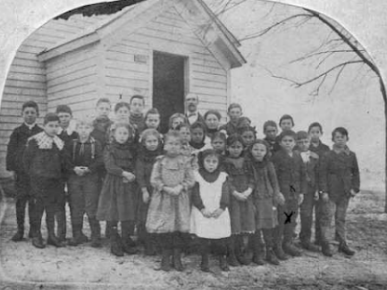
Schoolchildren and their teacher outside a schoolhouse near Elko. The boy with the X on him is Michael Schneider, ca 1910. SCHS Collection.

The same Scott County Argus article described another local first: “The first teamster in New Market was Peter Hoffelt. He made a small hand sleigh, loaded it with seventeen rabbits, and went to St. Paul to sell the rabbits and to buy a sack of cornmeal. He procured the meal and started for home, his wife in the meantime feeling very uneasy about him. On the second day about nine o’clock in the evening he arrived in New Market. He stopped at the house of Martin Eishen about bedtime and cried out three or four times: ‘Woah! Woah! Them d--d cattle never would stand.’ Mr. Eishen opened the door and said, ‘Where is your team Mr. Hoffelt?’ He laughed and replied, ‘I am the team and the driver too!’ and then started forward, reaching home about 11 o’clock that night. His wife met him on the road and assisted him in drawing the sled home. This is the story of the first teamster in New Market.”

In 1895 the area was officially incorporated as New Market. They built a hotel and school and continued to grow through the turn of the century, supported by the train station at nearby Elko. 

When the Chicago-St. Paul Railroad mapped out the area of Elko as a stop on their expanding rail lines in 1902, new businesses grew up around the railroad and existing businesses in New Market prospered. The town of Elko was officially incorporated in 1949 after a conflict with the township over liquor licenses. 62 of the 114 residents had petitioned to the Scott County Board of Commissioners requesting to become a village. The Board approved the petition and then the citizens of Elko voted on the measure. 

Advent of the Interstate

Use of railroads declined as automobiles became more popular and interstate highways popped up across America. Interstate 35 was constructed in the 1960s and the railroad left Elko a decade later. With these changes, business declined in both towns but housing construction boomed. 

As housing exploded, concerns grew surrounding the capacity of the existing sewer system. Housing construction stopped in the 1980s and a new sewer system was built─shared between Elko and New Market. 

Merger 

In 2004, the city councils of Elko and New Market began to consider the possibility of a merger.  Together, the two towns drafted a Cooperation and Combination Plan, which laid out the steps they would have to take for the approval and implementation of a merger. This plan was completed and approved by both city councils in January 2006.

Even before the merger, Elko and New Market shared several services in addition to the shared sewer system. Elko contracted with New Market’s fire department, and New Market borrowed Elko’s police department.

A public merger vote, open to all citizens of Elko and New Market, was held on March 21, 2006.  The merger passed with resounding success. In Elko, 213 people voted for the merger, while only 38 voted against, and in New Market the score stood at 224 to 47.

Sign for the merger between Elko and New Market, 2006. SCHS Collection.

The new Elko New Market was honored with two awards for the successful unification: an Excellence Award for Municipal Consolidation from the League of Minnesota Cities and an Innovation Award from the Humphrey Institute of Public Affairs. 

Today, the unified town of Elko New Market is home to more than 4,500 people, longtime natives and new arrivals alike. While distinct from New Market Township, the town of Elko New Market remains the commercial hub for township residents.

35-Day Crime Spree Capped by a Hail of Bullets, Part 2

By Charles Pederson

Picking up the story from Part 1, read on to find out how the Shakopee bank robbery of December 9, 1929, turned out.

A parade in downtown Shakopee, 1927. First National Bank is believed to be the third building from the right. SCHS Collection.

A parade in downtown Shakopee, 1927. First National Bank is believed to be the third building from the right. SCHS Collection.

Contemporary newspaper stories about the 1929 Shakopee robbery gleefully threw around hard-boiled turns of phrase that are nearly cinematic: “bandit trio,” “loot,” and “rattle of machine guns, crack of rifles and roar of shotguns”; the robbers were “mowed down.” Yet even this exaggerated language hardly does the scene justice.

Charles Brown, of the Minnesota Bankers Protective Association, described the intensity of the action:

“I turned my machine gun on them. At the same time, Sheriff Weckman opened up and so did Lester Brown, one of his deputies. Gregory Hartman, who operates a butcher shop across the street from the bank, then started firing with a rifle from an upstairs window.

One of the robbers tried to run down the street, but fell in front of a drug store next to the bank.

The third bandit ran inside the bank. I ran after him with the machine gun. He kept on going and went out the back door [where Tiedt filled him with hot lead].”

The Midday Ride of “Paul Revere”

Meanwhile, C. A. Manaige, age 82, veteran of the Civil War, gained his 15 minutes of fame as the “Paul Revere” of the day. Manaige happened to be driving his horse and buggy down a Shakopee street. Hearing gunshots, he realized what was happening. One newspaper writer had him “swinging his whip over his mare’s flank, . . . and beard flying in the wind, he shouted as he went, ‘Hey—the bank is being held up. Everybody out, get out your guns.’”

Another account, playing up the “Paul Revere” angle, stated, “The horse reared and galloped down the street, with Mr. Manaige shouting: ‘The bank’s being robbed! The bank’s being robbed!’”

What Happened Afterward

The three robbers had been wounded numerous times. Or as news reports put it, they were “riddled from head to foot” with bullets. The robbers were taken to nearby locations to have their wounds tended. Despite their wounds, all three survived. Accounts stated that the entire encounter took five minutes. But in that brief time, “the windows of the [escape vehicle] were shot away, the bank windows were broken, as were the windows of several neighboring stores, and bullets were lodged in walls and doorways for more than 100 feet.” Although a crowd had gathered at the sound of gunfire, amazingly—and despite the sheer poundage of the rain of lead—only the robbers were injured.

Sheriff Weckman stated he would file charges against the three men, needlessly adding that only two would be charged if the seriously injured McNearney died. In fact, McNearney did not die, but one of McKusick’s legs was so badly shot up that it had to be amputated. The third robber, George Larkin, was moved from the jail to the sheriff’s house for additional medical help. Later at trial, all three were given life sentences.

It is even possible that the men had additional mayhem in mind. The December 9, 1929, St. Paul Dispatch reported that, in the trunk of the getaway vehicle, authorities discovered hundreds of rounds of additional ammunition, bottles of illegal alcohol, and a new clothesline, “believed to be for the purpose of binding victims in case this became necessary.”

The Minnesota Bankers Association showed their gratitude for the efforts to protect their investments. They rewarded Weckman and Brown with $500 each; Tiedt and Hartman each received $250.

Screenshot (51).png

Unexpected Fame

The robbery garnered state, national, and even international attention. Contemporary news outlets placed Shakopee squarely in the world spotlight.

  • The Northfield News congratulated the foiling of the robbery. The citizens of Northfield—site of the famous James-Younger gang’s bank robbery of September 1876—had repelled the gang in a similar shootout 50 years earlier. The News, a local Northfield newspaper, alluded to the gunplay: “‘Say it with bullets’ is the motto every city should adopt when staging a reception” for bank robbers.

  • The New York Times produced a map under the heading “Interesting Places in News of the World.” Shakopee was highlighted, along with information about the “daring bank robbery” and its link to the Northfield gunfight.

  • The story reached as far as New Zealand. An Associated Press story in the Christchurch Star described the action in “the quiet village of Shakopee, Minnesota.” No doubt part of such foreign fascination lay in the fact that “more than 100 shots were fired,” playing into people’s views of the United States as the rough and unsettled Wild West.

And coming full circle, employees of the Belle Plaine First National Bank later identified McNearney, McKusick, and Larkin as the December 5 robbers of that institution.

Truly, the 35-day crime spree of 1929 left its stunning mark on Scott County. But time heals all wounds, and today, only faint echoes remain of  those violent events of 90 years ago.

First National Bank of Shakopee, 1958. SCHS Collection.

First National Bank of Shakopee, 1958. SCHS Collection.

35-Day Crime Spree Capped by a Hail of Bullets, Part 1

By Charles Pederson

In 1929, a massive gunfight between lawmen and the bad guys ripped through downtown. Was it in Chicago or New York City? No. It was Shakopee! 

People often associate the Great Depression (October 24, 1929–1939) with crime throughout the United States. Even Scott County had its share of illicit activity: throughout the county, gambling, illegal liquour clubs called speakeasies, and unlawful stills could be found.

Bank robbery was also on the agenda, including 35 days of robberies that rocked the county.

The Roaring 20s had seen a steep rise in bank robberies throughout the United States, and Minnesota bankers were not happy with government response. Rather than wait, the Minnesota Bankers Association organized groups of citizens called rangers (essentially, these were posses) to be deputized by county sheriffs in case of robbery. Additionally, rewards (“dead or alive”) of up to $5,000 ($80,000 today—multiply 1929 money amounts by 16 to get the estimated 2021 equivalent) were offered at each bank in the association for the capture or killing of any robbers. “‘Shoot to kill’ will be the instructions,” warned the Minneapolis Journal newspaper. Satisfied with their preparations, Minnesota’s bankers went about their business.


The Crime Spree Begins—First Robbery

On November 5, 1929, the Depression was less than two weeks old. In late 1929 and 1930, the unemployment rate jumped from 3.2% to 8.7% (still far below the 1933 high of nearly 25%). The U.S. economy had been weak during the summer of 1929, but it simply collapsed around people’s lives in October, robbing them of jobs, dignity, and future security. It may not be a surprise that ordinary folk felt pushed into crime to earn a living, or that those already in crimes stepped up their activities in an environment ripe for plucking.

Case in point, November 5, 1929: Three men entered the First Bank of Savage, demanding money and getting away with approximately $1,200. They escaped, though four men were later arrested and questioned. Of those four, John Morrow and Walter Williamson were positively identified by bank employees and were bound over to a grand jury. Byron Green and Edward J. Dee were released after bank employees could not identify them. Police, however, arrested Green in connection with crime in the southeastern Minnesota town of Caledonia and a series of creamery robbers in nearby counties.

Second Robbery

The excitement caused by the events in Savage was subsiding, and county life was just settling down, when bam!—on December 5, three armed men entered the Belle Plaine First National Bank. They threatened bank employees and got away with $6,000. They remained at large. Fear ratcheted up, and county residents fearfully wondered where and when the next robbery would be and what had happened to the robbers. All their questions eventually would be answered. For now, people could only speculate.

Bank check from the First National Bank of Belle Plaine, circa 1930. SCHS Collection.

Bank check from the First National Bank of Belle Plaine, circa 1930. SCHS Collection.

Mysterious Tip-Off

Shortly after the Belle Plaine robbery,  Charles Brown, head of the Minnesota Bankers Protective Association, dramatically announced he had received “from underworld sources” a tip about a robbery in Scott County. Acting on the tip, he notified all the county banks to be alert.

Around 2:00 a.m. on December 9, Brown received a second mysterious tip that the Shakopee bank was the target—for that very day. Brown notified the Scott County sheriff, Joseph Weckman. They armed themselves and several others and hid at short distances around the bank. Brown himself carried a Thompson submachine gun, famous for its part in New York and Chicago gangland shootouts.

Unaware of the warm welcome awaiting them in downtown Shakopee, three men drove into town. The men—Fred McKusick, also known as Frankie Morris, of Chicago; William “Bud” McNearney (or McInerney, depending which newspaper you read), of Saint Paul; and George Larkin—had stolen the car in Saint Paul. All three were known to police in various jurisdictions for criminal activity. No doubt they thought this would be a quick and easy, in-and-out bank job—a bunch of rural hicks against experienced lawbreakers. At least they were right about the “quick” part.

Inside and Around the Bank

Blissfully going about their everyday tasks, six people were already inside the bank: Henry Marshall, local farmer; Lucille Schwartz, bookkeeper; John Thien, cashier; E. J. Huber, assistant cashier; Theodore Weiland, president; and his son, C. T. Weiland, cashier.

Lucille Schwartz (far left) with her sisters as children, 1905. SCHS Collection.

Lucille Schwartz (far left) with her sisters as children, 1905. SCHS Collection.

The robbers parked in front of the bank and rushed in, forcing everyone onto the floor. Marshall stated that the “bandits fired a couple of shots into the ceiling, probably to terrorize us.” They grabbed $2,000 from the vault and headed for the street again. Huber later reported that the bank actually contained about $100,000. The early warning from Brown, however, had allowed the bankers to hide almost all the money.

The robbers could not have known that their easy day was about to end. When they emerged from the bank, at least five concealed people fired weapons, including Brown’s Tommy gun. McNearney, although shot several times, staggered back into the bank, attempting to escape through a back door. However, Al Tiedt, a nearby restaurant owner, raced out his back door when the shooting started. “I took the shotgun and ran out into the alley,” he recalled. When he saw McNearney, “I aimed and let him have it. The slugs hit him in the shoulder and face and sort of spun him around.” The robber dropped the money he carried but kept running, so Tiedt “hit him in the legs. He went down.”

Stay tuned for the exciting conclusion to the story in Part 2!