Mail-Order Homes in Scott County

By Charles Pederson

Online ordering, especially during the Covid-19 pandemic, has become a feature of U.S. life. Click a computer mouse or poke your phone with a finger, and voilà: a box arrives at your door. But even long before the Internet Age, in the first half of the 1900s, home delivery was available, though you had to use a paper catalog rather than a computer.

The best-known mail-order company was Sears, Roebuck and Co. Famous for its eagerly awaited annual catalog, Sears offered seemingly everything a household might need: toys, farm equipment, clothing, medicines, and more. The most dramatic order from the catalog, however, might have been a mail-order kit for an entire ready-cut house.

The Sears catalog spurred consumers’ Christmas wishes for a wide variety of goods. Sears Roebuck & Co. Consumers Guide, Fall 1900, Scott County Historical Society.

Notes on Mail-Order Homes

Sears Modern Homes—the branch of Sears that offered ready-cut homes—was perhaps the largest, but not the only, source for mail-order homes. Wardway Homes (Montgomery Ward), Aladdin, Harris Brothers, and others supplied kits for homeowners. These homes were found all over the United States and parts of Canada. Minnesota, and Scott County, too have their share.

In a 1919 congressional hearing, the manager of the Sears Lumber Department defined a kit house as “a permanent house and the method of its construction is not different from any other frame house where the lumber is framed (or cut to its proper length, notched, etc.), by hand by carpenters.” Rebecca Hunter, a respected researcher of mail-order homes, said, “The buyer received all the materials from one source: lumber, roofing, doors and windows, flooring, trim boards, hardware, nails, and enough paint and varnish to put 2 coats on everything. Electric, plumbing and heating fixtures were NOT provided as part of the house, but were available at extra cost. . . . Most buyers ordered from the closest supplier, as the buyer paid the freight charges.”

Mail-order homes were produced between 1906 and 1946. Between 1908 and 1942, Sears alone sold about 70,000 mail-order homes. Sears, however, was not the first manufacturer, waiting until 1915 to begin offering its own line of mail-order houses.

These days, finding, cataloging, and restoring such mail-order kit homes is popular. Entire books, websites, clubs, and Facebook pages are dedicated to this fascinating piece of little-known U.S. history.

The Appeal of Mail-Order Homes

Mail-order homes tempted homeowners for a variety of reasons. The “already-cut” part of mail-order homes was a major appeal for people who wanted a home of their own. A house kit could have as many as 30,000 separate pieces, each numbered and bundled with like pieces, accompanied by a handbook with instructions. Typically, the pieces could fill a couple of train cars, a significant part of a barge or a ship’s cargo hold, or a large truck trailer. The homeowner who ordered was responsible for the load reaching the construction site. The pieces were delivered from the manufacturer, often to a train depot or warehouse near the site. A home-building professional could be hired to assemble a home, or if the homeowners were handy, they could construct it themselves.

Mail-order homes came with an instruction book to guide builders through structure assembly, from beginning to end. Courtesy of Internet Archive.

Innovation and mass production of building materials allowed for a significant reduction in construction time. The Sears Archive noted that “precut and fitted materials [shrank] construction time up to 40%,” as did use of interior drywall and exterior asphalt shingles. Drywall—also called plasterboard or wallboard—was a new building material that widely replaced plaster-and-lath starting in the early 1900s. Asphalt shingles, introduced also in the early 1900s, replaced slate tiles or other roofing materials, with constant improvements throughout the 20th century.

By far the most relevant factor for ordering a kit home was price, although even here, prices varied, from several hundred to many thousands of dollars. The 1912 Sears catalog said of Sears model No. 167 (the Maytown), priced at $753: “By allowing a fair price for labor, cement, brick, and plaster, which we do not furnish, this house can be built for about $1,573.00, including all material and labor.” Researcher Hunter added, “Manufacturers claimed the pre-cut system would save the builder up to 30% compared to the cost of standard building methods.”

Properly sorted and stacked, the precut building elements of a mail-order home could be more easily erected on an existing foundation. Courtesy of Internet Archive.

Mail-Order Homes in Scott County

According to information from the Kit Homes Facebook group and the Lydia Area Historical Society, at least four mail-order homes have been located in Scott County. Two are confirmed Sears Modern Homes: one in Jordan, along the west edge of the county, and one in the northeastern Scott County, in the city of Prior Lake. The Jordan home is a Sears Glendale model. The Prior Lake home is a Maytown. At last count, the Kit Homes Facebook group had confirmed at least 22 Sears homes throughout Minnesota.

The Maytown (Modern Home No. 167), in Prior Lake, and the Glendale, located in Jordan, are confirmed Sears mail-order homes in Scott County. Courtesy of Sears Archives and of Antique Home Style.

Pam Killian of the Lydia Area Historical Society reported the local legend of two other mail-order homes in Scott County. The homes, built in the mid-1920s, are located smack-dab in the middle of the county, near the junction of Marshall Road, County Road 282, and Minnesota Highway 13. A May 1926 edition of the Shakopee Argus reported that “Ed Hafferman and Walter Killian are busy preparing the basements for their fine, new seven room bungalows, they are going to have erected in the near future.”

The story goes that the two homes, about a half mile apart, were similar designs from the same mail-order home manufacturer. Because the homes were so close in space and design, parts of each house were delivered to the wrong construction site, and some real sleuthing was required to untangle the mix-up. Apparently, the homeowners forgot the cardinal rule, found in a mail-order home handbook: “In unloading the [train] car, do not mix the lumber all up, but keep each different kind of material by itself as much as you possibly can. This will save you the labor of re-sorting this material later on.”

Scott County may be home to as-yet undiscovered mail-order homes from other manufacturers, though that hasn’t been established.

Wondering Whether You Live in a Mail-Order Home?

Many people question their own home’s origins. Consider the following as you try to determine whether your dwelling is a mail-order home:

●        Many mail-order home companies used distinctive identification markings on pieces. For example, Sears stamped alphanumeric codes on the lumber—one letter and three numerals. It may be possible to view these markings on ceiling joists in an unfinished basement, for example, or on exposed rafters in the attic.

●        Exterior or interior details may provide clues about whether a house is a mail-order home and, if so, which manufacturer. This, however, can be a less reliable way to identify houses, given that most remaining mail-order homes have been altered and that mail-order home manufacturers “borrowed” (or more accurately “stole”) plans from other builders for their own use.

●        Another clue may be found in the county recorder’s office. Old mortgage records name the financing entity. If the records show that a home was financed by Sears, Roebuck, for example, you can be fairly certain it is a mail-order Sears Modern Home, especially if combined with other clues. Other financing companies may provide clues to the manufacturer of a house in question.

If you are aware of any mail-order homes in Scott County—Sears, Wardway, Harris Brothers, or other manufacturers—we’d love to hear your story! Contact us at info@scottcountyhistory.org or message our Facebook page, https://www.facebook.com/SCHSHistory.


Learn More!

Thank you to Lara Solonicke of the Kit Homes Facebook group for her immeasurable help in producing this article. Thank you to Pam Killian of the Lydia Area Historical Society.

1926 Wardway Homes: Kit Houses. (n.d.). Daily Bungalow. https://www.flickr.com/photos/daily-bungalow/albums/72157613056938344/

Abid, Ayesha. (2018, October 20). Sears Is Fading, but Memories of Its Mail-Order Homes Endure. MPR. https://www.npr.org/2018/10/20/657770791/sears-is-fading-but-memories-of-its-mail-order-homes-endure

Guide to Kit Houses & Homes. (n.d.). InspectAPedia. https://inspectapedia.com/Design/Kit_Houses.php

How to Identify a Sears Kit Home. (2021, June 15). WikiHow. https://www.wikihow.com/Identify-a-Sears-Kit-Home Hunter, Rebecca L. (n.d.). Historical Architectural Research. http://www.kithouse.org/ Kit Home History. (2007, November 14). StarTribune. https://www.startribune.com/kit-home-history/11308806/

Montgomery Ward Co. (1930). How to Erect Your Wardway Ready-Cut Home. Internet Archive. https://archive.org/details/MontgomeryWardCoHowtoerectyourwardwayreadycuthome0001/ Montgomery Ward—Wardway Homes. (2015). Antique Home Style. https://www.antiquehomestyle.com/plans/montgomery-ward/index.htm

Thornton, Rosemary. (n.d.). How to Find Sears Modern Homes. https://www.oldhouseweb.com/architecture-and-design/how-to-find-sears-modern-homes.shtml

What Is a Sears Home? (2012, March 21). Sears Archives. http://www.searsarchives.com/homes/index.htm

If you are interested in writing for the SCHS blog, email info@scottcounthistory.org or call 952-445-0378.

As I Remember: Christmas

This blog post contains excerpts from “As I Remember,” a compilation of oral histories from Scott County’s senior citizens in 1980. The following are the memories of Agnes Morlock of Jordan, Edna Weckman of New Market, Josephine Skluzacek of New Prague, Elizabeth Schultz of Shakopee, Margaret Haas of Shakopee, Ann Chalupsky of New Prague, Carol Rybak of New Prague, and Anne Juni of New Prague. We have also included some photos of Christmas celebrations of the past!


Agnes Eilers Morlock, Jordan

Winter approaching, Christmas thoughts were in the air. Christmas was always a special event. Mother, with all her handiwork, provided many surprises. Dad, being a carpenter at hand, did his part with the toys. Everything was homemade. Our Christmas Tree was the most beautiful. It was usually a large tree with white real candles. These were burned only once, while we sang Christmas carols. The ornaments were animal cookies. It took nine days to mature the dough and then it was rolled and cut out and frosted in white on both sides. These cookies and candles were intermingled with garlands of strung white popcorn. What a sight! Christmas Eve was special too, when Dad, with his band, furnished the Christmas carols in church while we children sang at the top of our voices, unheard as the band music shook the rafters, but so, so, festive. Next morning there were gifts, some hanging from the ceiling, some hidden. Christmas excitement is universal to this day. 


Edna Weckman, New Market

The one thing I’ll never forget is going to midnight mass on Christmas Eve with the horses and sleigh. We bundled up to keep warm. The stars shining brightly, the church lighted up and the Christmas songs made one feel peaceful and happy. 

Ray and Loretta (Mamer) Robel of Prior Lake in their living room at Christmas, 1950. SCHS.


Josephine Skluzacek, New Prague

Have you ever heard of the mythical “Golden Pig” that was prevalent in Czech homes during the time I was growing up in the 1920s? I was born into the Czech family of Frank W and Agnes (Bouda) Skluzacek of New Prague, Minnesota. The family had three girls, Christina, Mary, and Josephine (myself) and six boys: the twins, Frank and Andrew; Wenceslaus; Joseph; George; and baby Edward, who died minutes after birth.

One year when my oldest sister, Christina, was about ten, she decided one Christmas Eve morning that she would see the Golden Pig. To see it, we were told we had to fast all day from food and drink until the Christmas Eve supper. She started out all right, left the breakfast table without partaking in food or drink. Mother felt so sorry for her because she knew the Golden Pig was nonexistent. No one ever got to see it. During the course of the morning, Mother started the dough and put the prunes for kolacky to cook. When they were cooked, Mother asked Christina to pit them. She was willing to do it and Mother watched her. Pretty soon, Mother saw Christina licking her fingers. Mother said to her, “You liked your fingers, and now you might as well take something to eat because you won’t see the Golden Pig.” Christina was so disappointed and never again made an attempt to see the Golden Pig. None of the rest of us ever tried it but we kept the secret of the old wives’ tale for the younger members of the family.

Christmas Eve supper was always a memorable event for all of us. It meant a lot of work for my mother, who put in days of preparing and used all the love she could muster to make it really worthwhile for all concerned.

Soup was first on the menu, from the Czech translation it meant, “a no good soup.” It was made from water, salt, saffron, and homemade noodles, and for our hungry stomachs, it hit the spot. Then came dried peas soaked overnight and cooked for hours on the back of the old cook stove. Buttered homemade noodles were followed by fried pike. There weren’t very many words exchanged, everyone was busy picking bones out of the fish. 

Kolacky, rolls, and calta (Christmas bread) were on the table. Now came the goodies, “sisky.” They were made like potato dumplings from mashed potatoes, but the flower was slightly browned and then the sisky were made about 4 inches long and 1 ½ inches around. These were placed in a well greased pan and put in the oven to brown. Every few minutes they were turned so that they would be browned all around. These were served with a lot of syrup and no matter how many Mother made, all were always eaten. Then we had apple strudel and the Christmas fruit soup, two kinds of the latter. My father liked his with cooked fish and the rest of us only liked the fruit soup.

Last came the nuts. Each of us cracked a walnut and depending on how the nut was inside indicated if we would be well during the coming year or not.

Our Christmas Eve supper table was laden with food all made from scratch and to this day we can always look back and say, “Everything was always the best.”

Elizabeth Schultz, Shakopee

When I was a little girl, they tell me all I asked for constantly was a big reed doll buggy (out of the Sears Wishing Book). My folks didn’t have much money so it was almost out of the question. But one Christmas morning it was there, a big navy blue reed doll buggy trimmed with cream colored wheels and handle, with a big jointed doll! I don’t know what happened to the doll, but I still have the buggy. It seemed Aunt Rose worked somewhere or knew someone so as to get a discount to make it possible for me to have the buggy. One year we did it all over to give to Mary, our oldest daughter, for Christmas, so it’s hers.

A decorated Christmas tree with a winter village in an unknown living room, 1963. SCHS

Margaret Haas, Shakopee

Christmas was an enjoyable time. We would go out in the woods and cut down our tree, place it in the dining room so the kitchen lamp that had a reflector would make the tinsel and trim sparkle and shine. We prepared lots of food and had lots of relatives come.


Ann Chalupsky, New Prague

Our godmother invited us for Christmas Eve to their house. They lived just across the woods. Dad hitched the two horses and bobsled. Our neighbor went with us. It was their married son. There were eleven of us in the sled. It was a dark, cold, winter night, lots of snow. The lantern was in front of the sled. All of a sudden dad drove over a stump, the sled tipped over, we were all in the snow. The folks took some peanuts, candy, and nuts along for the party, that was all over the snow. Dad set up the sled, brushed the snow off the blankets and clothes and we went on. We had a very nice party. The next day the neighbor went for the peanuts, candy, and nuts; he did find them in the snow.

A child, only identified as “Clark’s daughter,” posing for a photo next to an inflatable Christmas display featuring Santa Claus and a reindeer, 1963. SCHS.

Carol Rybak, New Prague

We celebrated Christmas with gusto. There was always a big Christmas tree in the parlor. The tree had long strings of candy which wound around like garlands, candies wrapped in foil, beautiful ornaments, and dozens of candles. My mother and father decorated the tree after we were sent to bed, and they would wake us when it was finished. They set a pail of water on each side of the tree in case of fire. After we had admired the tree in its glory, the candles were extinguished and then we enjoyed our gifts. There wasn’t much sleep that night because at that time instead of midnight mass, we had mass at 5:30 a.m. We usually walked to town to mass and so did many of the neighbors. It was wonderful trudging through the snow on a glorious Christmas night with everyone happy and shouting greetings.

Anne Juni, New Prague

The Christmas season meant Rorate, Baborky, Mikolas, and special food. Rorate was early mass during advent, starting at 6:30 a.m. Mass was in the chapel in the church basement. Czech songs were sung during the service. It was the challenge that urged us to attend and then some mornings we were allowed to stop at Dobihal’s Bakery for freshly baked crescent rolls. These rolls were delicious! That building was torn down last year. Nobody could compete with Dobihal’s rye bread or rolls.

Mikolas (St. Nickolas) came on the eve of December 6. We never saw him in our house but in the morning we each had a plate of goodies. Of course, only good children were thus rewarded. We carried on that tradition with my children.

Baborky came on December 8. Young women masked and dressed in white representing Saint Barbara went around the neighborhood asking the children to be good and pray. Those children who prayed were rewarded with treats and the parents in turn gave the good saints a monetary reward. I myself was a Baborka many times. Guess we looked like the ghosts that we see at Halloween time.

All the town musicians turned out for midnight mass. The same music was played then as now but maybe with more gusto. All the Komarek men played, father and three sons. Paul is the only one left. It was truly an ecumenical service. The late Professor Kovarik was the choir director in my time and he had the respect and cooperation of all the local musicians.

The day before Christmas, my grandmother would make the most beautiful and delicious vanocka. It was a braided sweet dough bread with several tiered layers. Sometimes raisins and candied fruit were added. She also made the vomacka for our Christmas Eve supper. That was the Christmas soup made of a variety of sweetened, cookies, and dried fruit with cinnamon and ginger snaps added for flavor.

The Christmas tree was in the parlor, sometimes called the front room. It was rarely used and heated only when company was expected. After Christmas Eve supper, the door was opened, the candles on the tree were lit, and treats and gifts were handed out. December 26 was St. Stephen’s Day and called second Christmas. That was the day for visiting.

The Coller family Christmas tree in their home in Shakopee, 1916.

As I Remember: Halloween

This blog post contains excerpts from As I Remember, a compilation of oral histories from Scott County’s senior citizens in the 1980s. The following are the memories of Leo Michael of Jordan and Lucille Grafenstalte Hirscher of Shakopee. We have also included some historic Halloween photos!

Halloween

In school days of long ago, one Halloween Day came around when the boys were aching for some excitement and decided to go out for the evening and celebrate as best we could. After school, we practiced football until dark, and then Halloween took over. 

We walked down to the brewery and there we saw a wagon near an open well. We removed the top of the well and dismantled the wagon into small sections and dropped them into the well. Then we replaced the cover of the well and left for other fun and excitement. 

Soon we came upon an outhouse, sitting there so quietly in the darkness. Just as four of us boys gave a good push to tip it over, we heard a voice saying, “Take it easy there, boys!”

Hearing that, we very gently set it back. As we walked away, I said, “Guess it is the wrong time…we will inconvenience a lot of people doing this at this time.”

So, we walked back into town. Some of us went to the Halloween dance and others went home. 

-Leo Michael, Jordan

Children wearing witch hats standing around a Halloween pumpkin display between 1965 and 1970. SCHS Collections.

Small Town, U.S.A.

I’ll never forget my meeting with the devil! My mother had taken me to a masquerade dance to see the costumes. We were sitting watching the dancers when the devil came up and spoke to me. 

He really was my idea of the devil. All dressed in red, complete with his horns, a tail, and a pitchfork. I was so frightened!

I didn’t realize until long after that the devil was our grocer. 

-Lucille Grafenstalte Hirscher, Shakopee

Photo of a group of Shakopee girls dressed up for Halloween. The seated girl is Sue Berg and she is dressed as a witch. The girl standing at the center back is Mabel Berg and she is dressed as a ghost. The girl on the facing left side is Mayme Ryan and she is dressed as a bride. The girl at the facing right side is Mary Scherkenbach and she is dressed as a ghost. 1910, SCHS Collections.

As I Remember: Grace Ploetz

This blog post is an excerpt from As I Remember, a compilation of oral histories from Scott County’s senior citizens in the 1980s. The following are the memories of Grace Ploetz, who grew up in Belle Plaine. There is even a donut recipe at the end, so read on!

Some Good Memories of the Past

About the year 1900, my father came to this country from Goteborg (Gothenburg), Sweden, at the age of sixteen. His older brother, Oscar, was established in the confectionery business in Duluth at that time. He sent my father to Gustavus Adolphus College in St. Peter to learn the English language and a short business course. My father spent a year in that area, then went back to Duluth. He had several different jobs as time went by. I remember him telling about being a salesman for a stationery company. He drove a horse and buggy rom Duluth to the Iron Range, taking orders from stores along the way. His largest sales were in valentines and school supplies. How he survived the cold weather, driving a horse and buggy in that part of the country, I never did know.

Mother came to Duluth about the same time, coming from a family of nine children, all living in a one room house on a farm near Valley City, North Dakota. She came to work for a relative who ran a boarding house. My father roomed and boarded at this place. My mother was a pretty gal, and a good cook. A romance started and soon they were married. Mother quit her job at the rooming house and went to work for a dressmaker, plus keeping house. There she learned the art of dressmaking. Making dresses for the elite in those days was an art and she never forgot the technique.

My father didn’t like being on the road, so he went into the confectionery business with his brother. In the meantime, I was born. My father stayed in business with his brother until I was about three years old. He then decided to open a confectionery business of his own. We lived in two rooms in back of the store. Mother and dad worked night and day, plus taking care of me. They made all of their own ice cream, cakes, pies, soup and sandwiches, seven days a week from 6:00 a.m. to 11:00 p.m. Finally, they saved a little money and decided to get into a business that would at least give them a rest on Sunday.

In 1912 Dad took the train to the town of St. Peter to see if he could rent a building. There was no vacancy, so on the way back he stopped at Belle Plaine. Dad made plans to start a variety store. At that time, they called it a five-and-ten cent store. I was six years old and started school. I got along fine until some of the kids called me a “ten center,” and also reported that competition was “going to have that Swede out of business in six months.” To me, this was tragic at the time; now I can laugh about it. When I reported all this at home, dad was very calm and told me to pay no attention. He also told me something I never forgot – “Be nice to your competitors. Someday they may be your customers.”

Mother and Dad worked very hard at getting this store organized. I remember the first winter we lived upstairs in a three room apartment. It was cold at times, the stove would be red hot, but we had to keep our feet wrapped up in a blanket to keep warm. One incident happened that I will never forget. Mother used to clean her best dress and dad’s ties in gasoline, and she kept a can of it in the storeroom. She had a young girl come in and clean this day and she filled the lamp with oil, which she found in the storeroom. That night she lit the lamp. We were home alone. Lamps fascinated me. They were new to me as I was used to the gas jets in Duluth. I watched the flame and it seemed to jump up and down. I as frightened. I told the girl, and she too knew it wasn’t right. So she blew it out. I went next door and borrowed a lamp so we would have some light. The only thing that saved us from an explosion was that the wick was saturated with kerosene and it wasn’t lit long enough. The good Lord was watching over us that night. My folks were so upset after they arrived home when I told them why we had the neighbor’s lamp.

The store prospered, not very fast, but soon there was an opportunity to move into a larger building and more stock could be added. By that time Dad had established his credit with the wholesale houses and the local banks (Belle Plaine had two banks in those days). He installed a 12-foot candy case and had the best assortment of bulk candy in town. Mother had a millinery department and Dad always said that was a store saver. She re-trimmed old hats, made them look like new, and she also sold lovely new ones. She was a good saleslady. Those days most of the men came with their lady to select a new hat. When it came time to choose, mother would always try the hats on herself. She looked nice in them all, but most always she looked best in the most expensive one.

The year 1925, My brother Carl was born. A few months before, Mother’s friend, Nellie Irwin, gave her a baby shower. This was an exciting party. None of mother’s friends knew that she was going to have a baby. She had confided in me, Nellie, and Ida Moore, who worked at the store. We got together and thought it would be fun to have a surprise shower, a surprise for the guests! Ida and I wrote the invitations, sent them out to Mother’s friends with, “Guess Who is Having a Baby?” The town was buzzing with gossip. One lady told mother she wasn’t going to buy anything good because she didn’t know who it was for. When the ladies arrived at Nellie’s house, all the packages were put in a large basket with strings that looked like they were attached to the basket. The only one that was attached was Mother’s. When she pulled, it came to her. The lady who wasn’t going to buy anything good fainted!

By this time, I was out of school and worked full time at the store. When Carl was about two years old, Mother would come to help when we had special sales. Often on Saturdays of the sale, we would offer hot coffee to the customers. This was mother’s specialty, which she made right at the store. She mixed and rolled them, cut and fried them, in between the time she visited with the customers. Dad made the coffee and always took such great pride in handing out a good cup of coffee. What could be better for free on a cold day?


Mother’s Donut Recipe

3 eggs

1 cup buttermilk

1 cup sugar

5 Tbsp. melted butter or margarine

4 cups of flour

1 tsp. baking soda

2 tsp. baking powder

1 tsp. salt

1 tsp. nutmeg

Beat eggs well. Add sugar, salt, nutmeg, and baking powder. Dissolve baking soda in buttermilk and add to egg mixture. Add flour, making a soft dough. Turn on to a lightly floured board, roll into a sheet, 1/3 inch thick. Cut with a floured cutter. Fry in deep fat at 365°, turning until brown. Cut with a floured cutter. Drain on absorbent paper, sprinkle with sugar. Always have a fryer cover handy in case the grease catches on fire. If so, place cover on fryer, and fire will be extinguished.


Coffee Recipe for an Old-Fashioned 45 or 50 Cup Coffee Pot

2 ½ cups coffee, regular grind

¼ tsp. salt

2 ½ gallons boiling water

1 egg white

2 cups cold water

Mix coffee, egg white, salt, and 1 cup cold water, and add to boiling water. When it starts to boil up, turn heat off and let stand 10 minutes. Add 1 cup cold water and coffee is ready to serve.

Never Forgotten: Earl Dols

Please Note: This blog post is an account of World War II, including mild language, violence, illness, death, and other themes that may not be suitable for younger readers.  While these stories are an integral part of history, some of the following content may be slightly graphic in nature.

The following is an excerpt from “Never Forgotten: Stories by Scott County, Minnesota, WWII Veterans” by Tom Melchior, in collaboration with the Scott County Historical Society.

Earl Dols volunteered for the Army and served in the 34th Red Bull Division, 1st Battalion, 168th Infantry and 175th Field Artillery Combat Team, except for the time he was detached from them and served with the British 1st Division.  Before joining the Army, Earl had finished the program for mechanics at Dunwoody College of Technology and was assigned to maintain military vehicles. Earl was shipped from Fort Snelling to Camp Claiborne, Louisiana, for basic training. He was then moved to Fort Dix, New Jersey and prepared to go over seas.

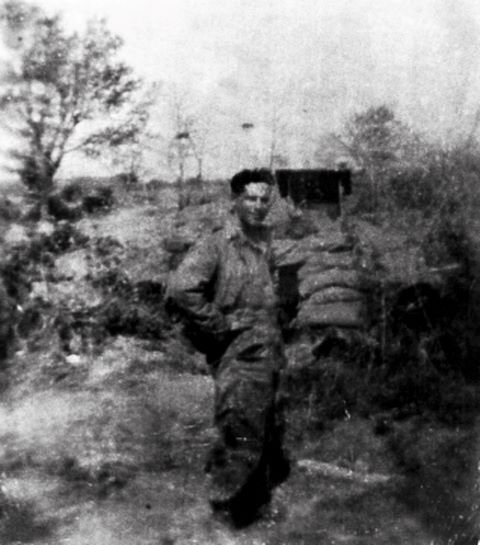
Portrait of Earl Dols.

On the third of March, 1942, we got all of our equipment checked over. It takes a long time to take care of 125 vehicles. I changed all the lubricating oil. Then on the 28th or 29th of April, we left the states on the USS Mexico that had been converted to a troop ship. They said that it used to be a banana boat. The Normandy was there, but that caught fire. The Normandy was a big French boat that held lots and lots of troops. They were pouring so much water on it and the thing capsized right in the harbor. A couple of buddies of mine and I went down to the Brooklyn Yards and we could see the thing there laying on its side. We didn’t know at the time that it was scheduled to move us. The USS Mexico was a small ship compared to an ocean liner like that.

We left on the 28th or 29th of April. We got to Belfast, Ireland, on the 11th of May. We had some training there, but then we were detached from the 34th and attached to the British 1st Division. We would sit around a table with gas masks. Put your gas mask on and breathe through there for one hour, but they didn’t use gas then. From there we went to Enniskillen, Ireland, for basic training. We were eating “1-and-14s” or “14s-and-1s.” A ration box would last one man fourteen days, or fourteen men one day. That was the British chow, hair ox-tail soup and such. As far as buying anything off of camp, you couldn’t. It was all fish and chips, fish and chips.

Then we were detached to the British and the old 34th stayed back on the British Isles. Afterwards they shipped the 34th and the 175th Artillery up to Scotland. We left Ireland for Scotland on a barge that was used in the Dunkirk invasion. While we were in Scotland, some of the equipment came. There they had better seaports. The USS Mexico was the only ship that came in at Belfast because the harbor was so shallow there that they couldn’t get a big liner in there.

We went to Inverurie in the northern part of Scotland for a couple months. We were training for amphibious landings. LSTs [tank landing ships] would come in there off the Atlantic coast. Because a lot of rivers flowed out into the ocean, the LSTs could back in there. About two nights a week we’d have a practice load with the trucks, mostly all 6-by-6s, Dodge command cars, weapons carriers, and Willis Jeeps and that kind of stuff. It was all loaded after dark, and it got so dark you could hardly see a hand in front of your face. About one o’clock the sun would start coming up again.

The guys got so good they could load a whole LST backing them in there so that when they had to get the hell off the enemy coastline, it didn’t take any time at all to drop the gate and off they went. They could load one of those LSTs in 30 minutes. It was so crowded in there you couldn’t hardly walk in between the vehicles and everything else.

We didn’t know what was going on. We took a couple of trucks and loaded them up with parts because we were going to be detached from our division and attached to the British 1st Division. We had gotten new vehicles and the British were using ours because the old 2-by-4 Chevy station wagons were all wore out and beat up, so we got all new ones. That took a while for the United States to make that stuff.

Dols and company working on a military Jeep.

After training in loading and unloading LSTs, they shipped us down to Glasgow, Scotland, for a month. They got us ready to load up on what had been the ocean liner Awatia, but that was changed into a troop ship. It was docked in Liverpool, England. The 175th Field Artillery was separated from our division, from the 34th, attached with the British 1st Division. They were a bunch of bastards. They shoved us in more or less for experimental use. We were trained on a British 25-pounder gun. That was equivalent to an 87-millimeter gun. We left the old 75-millimeter from World War I here because that was no match for the German armor. It was like taking a pea shooter. It was useless. We knew that.

We loaded up on the British ship Metrapole on the 15th of October, 1942, and sailed around on the Atlantic Ocean for 24 days. We looked up at the sun and it would be in the south, half an hour later in the east. We were zig zaggin’ all the time so the Krauts wouldn’t take a bee line on us. There were a lot of subs, U-boats, out on the Atlantic Ocean.

This guy Moody was from A Battery was a battery mechanic. I had been with the outfit nearly a whole year and I knew a lot of those guys, not personally, but I knew of them because of their jobs and my job. We were attached to the British outfit, 1st Division. A Limey soldier, as we called them, was cleaning his Tommy gun. Accidentally, it went off and five slugs cut across Sergeant Moody. We buried Moody at sea, put him down the plank into the water. He had a pet female dog he named Lady. The guys from A Battery kept the dog all during the war. When the war was over, some of the guys from the battery in Minneapolis brought the dog back and gave it to this guy’s mother.

Where did you land in North Africa?

The rest of the division came in as far as Oran, North Africa. The British and our 175th Field Artillery went in – they told us about a day or two before – through the Straits of Gibraltar. We didn’t know what the hell was waiting for us. We figured they would have sunk all of us. We went through there at night. I can remember looking to the left off the deck of the ship and I could see lights. I don’t know if it was Portugal or Spain, but we went through there with no opposition whatsoever. None.

I couldn’t figure that out. I think the Germans were so busy up in North Africa. It was [Winston] Churchill’s idea to spread this thing out so the Germans couldn’t concentrate on one little area.

We landed at Algiers and we had a little opposition there. We all got off the big ships on a rope ladder on LSPs [Landing Personnel Boats]. It was on a Sunday morning. They dumped some of us off here and some of us there and they said, “Stay put.”

We sat on the shoreline, three or four of us together. It was 10 o’clock, November 8th, 1942. Actually it wasn’t supposed to be done that way. It was a big, gigantic operation with lots and lots of mistakes. About four o’clock in the afternoon, they had runners who told us to go to certain areas. We marched into Algiers. It was pretty well settled then. There was a little dispute between the Free French and us. It took us awhile to get our equipment unloaded.

Then we were going to convoy across from Algiers toward Tunisia, a 400-mile trip that was pretty much desert, some roads. The wind would come up and we’d have dust storms that affected our equipment. We couldn’t oil anything. The dust would get in there and nothin’ would work.

We convoyed across North Africa and went up to Medjez el Bab. The 5th Armor was in there. It was wet and rainy and they got their tanks stuck. Every once in awhile you could hear a shell come in and “bomph” there would be big black smoke there. The Germans were adjusting on our positions. We were all green. We didn’t even know what it was. Some of the brass knew, I suppose, but we didn’t know.

There was little bit of a shack that some slept in, but I slept outside in a shelter-half with two blankets. It rained that night and I woke up the next morning and my hand – I had a wristwatch, just a cheap watch-- and my wrist was laying in water. So much for the watch.

Nothing happened ’till that night. We were waiting for orders to get out of there. We knew it was hot territory. We had a little candle burning in that shack. About 11 o’clock at night this guy from the 5th Armored came in. He had abandoned his tank. It was stuck in the mud. The Germans were about a half mile or three quarters of a mile out of town. He took his 45-pistol and dug a foxhole with it. He said that some of the German infantry was right around him. He waited for his chance and he got the hell out of there. He got into this town and saw this candle burning in this rackety old building and he rapped on the door and said, “You guys better get the hell out of here. The Krauts are down the road here about a half mile.” We waited for orders to move.

At last the order came down to move. We got out of there, but A Battery lost three guns and they were taken prisoner. “Old Soapy” Jones, he got his truck and gun out of there, but we lost four British 25-pounders.

 It was a funny start to the war. There was a pocket of Germans here and 20 miles away there was another pocket of Germans. The next morning, we come into this little town of Gafsa, and the Germans used their Stuka bombers. They were slow airplanes that maybe moved 120 knots an hour. They dive right straight down and drop their bombs and they’re off. There must have been quite a few of them because that morning about 10 o’clock they were hauling all the dead out of town and they had them all loaded up on two-wheeled carts to take them out to the cemetery. They were all civilians.

Did you encounter any fighting in Tunisia?

Oh, ya, we were there from November 8th for a couple of months. We used the British 25-pounder. From that time until the first part of January 1943, and then we got the American-made 105 guns. Then we were all back to the Red Bull outfit. They were kind of testing us out to see if we could do a lot. Nobody seemed to know what was going on except the big brass.

It was hot in the summer of ’43. It was all sand. We were in a town they called Matur and from there we convoyed back up to Oran. That’s where the rest of our division was. We were getting ready to make the landing in Italy.

On the move.

When did you land in Italy?

We came in and landed about the 9th of October at Salerno. The 45th or 36th Division went in there and they couldn’t hold, so the old 151st that I had been with at first was turned over to the 175th that was used at Salerno, because a German anti-tank outfit came right up and started firing on our gun positions. They said that if it hadn’t been for the 151st, we couldn’t have held Salerno. The Germans backed off, so we went up towards Naples, Italy.

We pulled in at Concerta, a town about ten, twenty miles out of Naples. That night Mt. Vesuvius blew up. We could see the stuff going up in the air. From there it went pretty slow. We went up toward the Gustav Line at Cassino. We didn’t move there for months, couldn’t get through.

The Gustav Line was a series of German military fortifications in Italy. The main line of fortification ran across Italy through the Apennine Mountains to the mouth of the Sangro River on the Adriatic Sea in the east. The center of the line, where it crossed the main route north to Rome (Highway 6) was anchored around the mountains behind the town of Cassino including Monte Cassino, which had an old abbey sitting atop it that gave the Germans clear observation of any attackers.

They figured the Germans were using the Abbey for a lookout because it’s sitting way up high. They said they weren’t using it, but one of our L5s or J3s observation airplanes said they could see an antenna sticking out, so then they knew the Germans were using that. They warned them and they just kept using it. We were losing too many guys, but you couldn’t get them out of foxholes. They had litter bearers taking them out and some of the bodies laid there for two or three weeks in the cold. You wouldn’t believe it, but that’s the way it was.

What made the battle of Monte Cassino such a difficult battle?

The Germans were dug into the mountains. They had been preparing that line for a long time. That was their Winter Line defense.

That was in the Liri Valley and Highway 6 come through there going up to Rome. We were trying to get through there to take Rome, but we couldn’t get through. About 10 o’clock in the morning, B-25s from the 13th Air Force came over and they dropped everything they had. We had 500 artillery pieces firing at the same time. I would have swore to God that if they shook it any more, the bottom of Italy would have fell off the bottom of Europe. They said it didn’t do any good. All that rubble gave the Germans protection.

We decided we would try a different way of getting there. We went up to Anzio. We loaded some of the equipment on LSTs.  They took about four men out of each section of ten men because there wasn’t room. We broke through about the fourth or sixth of June about a day or two after the invasion of Europe.

You said there were so many guys on the beach at Anzio that the Germans were shooting artillery at you.

 Yes, the beach was only about five, six miles wide and 18 miles long. Every night LSTs would go in there and dump some ammo and equipment, but it took a long time to get enough stuff to make a push. You can’t make a push and run out of ammunition. You couldn’t dig in because the water would come in on the beach. After two or three feet you’d strike water, so you couldn’t protect any of our provisions.

Anzio was a bastard. There wasn’t anyplace that you could go to have any protection because the Germans could reach us. The ocean was behind us. Germany was here in the mountains to the left; Germany was here in the mountains in front; and Germany was here in the mountains to the right. They clipped us from three sides.

Earl Dols at Anzio.

How did you get through?

It took awhile until we got enough equipment. As we brought the stuff in, the Germans would send in a barrage of artillery over and blow it all up. They figured they would run us right out into the Mediterranean. We got enough equipment and we pushed on through. It was either the 4th or 6th of June that we took Rome. About the same time the invasion at Normandy took place.

105,000 personnel from the United States, the United Kingdom, Poland, Canada, India, Free French Forces and New Zealand fought in the Battle of Monte Casino. American, British, and Canadian forces had 43,000 combat casualties (7,000 killed, 36, 000 wounded or missing) in the Battle of Anzio.

There was no fighting in Rome, right?

Yes, it was called an open city. We marched through Rome. We went past the Coliseum. We stayed on the outside of Rome for about a day and a half because the Germans had blown the bridge across the Tiber River and we couldn’t get across. We had the Bailey Bridge. The engineers would piece a bunch of this bridge together and push some of it across and add to it and push that across till they got over that span. It wasn’t like the pontoon bridges that had balloons underneath them These were all steel. They could handle some pretty big loads such as tanks, but not too many. They had to space them out. From there it was tough going up through those mountains.

Where did you go next?

To Città Vecchia where the Krauts had a big gun. They said the barrel was over 30 feet long. They used to fire that sucker at a little town by the name of Nett, hoping they’d hit some LSTs and stuff out in the water. You could hear that sucker come over – woop, woop, woop, woop, and a booster shot was behind it and that would give it another boost into the harbor at Natuna. Our L-5s, Ariel Observation Post, would go and try to locate where that gun was, but they never could find it. It was on a railroad gun. They’d fire the gun a few different times and pull it back into a railroad house.

How far did you go? Where did you finish?

We got as far as Livorno Luiano up in the Apennines Mountains about 45 miles north of Florence. We stayed there from the middle of October until spring. That’s when the invasion of Sicily took place. They didn’t need us anymore. They gave us a rest. We had enough. I saw Mussolini hanging upside down in a garage station at Milan. The partisans had killed him.

What were “screaming meemies”?

When they [the bombs] would drop they had like a small siren built right into them. It was to terrify the enemy. We had those dropped on us up at Anzio. They dropped everything on us. There was no place there where they couldn’t reach.

There were a lot of horses and cows and what have you on the beach. We had burros. There was one of them there, and ten or twelve of us would go up to get our mess, our chow. We’d go to Frank, the mess sergeant, and I always got a couple cubes of sugar. That old burro would come to meet me every morning and I’d feed these cubes of sugar to ’em. Never a morning would he miss. He’d be there. One morning he didn’t show up, so I went to look around a bit. A shell hit him and he was gone.

Can you talk about the Volturno River?

We crossed that about three different times. It was like a snake. You’d cross it here and go up a ways and here that thing was again. In the fall of the year when it rained, it was a couple miles wide. Our company commander, Captain De Wells, got killed there. He was a West Point guy. He wasn’t afraid of nothin’. Oh, that guy had guts.

There were so many mines planted. In one place we were in a rest area at the Volturno. The river bed was mined. The water had settled and you could see these pins sticking up from the river bed. The rain and the water from the higher land would come into this lower area and wash like a culvert. Our infantry would try to come up through these washouts. They [the Germans] had these “bouncing Betties” and you tripped the wires and they cut across your groin and killed ya.

It seems as though every place you went the Germans had machine guns.

I dream about them. Up to about a few months ago I could hear the German burp guns. Burrrrrrrrp, burrrrrrrrp, they were real fast. You could hear them at night at Anzio beach head.

Did you have any protection for your ears from the shelling?

None whatsoever. We didn’t have any. I never saw any. They [guys in the artillery] all had trouble hearing. We were coming around a bend and the 155, the Long Tom, was firing up this way. The muzzle blast from that 155 hit and I couldn’t hear anything for about three days.

What would you say was the worst fighting that you encountered?

Anzio. The Germans were north of us, east of us, and west of us. They had three sides. Shells were coming in all the time. It got so one day was like another. It was seven days a week. Sundays and Saturdays, that didn’t mean nothin’.

Earl Dols was awarded the following decorations and citations: Good Conduct Medal, Bronze Service Arrowhead, European-African-Middle Eastern Theatre Medal, American Defense Service Medal, and six Overseas Service bars: Algeria-French Morocco, Tunisia, Naples-Foggia, Rome-Arno, Northern Apennines, and Po Valley.

If you are interested in writing for the SCHS blog, email info@scottcountyhistory.org or call 952-445-0378.