
As I Remember: Jordan Breweries

Cover Image: Postcard of Schutz & Hilger’s Brewery in Jordan, 1940. SCHS Collection.

The following is from “As I Remember Scott County,” a collection of oral histories from Scott County’s senior residents in the 1980s. In this selection, Johanna Herder Duestermann shares her knowledge about Jordan’s local breweries. It has been slightly edited from the original for clarity.

Frederick Heiland took a homestead in the Jordan area in the late 1850s. He came from Leipzig in the German province of Saxony, where he had been a brewmaster. After establishing himself on a farm for some years, he moved to Jordan shortly after the Civil War to join a Mr. Berk, who ran a small brewery on the south end of Jordan on Highway 21.

Berk had begun to build caves back into the hills behind his building. There, the temperature was constant and conditions were ideal for aging the beer. Frederick Heiland took complete control of the business around 1873, and in a short time, enlarged the caves to their present 300-foot lengths. He installed ventilation for them to the tops of the hills. Frederick died in 1881, and his widow and children hired a German immigrant, a Mr. Piemeisel, to manage the business. In 1890, Piemeisel retired, and Frederick’s oldest son, John, took over. William Koschel, another German immigrant and expert brewmaster, as well as a good friend of Jacob Schmidt of Schmidt’s Company, helped run the operation.

John had also heard of a Bohemian named Pilney, who was skilled at the difficult art of making the malt used in the brewing process. He was so impressed with Pilney’s work that he brought him over from Bohemia to work for him.

John operated the brewery until 1904, when he sold it to brewmasters Koschel and Mesenbrink, who had been farming in the Jordan area. The brewery operated under that management until Prohibition was passed [in 1920].

About the same time that Frederick Heiland was taking over his business in 1873, another brewery was being erected by Sebastian Gehring, who, with a man named Pier, began a competitive business. Gehring soon took over sole ownership of the firm and named it Sand Creek brewery, but sold it to Peter Schutz and his brewmaster, Kaiser, in 1885. Schutz and Kaiser ran the brewery until the turn of the century.

At that time, Kaiser died, and a man named Peter Hilgers joined Schutz. They operated the second brewery until Prohibition, and opened again in the 1930s with the repeal of the Volstead Act [also known as the National Prohibition Act]. The last beer was brewed in the Schutz-Hilgers plant during WWII. The ruins can still be seen today.

Schutz & Hilger’s beer label, 1940. SCHS Collection.

The Koschel-Mesenbriink building was completely destroyed during the Prohibition years, when what is now Highway 21, was straightened and routed through the brewery property.

The two breweries carried on a tradition of beermaking in the “Old Country” style. Jordan had a bountiful supply of pure spring water, and the malt used in the brewing process was made from barley bought from local farmers. This made a rich lager beer.

The two breweries also initiated social festivities that brought people from miles around to Jordan. They constructed a large round pavilion dance hall on the site across the highway from the brewery ruins, which is now Mini Met Ball Park. The pavilion drew people from the Twin Cities who would travel there by boat on the weekends.

Beer was sold by the barrel and delivered by both companies in the famous large brewery wagons pulled by horses in teams of four and six. They had to weigh at least 1,700 pounds. Gravel roads were rare at this time, so wagons often became stuck in the mud. Most of the business was done with saloons. Free delivery and ice was provided to their customers, as well as free hot water to clean the copper coils through which the beer passed in the saloons. Deliveries were made to Green Isle, Blakeley, Belle Plaine, Henderson, and Arlington, but most of the business was done in Jordan.

The ruins of the Schutz & Hilger’s Brewery can be seen in the right center of the image during a flood in 1960. SCHS Collection.

As I Remember: Early 1900s Reminiscences

The following is from “As I Remember Scott County,” a collection of oral histories from Scott County’s senior residents in the 1980s. Carol Rybak of New Prague shares her memories of childhood and family history in Scott County. It has been slightly edited from the original for clarity.

My grandfather, Christian Fischer, and my grandmother, Theresa Birkman, were married in Scott County in 1858. They were both born in Germany and immigrated to the United States after the German Revolution in 1848. They met in St. Paul and decided to be married and homestead in Scott County. Their marriage was unique. Her was Lutheran and she was Catholic, and beacue there were few priests or ministers around at that time, they were married by the Justice of the Peace. They agreed that all boys born to the union would be baptized Lutheran, and all girls, Catholic.

They selected 160 acres about four miles east of Jordan. They built a log cabin and started to clear the land. Two sons were born to them at two-year intervals. Clearing the land was difficult, so my grandmother helped as much as possible. They left the baby asleep in the cabin and took the older one with them. A spark flew out of the fireplace, set the cabin on fire, and the baby died in the fire. Their grief must have been inconsolable. The child was buried in the woods where it was thought a church would be built. The cabin was rebuilt with the help of the community, but things were not the same.

After the Civil War, a law was passed enabling any man who had served in the Union Army the right to homestead land. A man by the name of Rohs had homesteaded a piece of land 1 ½ miles east of Jordan. He was a bachelor and had no interest in keeping the land, so he sold it to a man named Rodell, who, in turn, sold it to my grandfather, and the family move there. I still have the original papers signed by President Lincoln and his secretary, Stoddard.

There were rumors at that time that the railroad going west would run through the Minnesota Valley and also that a mill was being erected on Sand Creek. This made the location very desirable. Another cabin was built in the new place, and three more sons and two daughters were born. My father was the youngest of the children. My grandfather died of typhoid fever when my father was two years old. This left my grandmother with six children and a farm. The oldest boy, John, was fourteen years old. She was determined to run the farm, even though people advised against it. She was successful.

When John was eighteen, he decided to go west to seek his fortune prospecting for gold, silver, copper, etc. He roamed the mountains and discovered a vein of copper in Montana. He sent back such glowing accounts of success that the next brother joined him. This left George, who was married, to run the farm. My father was the youngest son and he was restless to join in the adventures of his brothers. He was there a short while, when John had an offer to sell his mine claim to the Anaconda Mine Company. It was too tempting to ignore. John came back home to visit his mother, then took a trip around the world. Of all the places he had seen in his travels, he decided that the Willamette Valley in Oregon was the most promising, so he bought 640 acres of land and settled there. Fred and George bought land near Merriam Junction, and my father came home to live with his mother and run the farm. Again, the house burned, and they built a big, square house of the usual type of that time.

My father called square dances with the Haigie Band, and it was at one of these dances he met my mother. She was a pretty, dark-eyed girl, and he was a tall, blue-eyed man. They fell in love, were married, and went to live in one half of the square house. It was a great arrangement because my grandmother helped take care of my sister, me, and my baby brother.

Grandmother was a marvelous woman. She was very intelligent and read everything available. She spoke and read English and knew endless stories to entertain us. She died when I was five. She was seventy-five years old when she died, and I still remember how dark her hair was against the white pillow sham.

We lived on that farm until I was in high school. My father injured his back and my mother decided to sell the farm. That farm house has so many memories for me.

We celebrated Christmas with gusto. There was always a big Christmas tree in the parlor. The tree had long strings of candy which wound around like garlands, candies wrapped in foil, beautiful ornaments, and dozens of candles. My mother and father decorated the tree after we were sent to bed, and they would wake us when it was finished. They set a pail of water on each side of the tree in case of fire. After we had admired the tree in its glory, the candles were extinguished, and then we enjoyed our gifts. There wasn’t much sleep that night, because at that time, instead of Midnight Mass, we had mass at 5:30 a.m. We usually walked to town to mass and so did many of the neighbors. It was wonderful trudging through the snow on a glorious Christmas night with everyone happy and shouting greetings.

Birthdays were a big celebration too. There was always a special meal and a big birthday cake. One birthday I remember especially was when my mother went to visit my father’s sister, who was sick. My father did not know how to bake a cake, so he made popcorn balls. I came home from school to find a huge pan of popcorn balls and a gift for my birthday.

Fourth of July was another holiday. There was always a picnic at the park and we each had a dollar to spend. It was so difficult to decide what to buy. There were so many tempting things.

The Harvest Picnic was a neighborhood celebration. We all drove out to Fish Lake and shared a huge potluck dinner. The men fished and played cards and the women set out their most delectable dishes, exchanged recipes, and gossiped. After everyone had too much to eat, all was packed up, because everyone had to get back home to do the chores.

In winter we had Wurst parties. There were no freezers in those days, except the great outdoors, and those temperatures were not dependable. All meat for the rest of the year was prepared at butchering time. In our area, everyone made sausage. It was canned, fried in lard, eaten fresh, or smoked. Whenever a family finished making their sausage, they would invite the entire neighborhood, and there was a big party that lasted until early morning. They came by sleigh or on foot. The early part of their evening was spent playing cards or just chatting. Then, a big supper was served of the sausage, potato, beans, salads, rolls, cakes, and cookies. Finally, the largest room in the house was cleared and the dancing began. One neighbor played the violin, and his wife the piano, and Father called the square dances. It was great fun and all had a wonderful time.

Every year, we went to the Carver County Fair. We met my Uncle Fred and his family at the ferry, then went to the fairgrounds. It was so exciting to cross the river on the ferry. It was a large, flat platform with a gate at each end. There was a thick cable strung from shore to shore and attached to large trees. The horses and wagons were driven on to the platform, and the ferry man pulled us across with paddles attached to the cable. We looked at the fair exhibits, watched the performances, and went back by ferry at dusk. It was great!

Ferry between Shakopee and Chanhassen/Eden Prairie, 1879-1880. SCHS Collection.

Not too many years later, Jordan managed to institute a fair too. We got season tickets for the family and went to the fair every evening. We saw the same performances, saw the same exhibits, and ate soup at the Lutheran stand before we went home. It should have been boring, but we all enjoyed it. My sister, who loved to cook, baked up a storm and entered pies, cakes, and cookies. My mother had her hand work, and my brother and I groomed every animal that looked healthy for the fair. My father was on the fair board and thought it looked better if all the stalls were filled even though they were not exhibition stock. The parade was the highlight of the fair. Every business sin town had a float and sent a band around. It was a gala affair!

That farm and the square farmhouse have so many memories that it would take pages to tell. The wonderful woods where we played and picked strawberries on the hillside, the clumps of blackberry bushes, the thorn apples and grapes we ate on our many excursions, and the trips to Helena on a Sunday afternoon along the railroad track to buy candy with the neighborhood kids, are just some of them.

I don’t know if everyone raised on a farm feels as I do, but to me, it was a wonderful experience. We lived near enough to town that we did not feel isolated. We walked 1 ½ miles to go to St. John’s School and had some excellent teachers. I especially remember Sister Andrina. She was a tall, stately, dignified, intelligent woman and a thorough teacher. She allowed us to advance according to our ability and used methods far in advance of her time. We had music, but none of us displayed any talent, though our parents tried. I enjoyed going to school, so the days passed by quickly and now they are only memories.

Cover Image: Aerial photo of the Whitlock-Tiegs farmstead in Belle Plaine during the late 1930s. While not Carol’s family’s farm, it may have been similar to the one she grew up on. SCHS Collection.

As I Remember: Our Colorful Circus Life

By Leo and Angela Albrecht, Belle Plaine

This excerpt is from “As I Remember Scott County,” a collection of oral histories from Scott County’s senior residents in the 1980s. Leo Albrecht of Belle Plaine, and his family, had a circus for many years, traveling the country and performing for audiences all over. The following contains some of his recollections of his childhood and time in the circus. It has been slightly edited from the original for clarity.

We were born in Belle Plaine when the days most looked forward to were Christmas, July 4th, and the circus. This was the horse and buggy days and before the radio and movies in our town. Dramatic plays, by both school children and adults, were popular.

When I was about seven years of age the Gollmar Brothers Circus came to Belle Plaine from Montgomery. A truly wagon show. They set up near my parents’ home and with great anticipation we youngsters were there to meet their arrival, very early in the morning. Oh! The thrill to see the animals, the fancy costumes, and the various acts. A circus with all the color, glitter, glamor, excitement, and thrills.

After the circus left town, we kids would play in the ring, which was left as it was. To make a circus ring, the circus crew would plow up a circle of sod, forming a ring about 40 feet in diameter. The outside of this was banked with dirt. The space on the outside of the circle where the sod was removed was about six feet wide, leaving the center grass intact. On top of the sod ring bank they drove in stakes, leaving them about four feet above the ground. They would then string three ropes around the stakes, forming a fence to hold the stock from getting out.

We would pick up the transparent colored papers that were wrapped around the popcorn bars. IN those days, all circuses sold popcorn in bars, which were about the size of a Cracker Jack box. We played circus, making a tent of burlap (burlap was easily obtainable in those days for free, as furniture and many articles came wrapped in it for protection while being handled in transportation), had parades, and tried to do some acrobatic acts. It became my burning ambition to become an acrobat and someday have my own circus. In playing, we had to have a menagerie, so my father bought us a goat. We caught striped gophers, pocket gophers, woodchucks, and birds. I tried so diligently and succeeded to stand on my head, walk on my hands, do handsprings, flip flops, and a few other stunts.

At age twelve, the era was for boys to work during vacation, so I went to work in my uncle’s brick yard. Now I was a wage earner and helped support our family of then seven children. The money I earned was given to my mother. At the end of each month she gave me a quarter for my pay. I spent it for five ice cream sodas and was broke until next pay day.

The brick yard work was hard working ten hours a day. We walked to and from home to work. During the noon hour we young ones would run to the river, which was close by, for a swim. My pay at age fifteen was sixteen cents an hour. When night came, I was ready for bed, no loitering uptown, nor any playing. I worked there until I was nineteen, practicing my acrobatics in the meantime. There being no physical education taught, I sent for some books that might help me to learn.

The wanderlust was in my blood, so I left for Duluth; then to Denver, Kansas, and Oklahoma, working at various jobs in the southern states. In the spring I came back to Belle Plaine and helped my brother decorate, wallpaper, and paint. Through this, I became a professional in that line. I had my own company and crew and had all the work I could handle. Being seasonal, I usually left for the south in the fall. However, the circus was still my first love.

At age twenty-eight in 1918, while painting steeples and high bridges in Seattle, Washington, Uncle Sam called me for World War I. I was sent to Fort Dodge, Iowa. There, I helped entertain the soldiers two and three times a week. I met many other performers. The famous Felix Adler was on the same program I was, as well as a man named Wilbur Wright [not the aviator], who I teamed up with after we were mustered out, calling our show “Wright and Albright.”

We toured together from 1922 through 1924, when an injury prevented him from doing his part in the act. We had traveled from town to town in a car and truck on dirt and gravel roads, staying at tourist camps – every town had one. There were no motels then.

I went back to Belle Plaine and got married in 1928, and in 1929, the Great Depression started. Would you believe that we then started our circus, when most of the small circuses went broke? We got all our equipment, tent, truck, props, amplifiers, and all necessary items together and then started our first season in May of 1930. Our son was then 15 months old.

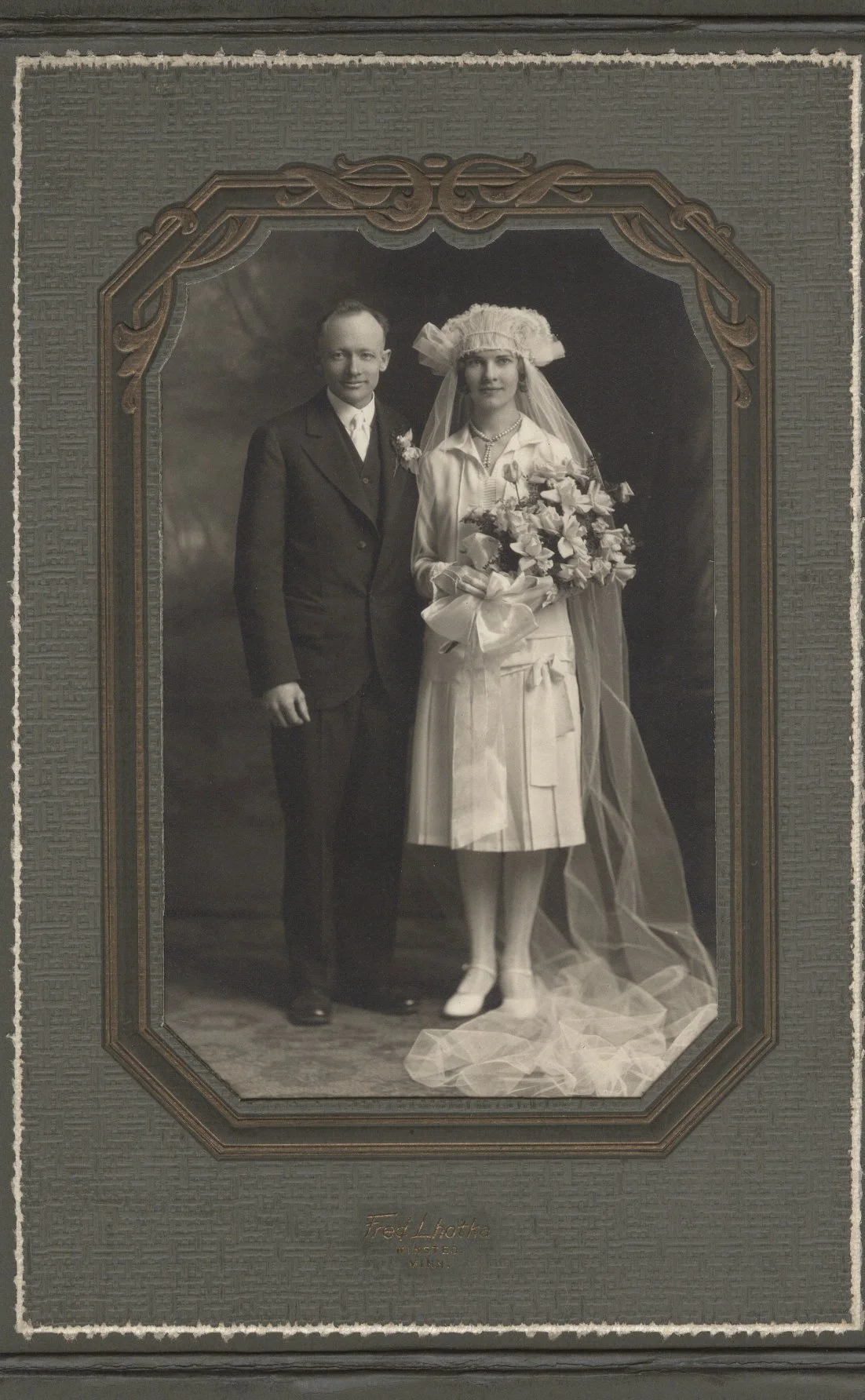
Wedding portrait of Leo Albrecht and Angela (Quast) Albrecht, 1928. SCHS Collection.

We traveled a town a day, with much rain and many disappointments, but of course we had our good days. Admission was 10 and 25 cents; gas was three to five gallons for $1.00. To keep everything going smoothly was a tremendous amount of work with long hours. Minnesota seasons were short, so we spent some winters in the south in Oklahoma, Arkansas, and Louisiana.

The Depression was far worse there than in the north. Many kids at age 15 had never had no shoes and had never tasted candy. We often bartered for bread, meat, chickens, or anything they could spare and we could use.  In Hot Springs, Arkansas, the bread and soup lines were of great length. When our second son was a year old, his diapers and clothes were stolen off the lines.

This was our pattern for many years.

When gas rationing went in after 1941, we had to cut down on trucks. By now, I had three sons. We joined out acts with circuses and carnivals. As the children grew, so did we in experience and knowledge, and kept adding to our entertainment. Gradually, the two older boys joined the Navy, so Leo and I, with our youngest son, had a large 100-passenger bus converted into living quarters and a place to carry our dogs and ponies, and we traveled with the larger circuses.

Promotional poster for the Albright Circus, 1955. SCHS Collection.

When the two sons returned from the Navy, we built a large portable 32 x 40-foot stage to play at fairs and celebrations. Many dignitaries, such as Governor Orville Freeman, Cedric Adams, Archer Nelson, Hubert Humphrey, the mayors of the towns, queen contestants, drawings, etc. were on this stage. The boys both married girls in the profession; they did aerial, contortion, rolling globe acrobatics, and singing. They boys worked animal acts, tumbling, chin balancing, rope spinning, announcing, and sometimes clowning. We had a complete unit of high class acts. We played fairs, celebrations, trade shows, schools, Christmas shows, shopping centers, and parades. We were a close knit family.

However, television and air conditioning took over and people enjoyed staying indoors. Fairs discontinued free acts and our sons were starting their families, so in 1967 we bid farewell to thirty-five years of trouping through 33 states.

Photograph of one of the wagons used for the Albright Circus. SCHS Collection.

Mail-Order Homes in Scott County

By Charles Pederson

Online ordering, especially during the Covid-19 pandemic, has become a feature of U.S. life. Click a computer mouse or poke your phone with a finger, and voilà: a box arrives at your door. But even long before the Internet Age, in the first half of the 1900s, home delivery was available, though you had to use a paper catalog rather than a computer.

The best-known mail-order company was Sears, Roebuck and Co. Famous for its eagerly awaited annual catalog, Sears offered seemingly everything a household might need: toys, farm equipment, clothing, medicines, and more. The most dramatic order from the catalog, however, might have been a mail-order kit for an entire ready-cut house.

The Sears catalog spurred consumers’ Christmas wishes for a wide variety of goods. Sears Roebuck & Co. Consumers Guide, Fall 1900, Scott County Historical Society.

Notes on Mail-Order Homes

Sears Modern Homes—the branch of Sears that offered ready-cut homes—was perhaps the largest, but not the only, source for mail-order homes. Wardway Homes (Montgomery Ward), Aladdin, Harris Brothers, and others supplied kits for homeowners. These homes were found all over the United States and parts of Canada. Minnesota, and Scott County, too have their share.

In a 1919 congressional hearing, the manager of the Sears Lumber Department defined a kit house as “a permanent house and the method of its construction is not different from any other frame house where the lumber is framed (or cut to its proper length, notched, etc.), by hand by carpenters.” Rebecca Hunter, a respected researcher of mail-order homes, said, “The buyer received all the materials from one source: lumber, roofing, doors and windows, flooring, trim boards, hardware, nails, and enough paint and varnish to put 2 coats on everything. Electric, plumbing and heating fixtures were NOT provided as part of the house, but were available at extra cost. . . . Most buyers ordered from the closest supplier, as the buyer paid the freight charges.”

Mail-order homes were produced between 1906 and 1946. Between 1908 and 1942, Sears alone sold about 70,000 mail-order homes. Sears, however, was not the first manufacturer, waiting until 1915 to begin offering its own line of mail-order houses.

These days, finding, cataloging, and restoring such mail-order kit homes is popular. Entire books, websites, clubs, and Facebook pages are dedicated to this fascinating piece of little-known U.S. history.

The Appeal of Mail-Order Homes

Mail-order homes tempted homeowners for a variety of reasons. The “already-cut” part of mail-order homes was a major appeal for people who wanted a home of their own. A house kit could have as many as 30,000 separate pieces, each numbered and bundled with like pieces, accompanied by a handbook with instructions. Typically, the pieces could fill a couple of train cars, a significant part of a barge or a ship’s cargo hold, or a large truck trailer. The homeowner who ordered was responsible for the load reaching the construction site. The pieces were delivered from the manufacturer, often to a train depot or warehouse near the site. A home-building professional could be hired to assemble a home, or if the homeowners were handy, they could construct it themselves.

Mail-order homes came with an instruction book to guide builders through structure assembly, from beginning to end. Courtesy of Internet Archive.

Innovation and mass production of building materials allowed for a significant reduction in construction time. The Sears Archive noted that “precut and fitted materials [shrank] construction time up to 40%,” as did use of interior drywall and exterior asphalt shingles. Drywall—also called plasterboard or wallboard—was a new building material that widely replaced plaster-and-lath starting in the early 1900s. Asphalt shingles, introduced also in the early 1900s, replaced slate tiles or other roofing materials, with constant improvements throughout the 20th century.

By far the most relevant factor for ordering a kit home was price, although even here, prices varied, from several hundred to many thousands of dollars. The 1912 Sears catalog said of Sears model No. 167 (the Maytown), priced at $753: “By allowing a fair price for labor, cement, brick, and plaster, which we do not furnish, this house can be built for about $1,573.00, including all material and labor.” Researcher Hunter added, “Manufacturers claimed the pre-cut system would save the builder up to 30% compared to the cost of standard building methods.”

Properly sorted and stacked, the precut building elements of a mail-order home could be more easily erected on an existing foundation. Courtesy of Internet Archive.

Mail-Order Homes in Scott County

According to information from the Kit Homes Facebook group and the Lydia Area Historical Society, at least four mail-order homes have been located in Scott County. Two are confirmed Sears Modern Homes: one in Jordan, along the west edge of the county, and one in the northeastern Scott County, in the city of Prior Lake. The Jordan home is a Sears Glendale model. The Prior Lake home is a Maytown. At last count, the Kit Homes Facebook group had confirmed at least 22 Sears homes throughout Minnesota.

The Maytown (Modern Home No. 167), in Prior Lake, and the Glendale, located in Jordan, are confirmed Sears mail-order homes in Scott County. Courtesy of Sears Archives and of Antique Home Style.

Pam Killian of the Lydia Area Historical Society reported the local legend of two other mail-order homes in Scott County. The homes, built in the mid-1920s, are located smack-dab in the middle of the county, near the junction of Marshall Road, County Road 282, and Minnesota Highway 13. A May 1926 edition of the Shakopee Argus reported that “Ed Hafferman and Walter Killian are busy preparing the basements for their fine, new seven room bungalows, they are going to have erected in the near future.”

The story goes that the two homes, about a half mile apart, were similar designs from the same mail-order home manufacturer. Because the homes were so close in space and design, parts of each house were delivered to the wrong construction site, and some real sleuthing was required to untangle the mix-up. Apparently, the homeowners forgot the cardinal rule, found in a mail-order home handbook: “In unloading the [train] car, do not mix the lumber all up, but keep each different kind of material by itself as much as you possibly can. This will save you the labor of re-sorting this material later on.”

Scott County may be home to as-yet undiscovered mail-order homes from other manufacturers, though that hasn’t been established.

Wondering Whether You Live in a Mail-Order Home?

Many people question their own home’s origins. Consider the following as you try to determine whether your dwelling is a mail-order home:

●        Many mail-order home companies used distinctive identification markings on pieces. For example, Sears stamped alphanumeric codes on the lumber—one letter and three numerals. It may be possible to view these markings on ceiling joists in an unfinished basement, for example, or on exposed rafters in the attic.

●        Exterior or interior details may provide clues about whether a house is a mail-order home and, if so, which manufacturer. This, however, can be a less reliable way to identify houses, given that most remaining mail-order homes have been altered and that mail-order home manufacturers “borrowed” (or more accurately “stole”) plans from other builders for their own use.

●        Another clue may be found in the county recorder’s office. Old mortgage records name the financing entity. If the records show that a home was financed by Sears, Roebuck, for example, you can be fairly certain it is a mail-order Sears Modern Home, especially if combined with other clues. Other financing companies may provide clues to the manufacturer of a house in question.

If you are aware of any mail-order homes in Scott County—Sears, Wardway, Harris Brothers, or other manufacturers—we’d love to hear your story! Contact us at info@scottcountyhistory.org or message our Facebook page, https://www.facebook.com/SCHSHistory.


Learn More!

Thank you to Lara Solonicke of the Kit Homes Facebook group for her immeasurable help in producing this article. Thank you to Pam Killian of the Lydia Area Historical Society.

1926 Wardway Homes: Kit Houses. (n.d.). Daily Bungalow. https://www.flickr.com/photos/daily-bungalow/albums/72157613056938344/

Abid, Ayesha. (2018, October 20). Sears Is Fading, but Memories of Its Mail-Order Homes Endure. MPR. https://www.npr.org/2018/10/20/657770791/sears-is-fading-but-memories-of-its-mail-order-homes-endure

Guide to Kit Houses & Homes. (n.d.). InspectAPedia. https://inspectapedia.com/Design/Kit_Houses.php

How to Identify a Sears Kit Home. (2021, June 15). WikiHow. https://www.wikihow.com/Identify-a-Sears-Kit-Home Hunter, Rebecca L. (n.d.). Historical Architectural Research. http://www.kithouse.org/ Kit Home History. (2007, November 14). StarTribune. https://www.startribune.com/kit-home-history/11308806/

Montgomery Ward Co. (1930). How to Erect Your Wardway Ready-Cut Home. Internet Archive. https://archive.org/details/MontgomeryWardCoHowtoerectyourwardwayreadycuthome0001/ Montgomery Ward—Wardway Homes. (2015). Antique Home Style. https://www.antiquehomestyle.com/plans/montgomery-ward/index.htm

Thornton, Rosemary. (n.d.). How to Find Sears Modern Homes. https://www.oldhouseweb.com/architecture-and-design/how-to-find-sears-modern-homes.shtml

What Is a Sears Home? (2012, March 21). Sears Archives. http://www.searsarchives.com/homes/index.htm

If you are interested in writing for the SCHS blog, email info@scottcounthistory.org or call 952-445-0378.

As I Remember: Christmas

This blog post contains excerpts from “As I Remember,” a compilation of oral histories from Scott County’s senior citizens in 1980. The following are the memories of Agnes Morlock of Jordan, Edna Weckman of New Market, Josephine Skluzacek of New Prague, Elizabeth Schultz of Shakopee, Margaret Haas of Shakopee, Ann Chalupsky of New Prague, Carol Rybak of New Prague, and Anne Juni of New Prague. We have also included some photos of Christmas celebrations of the past!


Agnes Eilers Morlock, Jordan

Winter approaching, Christmas thoughts were in the air. Christmas was always a special event. Mother, with all her handiwork, provided many surprises. Dad, being a carpenter at hand, did his part with the toys. Everything was homemade. Our Christmas Tree was the most beautiful. It was usually a large tree with white real candles. These were burned only once, while we sang Christmas carols. The ornaments were animal cookies. It took nine days to mature the dough and then it was rolled and cut out and frosted in white on both sides. These cookies and candles were intermingled with garlands of strung white popcorn. What a sight! Christmas Eve was special too, when Dad, with his band, furnished the Christmas carols in church while we children sang at the top of our voices, unheard as the band music shook the rafters, but so, so, festive. Next morning there were gifts, some hanging from the ceiling, some hidden. Christmas excitement is universal to this day. 


Edna Weckman, New Market

The one thing I’ll never forget is going to midnight mass on Christmas Eve with the horses and sleigh. We bundled up to keep warm. The stars shining brightly, the church lighted up and the Christmas songs made one feel peaceful and happy. 

Ray and Loretta (Mamer) Robel of Prior Lake in their living room at Christmas, 1950. SCHS.


Josephine Skluzacek, New Prague

Have you ever heard of the mythical “Golden Pig” that was prevalent in Czech homes during the time I was growing up in the 1920s? I was born into the Czech family of Frank W and Agnes (Bouda) Skluzacek of New Prague, Minnesota. The family had three girls, Christina, Mary, and Josephine (myself) and six boys: the twins, Frank and Andrew; Wenceslaus; Joseph; George; and baby Edward, who died minutes after birth.

One year when my oldest sister, Christina, was about ten, she decided one Christmas Eve morning that she would see the Golden Pig. To see it, we were told we had to fast all day from food and drink until the Christmas Eve supper. She started out all right, left the breakfast table without partaking in food or drink. Mother felt so sorry for her because she knew the Golden Pig was nonexistent. No one ever got to see it. During the course of the morning, Mother started the dough and put the prunes for kolacky to cook. When they were cooked, Mother asked Christina to pit them. She was willing to do it and Mother watched her. Pretty soon, Mother saw Christina licking her fingers. Mother said to her, “You liked your fingers, and now you might as well take something to eat because you won’t see the Golden Pig.” Christina was so disappointed and never again made an attempt to see the Golden Pig. None of the rest of us ever tried it but we kept the secret of the old wives’ tale for the younger members of the family.

Christmas Eve supper was always a memorable event for all of us. It meant a lot of work for my mother, who put in days of preparing and used all the love she could muster to make it really worthwhile for all concerned.

Soup was first on the menu, from the Czech translation it meant, “a no good soup.” It was made from water, salt, saffron, and homemade noodles, and for our hungry stomachs, it hit the spot. Then came dried peas soaked overnight and cooked for hours on the back of the old cook stove. Buttered homemade noodles were followed by fried pike. There weren’t very many words exchanged, everyone was busy picking bones out of the fish. 

Kolacky, rolls, and calta (Christmas bread) were on the table. Now came the goodies, “sisky.” They were made like potato dumplings from mashed potatoes, but the flower was slightly browned and then the sisky were made about 4 inches long and 1 ½ inches around. These were placed in a well greased pan and put in the oven to brown. Every few minutes they were turned so that they would be browned all around. These were served with a lot of syrup and no matter how many Mother made, all were always eaten. Then we had apple strudel and the Christmas fruit soup, two kinds of the latter. My father liked his with cooked fish and the rest of us only liked the fruit soup.

Last came the nuts. Each of us cracked a walnut and depending on how the nut was inside indicated if we would be well during the coming year or not.

Our Christmas Eve supper table was laden with food all made from scratch and to this day we can always look back and say, “Everything was always the best.”

Elizabeth Schultz, Shakopee

When I was a little girl, they tell me all I asked for constantly was a big reed doll buggy (out of the Sears Wishing Book). My folks didn’t have much money so it was almost out of the question. But one Christmas morning it was there, a big navy blue reed doll buggy trimmed with cream colored wheels and handle, with a big jointed doll! I don’t know what happened to the doll, but I still have the buggy. It seemed Aunt Rose worked somewhere or knew someone so as to get a discount to make it possible for me to have the buggy. One year we did it all over to give to Mary, our oldest daughter, for Christmas, so it’s hers.

A decorated Christmas tree with a winter village in an unknown living room, 1963. SCHS

Margaret Haas, Shakopee

Christmas was an enjoyable time. We would go out in the woods and cut down our tree, place it in the dining room so the kitchen lamp that had a reflector would make the tinsel and trim sparkle and shine. We prepared lots of food and had lots of relatives come.


Ann Chalupsky, New Prague

Our godmother invited us for Christmas Eve to their house. They lived just across the woods. Dad hitched the two horses and bobsled. Our neighbor went with us. It was their married son. There were eleven of us in the sled. It was a dark, cold, winter night, lots of snow. The lantern was in front of the sled. All of a sudden dad drove over a stump, the sled tipped over, we were all in the snow. The folks took some peanuts, candy, and nuts along for the party, that was all over the snow. Dad set up the sled, brushed the snow off the blankets and clothes and we went on. We had a very nice party. The next day the neighbor went for the peanuts, candy, and nuts; he did find them in the snow.

A child, only identified as “Clark’s daughter,” posing for a photo next to an inflatable Christmas display featuring Santa Claus and a reindeer, 1963. SCHS.

Carol Rybak, New Prague

We celebrated Christmas with gusto. There was always a big Christmas tree in the parlor. The tree had long strings of candy which wound around like garlands, candies wrapped in foil, beautiful ornaments, and dozens of candles. My mother and father decorated the tree after we were sent to bed, and they would wake us when it was finished. They set a pail of water on each side of the tree in case of fire. After we had admired the tree in its glory, the candles were extinguished and then we enjoyed our gifts. There wasn’t much sleep that night because at that time instead of midnight mass, we had mass at 5:30 a.m. We usually walked to town to mass and so did many of the neighbors. It was wonderful trudging through the snow on a glorious Christmas night with everyone happy and shouting greetings.

Anne Juni, New Prague

The Christmas season meant Rorate, Baborky, Mikolas, and special food. Rorate was early mass during advent, starting at 6:30 a.m. Mass was in the chapel in the church basement. Czech songs were sung during the service. It was the challenge that urged us to attend and then some mornings we were allowed to stop at Dobihal’s Bakery for freshly baked crescent rolls. These rolls were delicious! That building was torn down last year. Nobody could compete with Dobihal’s rye bread or rolls.

Mikolas (St. Nickolas) came on the eve of December 6. We never saw him in our house but in the morning we each had a plate of goodies. Of course, only good children were thus rewarded. We carried on that tradition with my children.

Baborky came on December 8. Young women masked and dressed in white representing Saint Barbara went around the neighborhood asking the children to be good and pray. Those children who prayed were rewarded with treats and the parents in turn gave the good saints a monetary reward. I myself was a Baborka many times. Guess we looked like the ghosts that we see at Halloween time.

All the town musicians turned out for midnight mass. The same music was played then as now but maybe with more gusto. All the Komarek men played, father and three sons. Paul is the only one left. It was truly an ecumenical service. The late Professor Kovarik was the choir director in my time and he had the respect and cooperation of all the local musicians.

The day before Christmas, my grandmother would make the most beautiful and delicious vanocka. It was a braided sweet dough bread with several tiered layers. Sometimes raisins and candied fruit were added. She also made the vomacka for our Christmas Eve supper. That was the Christmas soup made of a variety of sweetened, cookies, and dried fruit with cinnamon and ginger snaps added for flavor.

The Christmas tree was in the parlor, sometimes called the front room. It was rarely used and heated only when company was expected. After Christmas Eve supper, the door was opened, the candles on the tree were lit, and treats and gifts were handed out. December 26 was St. Stephen’s Day and called second Christmas. That was the day for visiting.

The Coller family Christmas tree in their home in Shakopee, 1916.