This is My Life: Beatrice Zweber Remembers Getting Married in 1919

This blog series is adapted from a memoir by Beatrice Zweber Mahowald of New Market. Her grandson, Pat Mahowald, compiled her autobiography with photographs and family research. Beatrice took over the household management on her family’s farm at age 15, after the death of her mother and the marriages of her older sisters. It has been slightly edited from the original for clarity. Part I can be read here ,Part II is here, and Part III is here.

My husband’s father [Nicholas Mahowald] died December 1911. He was the first person to be buried from our new church at New Market on December 22, 1911, so in 1912 the Mahowald family moved to New Market. My husband was seventeen years old then. George used to work with his father when he wasn’t in school. His father did cement work, so George went on with his father’s trade.

George supported his widowed mother, sisters, and brothers till two weeks before we were married. His mother said he could keep the last two weeks wages before the wedding, and I’m sure that wasn’t a big check. There were nine living children in the Mahowald family. George was the second oldest.

A few weeks before the wedding, I went to Holm and Olson’s in St. Paul and ordered all my flowers. My bride’s bouquet, the bridesmaid bouquets, the men’s flowers, the lily for the ringbearer, and the basket of flowers for the flower girl. I paid for them and told them to mail them on the noon train to Elko, Minn. on June 16th, the day before my wedding. My brother went to meet the train, but there weren’t any flowers left off. We thought they would come on the evening train, so my brother Alex went back to the depot. That train arrived at 7:30 PM and there were still no flowers. He came back and he was really afraid to tell me, so we telephoned to Holm and Olson’s. I don’t know how we even go ahold of them at night, but they said they had mailed out the flowers on the noon train on June 16th. They said if someone would come to St. Paul and get the flowers they would make up a new order and have them ready at midnight. I would have to sign a paper saying that I didn’t get the flowers. because they were going to trace them.

I went to bed but I didn’t sleep. I cried all night. The next morning when I came downstairs my cousin was already working in the dining room, and she said look at the beautiful carnations they sent along extra because they knew you felt bad. Holm and Olson wrote me a letter after the wedding and they said the flowers went to Ecko, Minn. instead of Elko, Minn. I never did find out if the flower shop put on the wrong address or if the railroad made the mistake.
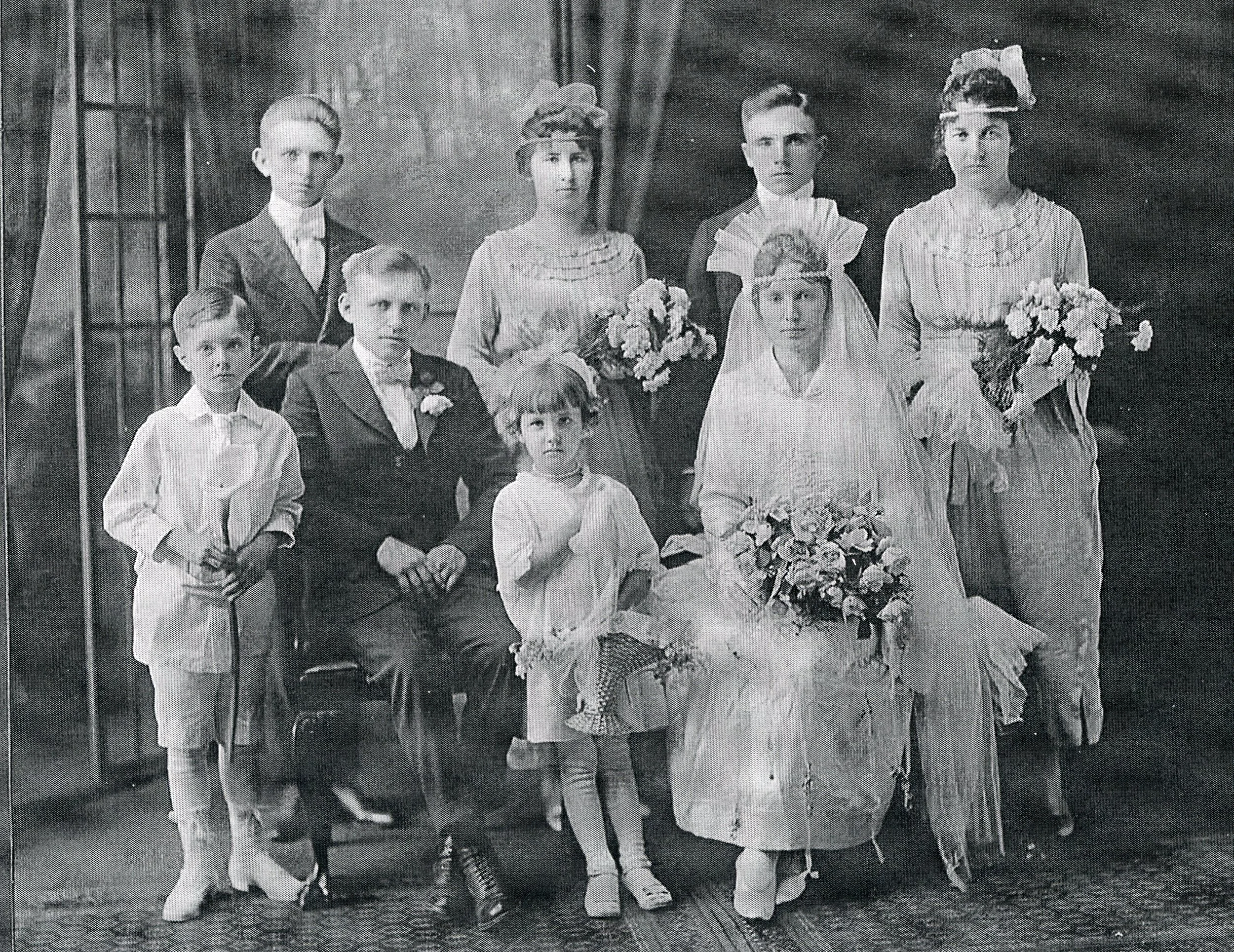
Beatrice and George’s wedding party. Image courtesy of Pat Mahowald.

On June 17, 1919 I was married in New Market Catholic Church by Father Siebert. My cousin Margaret Zweber was bridesmaid, my cousin Sue Zweber was maid of honor, my brother Alex and Anton Mahowald were best men. My niece Helen Hauer was flower girl and my nephew Wilfred Zweber was ring bearer. I was twenty-one years old and my husband was twenty-four when we married.

It was on a Tuesday, a nice sunny day. In the afternoon there was a storm all around us, but it didn’t rain at New Market. We had a very small wedding, we only invited my husband’s mother, his brothers and sisters, my brothers and sisters and their families for dinner and supper at the house. There waere also three uncles and five aunts. My friends waited on table.

In the evening we had a very large crowd at the free wedding dance. The Metropolitan Band from Minneapolis played for our dance from nine o’clock in the evening till four o’clock in the morning. This band cost us sixty dollars. The dance was in the New Market town hall. Most of the crowd stayed till the band went home. So, it was almost morning when we got home. I got about an hour and a half of sleep before I had to get up and make breakfast and get the house cleaned up after the wedding. There was a lot to clean.

We didn’t go on a honeymoon. People didn’t go on a honeymoon those days. We didn’t even have time to have our wedding picture taken until the second day. We had our picture taken at St. Paul. We drove with two cars because there were quite a few of us.

The third day after my wedding I washed clothes all day. The boys took my pictures while I was hanging up the wash. I had sheets, tablecloths, and lines and lines of clothes and such large pieces. I have pictures of my wash in my album.

A short time before my wedding, Dad said, “Why don’t you stay here and work for us? We have to get someone and you might as well stay.” He offered me a dollar a day. I stayed and worked just like I always did, canning, cooking for threshers and silo fillers, for company, and everything that came along. George did cement work in summer but in winter 1919 he sawed wood with a man, they would saw fire wood for farmers. I’m sure he didn’t earn much money for that.

Beatrice and Aelred. Image courtesy of Pat Mahowald.

I worked at home for eleven months till May 1920. Then we moved to Lakeville because we were building a house there. It was to be ready the later part of August, and I was expecting my first child. He was born September 2, 1920. The doctor said he weighed ten pounds, but he guessed that because the doctor didn’t carry a scale. We named him Aelred Alexander.

This is My Life: Beatrice Zweber Remembers Her Brother's Life with Tuberculosis

This blog series is adapted from a memoir by Beatrice Zweber Mahowald of New Market. Her grandson, Pat Mahowald, compiled her autobiography with photographs and family research. Beatrice took over the household management on her family’s farm at age 15, after the death of her mother and the marriages of her older sisters. It has been slightly edited from the original for clarity. Part I can be read here and Part II is here.

My brother Herman went to school all his life. He would spend the summer working on the farm but in fall he would go back to school. When he graduated from St. Thomas College at St. Paul he won a gold medal for being the best chemist in his class.

After college my brother went to Chicago where he entered the university medical school. He was learning to be a doctor. He went to Chicago with Dr. Casey (a local physician) and his family. He stayed at the same apartment house where they stayed.

My brother didn’t feel good that fall, but my dad did take him to our doctor and he was alright when he left. In spring, we had a letter from Dr. Casey and he said Herman was sick and went to a doctor. That doctor said he had tuberculosis and would have to leave school. It was a great shock to all of us.

Zweber family in 1913. Beatrice sits in the carriage. Herman sits in the grass on the far right. Scott County Historical Society

He was a very sick boy when he came home and had a lot of very sick spells during the years he lived. He was very good about it. He knew there wasn’t any cure for him. He was in the doctor’s care all the time. Dr. Kennedy was a good friend of my brother Herman. Well, it was a good thing that he was learning to be a doctor so he knew how to take care of himself and also to take care of us that had to live with and around him. He slept alone and used his own dishes and silver, his own towels and dishtowels, but it was still dangerous for us kids and Herman thought maybe if he would go west it would be better for his health. He went to Mount Angel, Oregon again. He didn’t stay there too long, but was gone long enough that my dad could buy insurance policies for me and my brothers at home. Then Herman came home and he wanted to live alone so he moved in the grainery upstairs (which was once a house) so that he had a big room. He would come in our house for his meals but he always ate alone. He would spread newspapers over the kitchen table, then he would spread out his own dishes and silver. I always kept his food in the kitchen. We ate in the dining room. After he ate his meals he would put his dishes and silver in his dishpan and he would boil his dishes. He would gather the newspaper with the crumbs he ate and he would burn that in the stove. There was always fire in the wood stove.

Then he left again. He went to New Leipzig, North Dakota and worked in the bank for a while with our brother J.P. After that he went to St. Paul and worked for an undertaker for a while. I think he slept in the undertaker parlor - don’t know for sure.

He came home again and Dad built him a house close to our house. He used to wash his own clothes but I ironed them. None of us ever caught the disease from him. He died very suddenly of a hemorrhage on December 5, 1920. He was 29 years old. He was waked in our parlor and buried in the Catholic Cemetery on December 7th at New Market.

This is My Life: Beatrice Zweber Remembers Threshing Crews

This blog series is adapted from a memoir by Beatrice Zweber Mahowald of New Market. Her grandson, Pat Mahowald, compiled her autobiography with photographs and family research. Beatrice took over the household management on her family’s farm at age 15, after the death of her mother and the marriages of her older sisters. Part I can be read here.

What was the worst was when the threshers would come. They were always there for two days, for breakfast, afternoon lunch, and late supper. In those days there weren’t any ice boxes or refrigerators in the county and it was a lot harder to get the food ready. My sisters always came home to help with the cooking for the threshers, otherwise I wouldn’t get the dishes washed. And there were so many to wash.

I would bake fresh pie for dinner, cake for supper, and fresh coffeecake and buns for lunch. The bread I’d bake before the threshers came. We all worked hard all day. We cooked too good, that’s why the threshers ate so much.

This certain year I knew I would have the threshers for breakfast. They were going to move the machine over early in the morning, so that night before I went to bed, I set the table and I had the potatoes all peeled and cut up so I could put them in the frying pan as soon as I would get downstairs. My sisters didn’t help me with the breakfast. I was alone for that, and here my dad called me about 10 pm and said the threshers are here and they didn’t have any supper. They moved over to our place after dark because they didn’t want to eat another meal at the place they were. They said the food was so terribly bad there, so I got up and fried the potatoes, went in the basement, got up some fried down pork (which I also had planned for our breakfast) and I made them a good supper. Today I would say, “I’m in bed. Let them go home or go hungry.”

I had all those dishes to wash and dry as the whole thresher crew came along. I must have fed a dozen men. It was late when I got to bed, and the next morning I had to be up early. I was really mad at those threshers but it was Dad’s fault. He should have told them I was asleep. Just think of how nice the farmers’ wives have it nowadays. They have combines now, so they only need to feed their own family.

Some of the threshers used to sleep at the farmer’s house and they were so dirty when they slept in the beds two nights the sheets were black dirty, and they would dump the straw from the their clothes on the floor. I was always so glad when we were done with the threshing.

Lead image: Threshing at Augustus Keup Farm, 1896

This Is My Life: Beatrice Zweber Remembers Appendicitis in 1914

This blog series is adapted from a memoir by Beatrice Zweber Mahowald of New Market. Her grandson, Pat Mahowald, compiled her autobiography with photographs and family research. Beatrice took over the household management on her family’s farm at age 15, after the death of her mother and the marriages of her older sisters. The incident she describes below took place in 1914, when she was 16 years old and a primary caretaker for her family. It has been slightly edited from the original for clarity.

After dinner, I wanted to go to bed but I found out I couldn’t lay down. So I sat on the edge of the bed with my elbows on my knees and my face in my hands. I was so tired but I just couldn’t lay down. I had such pain so at four o’clock in the morning I went in my brother Henry’s room and I told him that I sat up all night and that I was very sick. He said he would get up and feed the horse so dad could take me to the doctor.

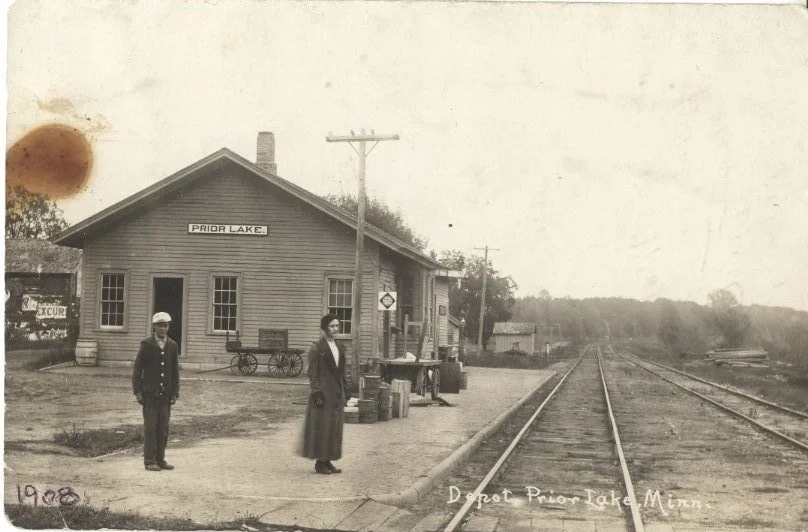
The horse had to eat first because this was a far trip to Prior Lake, which is about eleven miles from our home [in New Market]. A horse can only walk about three miles in a half hour. It must have been 8:30 when we got there, because the doctor was at his office. When the doctor examined me, he said I had appendicitis. My dad got very excited and he was going to put me on the train at Prior Lake that stops at Shakopee, and then from there he was going to transfer to St. Paul on a train. But Dr. Kennedy said, “Oh no, Mr. Zweber, this child is too sick to operate on now.”

Prior Lake’s train depot in 1908. Scott County Historical Society.

He gave me some medicine in the office and said Dad should take me home, and I should go to the hospital on Monday. So Dad and I started the long trip home.

On Tuesday August 24, 1914 I had my operation. My dad went along into the operating room. When I laid on the table they told me to inhale the ether, but I didn’t do it. [Ether was a liquid anesthesia used in the 19th and early 20th centuries. Physicians dropped ether onto fabric held over a patient’s face by a mask.] I could see my dad sitting there and I felt so bad for him because he really looked sad. I thought of my three younger brothers and I thought now if I die who would take care of them. I wanted to cry but I really couldn’t do that because they said inhale. I just couldn’t inhale that stinky stuff. Anyway they must have poured it on because I went to sleep.

When I woke up I was in my room at St. Joseph’s hospital. Two doctors and some nurses were with me, and I was really sick. In those days an appendicitis operation was serious and dangerous because they didn’t have the medicine to fight infection like they have now. They would keep you in the hospital two weeks. I didn’t like it at St. Joseph’s because they didn’t feed me enough. I remember the first breakfast at home. My cousin brought me a great big plate of hot beef stew and gravy and several pieces of toast made from homemade bread. I ate it all.

Lead Image: Photograph of Beatrice Zweber in 1913. Scott County Historical Society.

History of the Shakopee Central School, Part 3

This blog series is adapted from a paper written in 2003 by Chris Kiecker on the history of the Central School Building in Shakopee. Over the years, the building has had many names, including Union School, Shakopee High School, Central Elementary, and the Central Family Center. To read the full paper in its original format, please visit our research library. Part 1 explores the early history of the school, Part 2 details new mid-century expansions, and Part 3 discusses the many modern changes.

Post 1960 Addition

 Although the 1960 addition was the last major structural change to the high school, the building would experience many changes in the upcoming years. Eventually, voters did approve the construction of the new high school, and the original school produced its last graduating class in 1965. In fall of 1965, the school would become the junior high with the completion of the new high school. The old school would still serve an important role in the community as the only public school with an auditorium, and many of the high school’s programs were still held in the 1929 auditorium.

New Shakopee High School (present-day Shakopee West Middle School), 1966. Scott County Historical Society.

Even with construction of Sweeney Elementary School in the late 1960s, the school board determined that the 1968 district enrollment of 1,776 students was expected to increase to 2,850 students by 1972, and additional space would be needed (33). With that future problem in mind, a bond election for $2.1 million was set for February 11, 1969. Of the $2.1 million, $160,000 would be used to remodel the old school, the other funds would be used to construct what is now Pearson Elementary and to provide a significant addition to the high school, including a second floor of classrooms, added industrial arts facilities, and a 600 seat auditorium (34).

Auditorium before its removal in 1969.

With the approval of the $2.1 million in funding, the school board began planning for the improvements to the old high school, now the junior high school. The improvements included the renovation of the auditorium space into an expanded gymnasium space, the remodeling of the science and home economics areas, and the replacement of the old lighting system with modern fixtures throughout the building (35). As soon as school was out in June of 1969, the remodeling was immediately underway, with the project to be completed before school was again in session that fall.

The energy crisis of the mid 1970s brought about some changes to the school in various ways. The most dramatic change was the boarding up of the large windows in the gymnasium to prevent excessive heat loss, a change to the aesthetics of the building that would last almost 30 years. With the energy improvements, electrical and mechanical systems also received updates to increase efficiency. At this time, the school district was again experiencing a shortage of space, which caused the junior high to be moved to the new high school building and the schedule to be changed to a split shift, in which the high school students would attend class in the morning and the junior high in the afternoon. During this time, the old high school building became Central Elementary School, and eventually, the crowded quarters were relieved with the opening of a new junior high school in 1976 [present-day Shakopee East Middle School].

The Central Elementary building has likely received smaller improvements throughout the 1980s and 1990s, such as the installation of an elevator in the mid 1990s, and various technological updates, but nothing structurally significant. During the summer of 2002 the building received a $1,000,000 facelift. Included in this project were the installation of insulation and stuccowork over the deteriorating glass block exterior walls of the 1950 and 1960 additions. Many windows were replaced in the structure, including all windows in the 1929 addition. Plywood and fiberglass insulation was removed from the gymnasium windows, and the old windows were replaced with high quality aluminum windows, exposing new generations to the aesthetic beauty of the 1929 addition. The classrooms located above the gymnasium were updated with new mechanical and electrical systems, as well as finishes such as false ceilings and carpet.

New windows in the 1929 addition, winter 2003.

New windows in the 1929 addition, winter 2003.

The school is currently [as of 2003] home to the school district offices and the community education programs. Early childhood programs are held in classrooms in the old elementary wing.

Addendum by Scott County Historical Society Staff

After many years of providing education, office space, and family resources in the Central School, or the Central Family Center, the building was demolished the week of September 4, 2023. SCHS has many photos, negatives, and relevant objects to the school in our collection, and most recently, have acquired three different kinds of bricks used in the construction and additions to the building.

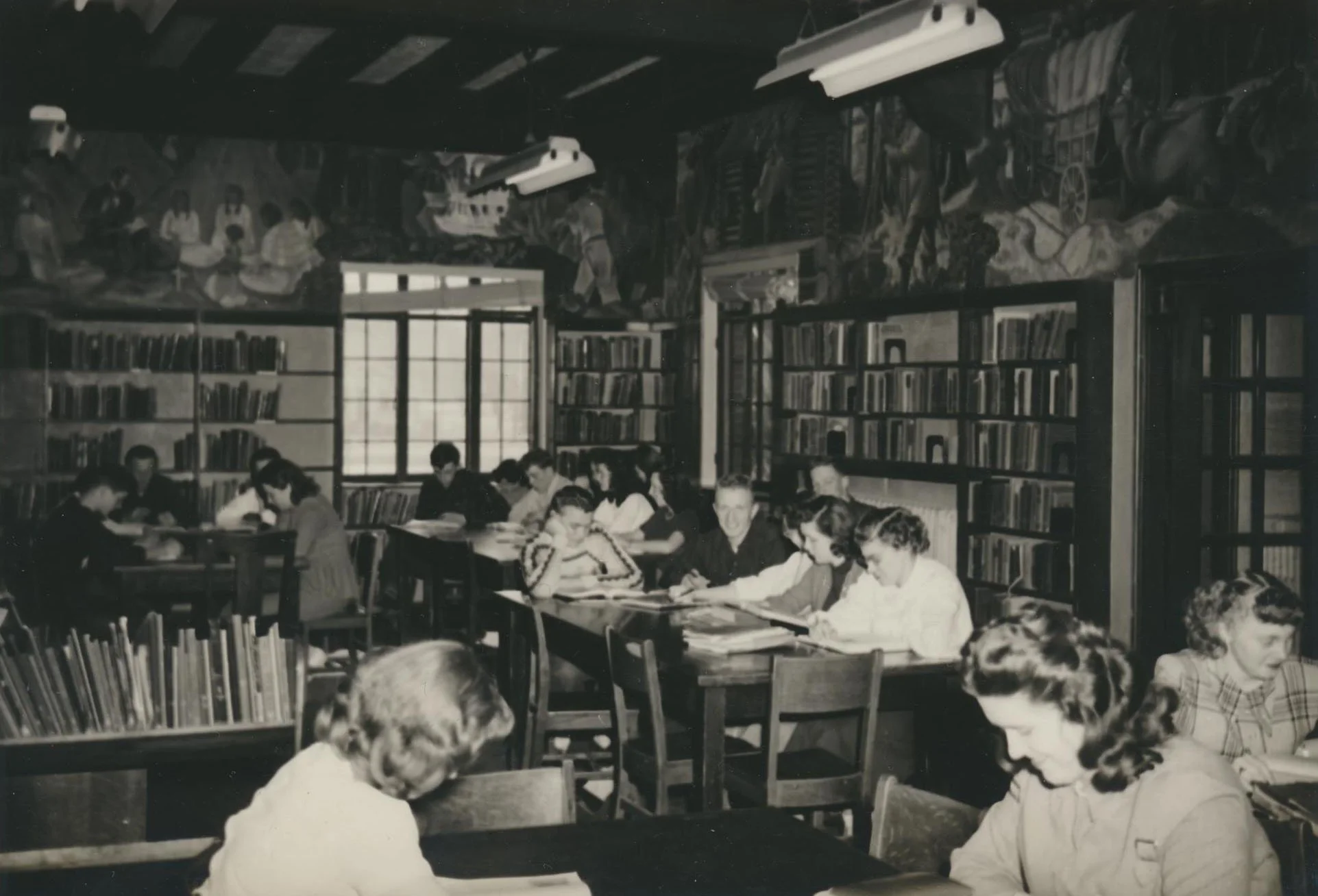
Another item of historical significance within the walls of the building was a 1938 Works Progress Administration mural, painted by Harmon Arndt, a graduate of the Minneapolis School of Art. The mural depicts the history of Shakopee beginning in the 1840s, and appeared on the walls of the library (and later band room). The mural was saved prior to demolition and sent to the Midwest Art Conservation Center for conservation treatment. It remains in possession of the Shakopee school district.

Shakopee High School Library with the WPA mural in the background, 1950s. Scott County Historical Society.

Shakopee High School Library with the WPA mural in the background, 1950s. Scott County Historical Society.

Part 3 References

33. Shakopee Valley News, January 30, 1969, page 1.

34. Shakopee Valley News, January 30, 1969, page 2.

35. Shakopee Valley News, February 27, 1969, page 1.


Acknowledgments, as they appear in the original document

Coller II, Julius A. The Shakopee Story. Shakopee, Minnesota: Lakewood Press. 1960.

Scott County Argus, 1894, 1897.

Shakopee High School Yearbooks, 1953-1967.

Shakopee Argus-Tribune, 1929, 1930, 1948, 1949.

Shakopee Valley News, 1949, 1958, 1959, 1969.

Thank you to Mr. Bob Greeley, Shakopee Community Education Director, for providing access to the structure and the school district’s old building plans.

Thank you to Mr. John Cole, former Junior High Principal, for sharing his knowledge of historical school district information.

Thank you to the Scott County Historical Society for their well organized research facilities and access to Shakopee Argus-Tribune and Shakopee Valley News archives.

Thank you to Mrs. Edie Cook, Shakopee High School English teacher and yearbook coordinator, for the use of past SHS Yearbooks.