The Land Before Cars

19990530162.jpg

Automobiles and roads are often taken for granted in modern life. The number of people who can remember a time without cars or an interstate highway system are sadly dwindling. This period in history is at the twilight between living memory and historical artifact. Despite the abundance of cars and roads today it was only a little over a century ago that people were riding in a wagon to town, and making their way across rough dirt and gravel roads. The first record of a car in Shakopee is from 1901, and automobiles in general did not start to become popular until the 1910s when they entered mass production.

20000470001.jpg

It was not uncommon for people to walk from one place to another, unless they were going between towns. Farmers had wagons they could use to get around and in the towns, carriages were more common. Consider snow falls in those times for a moment. Pictured is a crew shoveling snow off the road in Shakopee. Imagine how long it would take to clear roads, or even haul the snow out of the way. Today, snow plows have thousands of pounds behind them and a motor capable of providing far more power than a horse could muster.

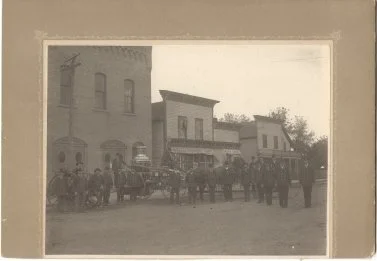
20090300021.jpg

The idea of modern conveniences and services are seldom thought of as they were in the past. For example, this photograph of a Fire Department from Belle Plaine shows a team of horses pulling a massive water tank. Today, a bright red truck would fly down the road and hook into a hydrant system. This is one of several major services that is seldom thought of a product of the modern road system and engines. Emergency services were more practical in town and cities than out in the country. Water tanks on wagons were used when away from the towns, but they were limited and did not have a very large volume to the tanks.

As cars became more plentiful, and roads went from gravel to paved, the world became more connected. It is difficult today to consider living our lives without hopping on some highway and zooming at 70 miles an hour. It has been a little more than a century since the lives of Scott County moved at one horse power.

Fire at the Camp!

Last week the Scott County History Blog profiled the National Youth Administration Camp that was located outside of Shakopee in the late 1930s and early 1940s. With hundreds of young people living in one place, the camp was bound to be a hotbed of stories and misadventures. One incident in particular was profiled in the Shakopee Argus-Tribune on February 27th, 1941. Two days before the camp had been hit by a massive fire. The Argus-Tribune reported the basics of the fire, but allowed the bulk of the story to be told through a letter that “Ted”, a camp enrollee wrote home to his parents:

“Dear Mom and Dad:

“I know you’ve read all about it so there probably isn’t much left for me to tell.

“I was in bed when the siren blew, for the fire was discovered after lights-out. Nevertheless, I managed to be one of the first ones there., We used our hand extinguishers until enough fellows came to form a bucket brigade, but we knew it was out of control. While the fellows kept fighting some of us tried to salvage our tools and equipment until the heat became unbearable. You cam imagine our relief when the Shakopee Fire Department arrived, but our hopes were short lived, for the tanks of welding gas began to explode and it was impossible to stay. Chaska and Jordan also arrived with their equipment and we were able to pump water from the river yet the most we could do was keep the flames from the hanger and other buildings nearby. While we worked, we saw our welding shop go; practically helpless we watched the flames roar through the machine shop; we stood b as the firemen battled them through auto mechanics, where the fire was finally brought under control leaving but one wall standing.

“If you could have seen it in the morning; where the machine shop had stood, only the scarred heavy metal lathes, grinders, shapers and milling machines remain.  Two twisted cars and a wall are all that is left of the auto shop. Except for a few torn takes which held the welding gas, nearly everything is ashes.

“Of course we all felt pretty bad but words of encouragement began to lea from Cap Whelan’s office. Later at a meeting we learned that new machines and equipment were to be shipped immediately. We were also happy to hear that we have been offered equipment and shops by the businessmen of Shakopee to be used until our courses are reestablished.

” Fortunately our new welding unit was still in the storeroom, so it will be installed in a new larger shop

” Since the aviation classes can be held in Minneapolis, the auto mechanics and body and fender courses will be setup in the large space which was the hanger. Sheet metal drafting and blue print reading will be taught here at the project, while the actual work experience will be gained, for the time being, in a shop at Shakopee

“The people of Shakopee have been really swell. It seems that nearly everyone has tried to help. Besides the businessmen’s generous offers, we are are grateful to Chief Ring and his volunteer fire department

“I know you’ve all been worried. You’ll be glad to hear there were no serious accidents, a  few boys were scratched and our caretaker, Pat Hardegan was struck below the knee by a piece of tank when it exploded.

“Well, we’re all happy that things have turned out so well, and that everything will soon go on as usual

“Don’t bother to write, for I have my leave to come home for the weekend

Your loving son, Ted”

From New Deal to Navy: The National Youth Administration Camp in Shakopee

During the Great Depression Scott County, like numerous counties across the nation, was faced with the problem of homelessness. One road to relief was the construction of five “transient camps”, profiled in last week’s Scott County History blog post. These camps were an effective, but short lived solution. The administrative center of these camps was located just outside of Shakopee. Originally constructed in 1934, the Shakopee camp was emptied by 1938.  It was determined that the facility would have new life as a NYA, or National Youth Administration camp.

National Youth Administration Recuitment poster, 1941. Work Projects Administration Poster Collection (Library of Congress).

National Youth Administration Recuitment poster, 1941. Work Projects Administration Poster Collection (Library of Congress).

The National Youth Administration was a New Deal program launched in 1935. Similar to work-study programs for college students today, the NYA paid a grant stipend for part-time work to young people between the ages of 18 and 25. Some of this work was in the educational sector, helping out with administrative and maintenance tasks at academic institutions. Other projects provided on-the-job training in fields such as forestry, agriculture and construction. The goal was to provide meaningful paid work to young people that would teach on-the-job skills, giving beneficiaries an eventual leg up in the job market. An added aim was keeping young people from flooding the already strained traditional labor market.

The National Youth Administration Camp outside of Shakopee was a unique affair. It combined the work-study goals of traditional NYA jobs with the housing  of the former transient center. The Shakopee Argus-Tribune announced the development of the camp on March 31st, 1938. It described the goals of the program thusly: “…a practical education center for deserving young men between the ages of 18 and 25… it is not like the CCC [Civilian Conservation Corps] in that it is non-military. Boys enter on a six-month tenure. They will work a half day and study a half day and draw a small wage. The program is not one primarily of employment but one in which willing youths may be aided educationally”. An official bulletin printed in the April 7th Argus-Tribune formally stated “The primary purpose of this project is not to directly prepare young men for employment but to make possible exploratory experiences in various fields which may lead to self-maintenance and which will better qualify young men for worthwhile home and community life”. The educational opportunities listed were agriculture, auto mechanics, carpentry, welding, forestry, and shoe repair.  Basically, the camp provided a vocational liberal-arts education.

Headline announcing the construction of Shakopee’s NYA Camp. From the Shakopee Argus-Tribune, April 7, 1938. SCHS Collections

Headline announcing the construction of Shakopee’s NYA Camp. From the Shakopee Argus-Tribune, April 7, 1938. SCHS Collections

The camp was limited in who it served. Only males could enroll in the program, and they must “be certified as in need by an approved public relief agency”. Each enrollee drew $30.00 per month, $20 of which provided for room and board, and $10 for the boys and their families. The youths were housed in rough-cut cabins and provided with food in a mess hall, recreational facilities and medical care.

As time passed, opportunities at the camp expanded.  On March 20, 1939 the Shakopee Argus-Tribune reported that the camp was producing a radio program entitled “Tangled Lives”. Each week the program presented a dramatized enactment of a problem performed by NYA enrollees. Problems ranged from “Should I apply to College” to “Physical Disability”. After the performance, a team of experts would assemble to share possible solutions with listeners.

On September 1st, 1939 Hitler invaded Poland and, at least in Europe, World War 2 begun. While the US did not officially join the conflict until 1941, rumblings of war could be felt In Shakopee’s NYA camp. On September 14th, 1939 the Shakopee Argus-Tribune announced a $200,000 allocation to train camp youth in airplane mechanics through a program under the supervision of Col. Victor Page. In August of 1940, the camp youth began construction of two seaplane bases that would, upon completion, be shipped where they were needed. The work at the camp was focusing more and more on national defense.

Administrative building of the Shakopee NYA camp. The building was originally Murphy’s Inn, and was located on the site of what is now The Landing. SCHS Collections, 1938

Administrative building of the Shakopee NYA camp. The building was originally Murphy’s Inn, and was located on the site of what is now The Landing. SCHS Collections, 1938

On July 1st, 1941, nearly 5 months before US entry into WW2, the enrollment at the Shakopee NYA camp was suddenly bumped to the staggering number of 544. The order to increase enrollees came from the Office of Production Management in Washington, and specified that the new recruits be trained in defense production. Along with quarters for the new boys, a machine shop and facilities for training in radio operation and communication were added.

By 1942 the United States was firmly entrenched in war. On February 12th, 1942 the Shakopee Argus-Tribune announced that authority over the NYA camp would be formally transferred to the US Navy, who planned to use the facility to train recruits as Navy machinists.

After the end of World War 2 ownership of the camp lands was transferred to the Shakopee Public Schools. The rustic cabins that housed NYA and Navy recruits became rental properties, housing Scott County families until the early 1960s. Interested in visiting the old NYA camp? The ruins of Murphy’s Inn- first the Administration building of the transient camp, then the center of the NYA camp- are currently part of The Landing, a historic site in the Three Rivers Park District.

Written by Rose James, SCHS Program Manager

Shelter From the Storm: Depression-Era Homeless Camps in Scott County

Administration Building of Shakopee’s Camp No. 5 as of 1960. Photo from the SCHS Collections.

Administration Building of Shakopee’s Camp No. 5 as of 1960. Photo from the SCHS Collections.

Minnesota just endured a week of icy chill brought on by the epic polar vortex. With temperatures dropping into the deep negatives, there was much concern for our state’s most vulnerable citizens. Throughout the state, buses, libraries and other public buildings were designated as warming centers, and lists of open homeless shelters made the rounds on social media. No one wanted a neighbor to be caught out in the cold.

This is not a new phenomenon. During the Great Depressions, the number of people without a stable home or shelter exploded in this country. Hoovervilles, homeless encampments named in satirical honor of the US President, sprang up around the nation. In 1921 unemployment was holding at 3.2%. By 1933 it had risen staggeringly to almost 25%

Scott County was not unaffected by this national tragedy. On June 21, 1934 the Shakopee Argus reported that 520 acres near Shakopee had been purchased as a “Transient Relief Headquarters”. Camp land was composed of what once were several adjoining farms, owned by the families Donovan, Pond and Kelly respectively. The sale was conducted by the highway department and totaled $46,000. Once secured, the land was to be used for one of five camps in the Minnesota River Valley used to house homeless men. At the time of purchase a camp in Mendota (creatively named Camp No.1) was already providing shelter for 225 men, and a temporary camp in Savage (Camp No. 3) was housing an astonishing 525 more- ranging in age from 17 to 87. The hope was that the camp near Shakopee (Camp No. 5) would provide additional housing and act as a headquarters for transient relief in the area. The other three camps in development, according to the Argus, were No. 2 at Cedar Ave, No. 4 between Savage and Shakopee.

The plans for Camp No. 5 in Shakopee were not small. The supervisor of the camps, J.T. Giascock told the Shakopee Argus that the camp would include a “fifty-bed hospital, dental quarters, diet kitchen, and isolation ward”. The plan for the camp was as follows: “Every man is assigned to some camp duty such as messenger, first aid, kitchen duty, clerical work, doctor and dental assistants, landscaping, gardening, carpentry and other occupations. Each man works 36 hours a week – from 8am to 11am and from 1pm to 4pm daily. Thirty-three hours of work apply for food shelter and clothing and for each of the remaining three hours each man draws  thirty cents”.

Before 1934 ended, camp No. 5 was home to more than 200 men. While there is no former employment data for the Shakopee camp in particular,  The Shakopee Argus reported  on June 21, 1934 that the 5 camps across the valley were home to “200 ex-service men, several college graduates, electricians, once-prominent bankers, former thriving business-men, and a number of highly skilled laborers”.  These camps were federal efforts. In fact, the Argus noted that although they interviewed 7 camp residents, none of them were residents of Minnesota. The writer also noted that this was not a problem as the camps were put in place to help “take care of relief for all transients, local homeless, state homeless and federal homeless “

In spite of extensive planning, the Transient camps were a short-lived affair. By August 22, 1935, barely a year after their inception, it was announced that government transient camps across the nation would be closing. The plan was for the Civilian Corps and other successful New Deal programs to absorb those able to work, and for state and community services to help the remaining residents. Emptying the camp was a drawn-out affair.  A month later, in September of 1935 the Argus reported that the men from Camp No. 5 had been moved to Camp No. 4. Although the camp was not accepting new residents, 170 men still lived there.  By Halloween, 1935 the population at Camp No. 4 was down to 92, and 10 men had been moved back to Camp No. 5. On December 5th 1935 it was reported that Camps No. 4 and 5 would both be “completely and definitively closing by Saturday”.

Slightly more than a year later, on Christmas Eve 1935, the front page of the Shakopee Argus Tribune read “Shakopee, Savage Camps Not Closed: Continuation of Program Assured, 560 Homeless Men Being Cared For”. In spite of this, the make-up of the camps had changed. Now, “less than 10” of the 560 residents were from states other than Minnesota, and rather than federal dollars, funding was “now provided by the county from which the individual comes or through self-support”

Eventually the camps did close, but they did not lay vacant long. By 1938 plans were announced to turn the Shakopee facility into a destination for another New Deal program- the National Youth Administration Camp.  The Shakopee NYA camp will be profiled in next week’s SCHS blog post.

What’s Cooking?

After indulging over the holidays, it seems that each January we pledge to exercise more and eat healthier.  Cookbooks are the go-to resource for the “eating-better” part of that new commitment.  But did you ever wonder about where these marvels of gastric chemistry originated?

Prior to the 1750s, cookbooks were written by chefs for chefs.  Many families had their own “note [cook] books”, that included recipes not only for food, but also for medicinals (think headache cures) and cleaners (such as shoe polish). The first cookbook for housewives was published in England in 1757.  It consisted of artistic recipes designed to help homemakers create fancy meals.

America’s first known cookbook, American Cookery, was written in 1796 by Amelia Simmons.  Many of the book’s recipes called for distinctly American ingredients such as pumpkin and corn.

In 1845 Eliza Acton wrote Modern Cookery for Private Families, and was the first cookbook to list ingredient quantities and cooking times.  In addition to recipes, Acton’s book included information for women about morals and etiquette.

Fannie Merritt Farmer is credited with creating the modern cookbook.  Farmer attended and later taught at the Boston Cooking School.  In 1896 she wrote Boston Cooking School Cook Book.  Using scientific methods, her recipes were the first to give precise measurements and instructions.  She also established the practice, still used today, of writing a recipe by first listing the ingredients and their amounts and then writing out precise instructions for preparing the dish.

So, the next time you use a cookbook, think of its long history and all the trial and error that went into creating the yummy recipes.  Happy Cooking!

20080300001.jpg