
It's All Fun and Games

legacylong-300x170.jpg

June 13th marked the launch of our summer 2019 series of free mini-camps and craft workshops at libraries throughout Scott County. This program, funded by the Minnesota Arts and Cultural Heritage (Legacy) Amendment, allows us to bring fun engaging history activities to the young people of Scott County during their summer vacation.

This year our theme is GAMES. Participants in our “I’m Game” craft program will learn a bit about how fun in the past differed from today, and then try their hand at making a kite, or a hoop and stick toy.

Capture.JPG

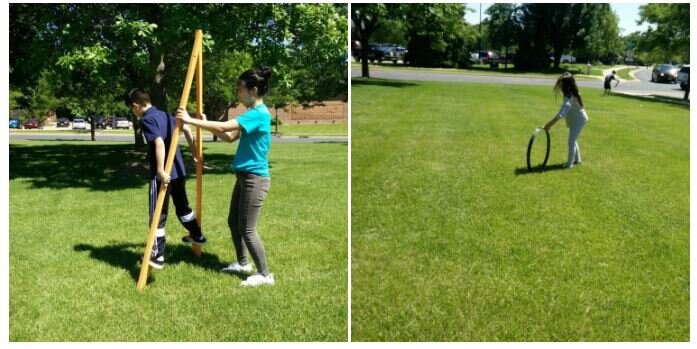
Older kids, up for a greater challenge, can register for a “Game On” mini-camp! There, they will get to make a hoop and stick toy, use scavenged materials to invent their own games, and try their hand at historic stilts, hoops and graces games outside.
Capture2.JPG

The kids who participate in these programs are quick to share their knowledge about how the lives of kids in Scott County 150 years ago were different from their lives today. They mention technology, a lack of video games, and the fact that houses didn’t have air conditioning (leading kids to want to play outside more). It was also a bit harder to get the variety of amusements in 1869 that are available today. Towns certainly had shops, and it was possible to order things by mail, but the selection was a bit different, and it took quite a bit longer for your packages to arrive. Children were likely encouraged to create their own toys and games.

That being said, kids still had fun, and, just like today’s big ticket items, there were games and toys that kids across the United States (and other nations) enjoyed. Three of those games- stilts, hoops and graces- are available to try by participants in our mini-camps. We will also be bringing them along with the Scott County Library Readmobile, and to fairs and festivals around the county this summer. Below, see what children’s literature of the past said about these three popular pastimes:

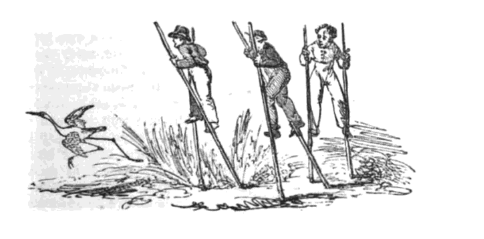
“Up In The Air On Stilts”, from The American Boy’s Book of Sport: Outdoor Games For All Seasons by Daniel Carter Beard  Published 1896
stilts.png

“According to the newspapers, walking on stilts is the very latest fashionable amusement for the ‘new woman’ in London. It is safe to say that before long you boys will be called on to make stilts for your sisters. There can be little doubt that a time is coming when a book written for boys will be the one girls will read, or rather, every book will be written for young people will be addressed to both boys and girls. Just why girls should not walk on stilts or engage in any similar sport no one has yet given a satisfactory answer. Twenty five years ago the boys used to make stilts with very low blocks for their sisters and the girls would seldom use them, but insisted on using their brothers’ high blocked stilts.

One bright boy on Fourth Avenue, New York City, has made a pair of stilts out of old laths from the ruins of some dismantled house. Three laths nailed together form each stilt pole, and the blocks are made of a graduated lot of lath pieces nailed together. Now, if a small boy in the tenement district can make himself a good serviceable pair of stilts out of some old laths, there can be no doubt that the boys who read this book will be able to find the material and tools to build themselves beautiful gadabouts”

“The Game of Graces”,  Lydia Marie Child’s The Girls Own Book, published 1838

game_of_graces_-_1831.jpg

“This is a new game, common in Germany, but introduced to this country from France. It derives its name from the graceful attitudes which it occasions. Two sticks are held in the hands, across each other, like open scissors: the object is to throw and catch a small hoop upon these sticks. The hoop to be bound with silk, or ribbon, according to fancy. The game is played by two persons. The sticks are held straight, about four inches apart, when trying to catch the hoop; and when the hoop is thrown, they are crossed like a pair of scissors. In this country it is called The Graces or The Flying Circle.”

A side note- author Lydia Marie Child is fascinating in her own right! Learn more about here here. 

“The Hoop”, from The American Boy’s Book of Sport: Outdoor Games For All Seasons by Daniel Carter Beard  Published 1896

“Everybody knows how to roll the hoop in the usual way. There is no horse, however trained, that obeys the hands of the rider with such precision. There is no ship, with the best pilot, which so correctly follows the guidance of its rudder. Here is a hoop, ruled by a stick, which maneuvers and drives it over the ground in all directions- to the right, to the left, straight on, backward, forward, describing a curve, a broken line, a triangle or, in a word, all the series of geometrical figures. Many players can contest with their hoops, and challenge each other, to know who shall drive his hoop the longest time without getting out of breath, or who shall be the first to reach a goal agreed on. In this latter case, all the players taking part in the contest should stand together on the same line, and start at a given signal… The hoop is like the skipping rope, one of the best exercises for giving strength and suppleness to the limbs.” 

hoop.png

Are you interested in joining us for any of our historic games programs? See the full schedule below, and contact your local library to register for mini-camps! All programs are free of charge.

 I’m Game! Library Crafts:Best for young people aged 6-10 and their families 
Shakopee Library: June 13th, 10:30am-11:00am
Prior Lake Library: June 15th, 12:00pm-12:30pm
Jordan Library: June 20th, 10:30am-11:00am
New Prague Library: July 2nd, 10:30am-11:00am
Elko New Market Library: July 3rd, 2:00pm-2:30pm
Savage Library: July 12th, 10:30am-11:00am
Belle Plaine Library: July 16th, 10:30-11:00am

 Game On! Library Camps:Best for young people aged 8-12
Savage Library: June 13th, 2:00pm-3:00pm
New Prague Library: Jume 18th, 2:00pm-3:00pm
Belle Plaine Library: June 20th, 2:00pm-3:00pm
Prior Lake Library: July 2nd, 2:00pm-3:00pm
Shakopee Library: July 12th, 2:00pm-3:00pm
Jordan Library: July 16th, 2:00pm-3:00pm
Elko New Market Libray: July 17th, 2:00pm-3:00pm

Written by Rose James, SCHS Program Manger

What's in our Collections?

Our collection has all manner of interesting items in it from flags, to jackets, to postcards. We collection items related to Scott County from all over the state. However, it’s important to be careful when taking things into the collection. I admit that I am a bit of a hoarder personally, and curators tend to be. I often have to fight my urge to accept everything that walks through the door, and ask myself some very basic questions. First of all, who is the item about and what is it, followed by when is it from and where in Scott County. The last question is the most important, and the one that is hardest to answer. Why? Why should we accept this item? What stories or insights into the people of Scott County can this item bring that we don’t already have?

collection-2.jpg

It seems important to share this aspect of what we do here. I have had to turn down donations recently because they would be duplicate items, or wouldn’t be usable for relating the county’s history. If you are interested in donating artifacts, documents, papers, anything really, we encourage you to do so. Our collection is far from complete, and honestly never can be. Should you have something in mind that you would like to donate, give us a call first and let us know what you have. We might not always accept donations into the collection, but it might go into our education collection, or we might know another organization that would be interested as well. Like you, we hate to see things thrown in the trash and we do what we can to ensure that history continues to live on, even if we can’t be the ones to give it a home.

Baseball Memories

Written by Elaine Rybak Clyborne Barber, Sept 23, 2018 for the opening of “Play Ball: Sports in Scott County” 

New Prague, 1914. Photo from the SCHS Collections.

New Prague, 1914. Photo from the SCHS Collections.

My childhood was filled with the connection of my family members and the athletic traditions of my home town, New Prague. This is the reason for my writing out my memories for this special event at the Scott County Historical Society and the program on small town baseball. But first, a short history of how my  family came to Scott County. My family had arrived in Minnesota from the Austrian Hungarian Empire, a part now known as the Czech Republic, to Scott County in 1865. They were looking to escape the military duties of their homeland, and they were seeking opportunities to seek their fortune and a better life for their families. They settled in Nova Praha, New Prague after the journey from the small villages southwest of Vesili, which is south of Praha in Bohemia.

My family came to New Prague not as farmers, but as trade workers and merchants to supply the needs of the growing farming community surrounding the town. The first man of the Rybak family was a blacksmith, but the next generation of men started stores and saloons in the town. By the early 1900s my grandfather opened a brewery in New Prague named the OK brewery. This company closed during the Prohibition years, and they went into making their own flavors of soda pop under the name of Rybak’s bottling Works, which also distributed Schmidt Beer after the Prohibition years ended.

My father and his two brothers were educated in the New Prague schools and were active in various town activities. It was my father, Mathew Albert Rybak known as Mike who was very interested in athletic events. He belonged to the Sokol club (gymnastic society) and played football, but his passion was for baseball. He was featured in the recent 2018 Minnesota State Amateur Baseball publication which was printed for the tournament when New Prague, Jordan and Shakopee hosted the tournament games.

There are photographs of him at bat as a young man and another one of my mother, Clara Rybak, and I standing in front of the score board dedicated to him at a field named for him after his death in 1953. His statistic were also printed in that publication, but there were many years when he was still playing that did not make the book. I am so delighted that I have the 1921-1922 score book records of the town games against Jordan, Chaska and other small towns- many of them in Le Seuer.

One of the things that I am most proud of in my life was his dedication to organizing the town team when WW2 ended. He supported that town team as a player, a manager, and in a financial way. It was during those years when I followed the games that I began keeping score myself, which I still do to this day when I watch the Twins playing. When he died, the headlines on the New Prague Times read “Mr Baseball Dies. Mick’s Bat is Silent”.

Over time repairs were needed at the Mike Rybak Memorial Park near the golf course in New Prague. The score board was replaced with an electronic one and the name was changed to the Memorial Park, honoring all the people including the vets who played on that field.

In preparation for the state tournament many things were upgraded and improved! But my memories of the importance of sharing time with my mother and father at that field are rich and precious in my memory bank. those were the good old days of my childhood.

Prohibition is on its way!

If you haven’t seen our Play Ball exhibit, I encourage you to come in and take a look around. While we are proud of the Play Ball exhibit, our staff never rests and we are starting to plan our next large exhibition. In 1919, the 18th Amendment, or Prohibition, was signed into law across the country. In honor of this anniversary, our next exhibit will be on this thirteen year period of our history. As a county with some many breweries, this history is important to telling Scott County’s story. Beyond the booze which always comes up with Prohibition, gambling was outlawed too and led to Shakopee’s nickname of Little Chicago for its gambling parlors. This should be a blast to create, or at least I hope so.

19960070005.jpg

Unfortunately, our collection is lacking in items from Prohibition and the time around it. This is where you can help. We are look for artifacts and items from the time of Prohibition to possibly go into our upcoming exhibit. We are interesting in looking at anything you might have from that time, and might be interested in taking it on loan for the exhibit. If you or someone you know has something you think might fit, please contact us. We want to put together the best exhibits that we can, and you can help us ensure that we do.

Thoreau’s Journey along the Minnesota River

184747-004-a833884f.jpg

In the spring of 1861, Henry David Thoreau embarked on a trip to visit Minnesota. At the time he was suffering from advanced tuberculosis which he had contracted in 1835. His doctor recommended a change of climate, and the fresh air of the American West to help clear Thoreau’s lungs.

It was upon this recommendation headed west for an expected 3 month journey. He brought along 17 year old Horace Mann Jr, a young botanist, as his companion. The two traveled through Niagara Falls, Detroit and Chicago before traveling by boat to St. Paul.

Thoreau was not impressed with St. Paul, commenting in a letter “At St. Paul, they dig their building stone out of the cellar; but it is apparently poor stuff”, but he was fascinated by Lake Harriet.  Thoreau, Mann, and local geologist Dr. Charles Anderson spent a great deal of time on the lake’s shores, examining the water, woods and marshes of the area.  They also cataloged sightings catbird, goldfinch, oriole, tanager, horned lark, flicker and killdeer.

The nature and air were not the only draw that Minnesota held for Thoreau. In the mid to late 1800s, some European Americans in the United States experienced what can be described as a cultural morning for the American West. Today we associate that time period with popular tales of cowboys on the frontier, but at the time it seemed to prominent European American thinkers like opportunities for “exploration” were dwindling. With this came a desire to preserve the stories and culture of American Indians, ironic considering the  concurrent American government policy towards First Nations. With this in mind, Thoreau planned to follow the Minnesota River into the interior of the state and visit the Dakota Nation for himself.

On June 25th, 1861 Thoreau wrote the following letter describing his journey by steamboat along the Minnesota River:

19960160095.jpg

Dear Sir,
After spending some three weeks in and about St. Paul, St. Anthony, and Minneapolis, we made an excursion in a steamer some 300 or more miles up the Minnesota River, to Redwood, or the Lower Sioux Agency, in order to see the plains and the Sioux, who were to receive their annual payment there. This is eminently the river of Minnesota, for she shares the Mississippi with Wisconsin, and it is of incalculable value to her. It flows through a very fertile country, destined to be famous for its wheat; but it is a remarkably winding stream, so the Redwood is only half as far from its mouth by land as by water. There was not a straight reach a mile in length as far as we went, generally you could not see a quarter of a mile of water, and the boat was steadily turning this way or that. At the greater bends, as the Traverse des Sioux, some of the passengers were landed and walked across to be taken in on the other side. Two or three times you could have thrown a stone across the neck of the isthmus while it was from one to three miles around it. It was a very novel kind of navigation to me.

The boat was perhaps the largest that had been up so high, and the water was rather low (it had been about 15 feet higher). In making a short turn, we repeatedly and designedly ran square into the steep and soft bank, taking in a cart-load of earth, this being more effectual than the rudder to fetch us about again; or the deeper water was so narrow and close to the shore, the we were obliged to run and break down at least 50 trees which overhung the water, when we did not cut them off, repeatedly losing part of our outworks, though the most exposed had been taken in. I could pluck almost any plant on the bank from the boat. We very frequently got aground and then drew ourselves along with a windlass and a cable fastened to a tree, or we swung round in the current, and completely blocked up and blockaded the river, one end of the boat resting on each shore. And yet we would haul ourselves round again with the windlass and cable in an hour or 2, though the boat was about 160 feet long and drew some 3 feet of water, or, often, water and sand. It was one consolation to know that in such a case we were all the while damming the river and so raising it.

We once ran fairly on to a concealed rock, with a shock that aroused all the passengers, and rested there, and the mate went below with a lamp expecting to find a hole, but he did not. Snags and sawyers were so common that I forgot to mention them. The sound of the boat rumbling was the ordinary music. However, as long as the boiler did not burst, we knew that no serious accident was likely to happen. Yet this was a singularly navigable river, more so than the Mississippi above the Falls, and it is owing to its very crookedness. Ditch it straight, and it would not only be very swift, but soon run out.

It was from 10-15 rods wide near the mouth and from 8 to 10 or 12 at Redwood. Through the current was swift, I did not see a ‘rip’ on it, and only 3 or 4 rocks. For 3 months in the year I am told that it can be navigated by small steamers about twice as far as we went, or to its source in Big Stone Lake, and a former Indian agent told me that at high water it was thought that such a steamer might pass into the Red River.

In short this river proved so very long and navigable, that I was reminded of the last letter or two in the Voyages of Baron la Hontan (written near the end of the 17th century, I think) in which he states that after reaching the Mississippi (by the Illinois or Wisconsin), the limit of previous exploration westward, he voyaged up it with his Indians, and at length turned up a great river coming in from the west which he called ‘la Riviere Longue’ and he relates various improbable things about the country and its inhabitants, so that this letter has been regarded as pure fiction – or more properly speaking a lie. But I am somewhat inclined now to reconsider the matter.

The Governor of Minnesota (Ramsey), the superintendent of the Ind. Affairs in this quarter, and the newly appointed Indian agent were on board; also a German band from St. Paul, a small cannon for salutes, and the money for the Indians. There were about 100 passengers chiefly from St. Paul, and more or less recently from the N. Eastern states; also half a dozen young educated Englishmen . . .

The last of the little settlements on the river, was New Ulm, about 100 miles this side of Redwood. It consists wholly of Germans. We left them 100 barrels of salt, which will be worth something more when the water is lowest, than at present. Redwood is a mere locality, scarcely an Indian village – where there is a store and some houses have been built for them. We were now fairly on the great plains, and looking south, and after walking that way 3 miles, could see no tree in that horizon. The buffalo was said to be feeding within 25 or 30 miles.

A regular council was held with the Indians, who had come in on their ponies; and speeches were made on both sides thro’ an interpreter, quite in the described mode; the Indians, as usual, having the advantage in point of truth and earnestness, and therefore of eloquence. The most prominent chief was named Little Crow. They were quite dissatisfied with the white man’s treatment of them and probably have reason to be so. This council was to be continued for 2 or 3 days – the payment to be made the 2nd day – and another payment to the other bands a little higher up the Yellow Medicine (a tributary of the Minnesota) a few days thereafter.

Yours Truly, Henry David Thoreau

Sadly, the trip did not have it’s desired restorative outcome. Thoreau passed away less than a year later, on May 6th, 1862. He did not live to see the outbreak of the US-Dakota war that the sympathies expressed in his letter hinted at to modern readers. His writings do provide an invaluable first-hand account of the difficulties of travel along the Minnesota River during the era of steamboats, and the complex relationship between European American and Dakota culture leading up to the  US-Dakota War.

Written by Rose James, SCHS Program Manager