
The Scott County Fair: An Old Institution

Written by Marge McNeil

Fairs have been held in Shakopee since 1857 when an agricultural society was organized by Major R. G. Murphey and D. L. Howe. It was under the auspices of this society that the fair was held in 1857. It is recorded that some fine samples of produce, wheat and corn were exhibited and that the fine hogs show caused recently arrived immigrants to marvel at the possibilities of the new land.

Trapeze artist at the Shakopee Fair, 1905. Photo from the SCHS collections. 

Trapeze artist at the Shakopee Fair, 1905. Photo from the SCHS collections.

In 1872 the Scott County Agricultural Society was organized. Fairs were held annually by this society until 1898. In the 1870s few farmers in Scott County were able to produce anything worthy of exhibition purposes, as they were lucky to raise enough to eke out an existence for themselves and their families. Everybody could raise giant pumpkins though, and there was considerable rivalry among farmers in this respect. Horse racing was then the sport of kings and no county fair was complete or of any consequence without a racing card. Among the amusement features of these early fairs were balloon ascents, tent vaudeville shows, and magic acts.

Trapeze artist at the Shakopee Fair, 1905. Photo from the SCHS collections. 

Trapeze artist at the Shakopee Fair, 1905. Photo from the SCHS collections.

In September of 1912 three days of fun, frolic and frivolity marked Scott County’s Agricultural Fair and Street Carnival. Shakopee was the lotus for thousands of pleasure seekers after progress in agriculture. Domestic arts, fine arts, music, dancing, free shows and carnival antics were presented creating an atmosphere of neighborly good fellowship. The Shakopee Street Fair and Carnival offered two open air exhibition stages, one at Lewis and Holmes and the other at Bridge Square. Adding to the festivities were ballgames, dancing until 3am, and of course…politicians.

In 1915 a decision was made that a County Fair would be held in Jordan in September to replace the mid-winter fair that had been held annually for a number of years. The acreage known as Schultz & Hilgers park was leased for a term of years to serve as the fairgrounds. The crowd for the three-day event was estimated to be seven thousand and it was considered to be successful. Entries in the agricultural department totaled 355. Friday’s livestock parade was the hit of the fair. For the second year of the fair a new women’s building was built. Attendance was estimated at 21,000 with 1607 exhibits in all departments. Entertainment included band concerts in the afternoon and evening, trained animal acts, entertainers, free movies, parades and a Grand Ball with two orchestras.

Livestock auction at the Scott County Fair, 1955. Photo from the SCHS Collections 

Livestock auction at the Scott County Fair, 1955. Photo from the SCHS Collections

There were several other fairs of note.  The 1927 fair was a record breaker in the department of 4-H club work, which was growing in importance throughout the county. Sadly, no fair was held in 1947 because of September’s rampant polio epidemic. Finally the Sunday afternoon parade was canceled in 1962 when the cost of engaging parade units became higher then the county merchants could support.

During the 1960s the fair board began to feature more local talent for the grandstand entertainment rather than pay professional acts. Tug-of-war contests were scheduled with teams made up from people from throughout the county, tractor pulls became popular, and in the 1970s demolition derbies were featured which are still a main grandstand attraction today. For fifty-seven years the fair was successfully staged in the park in Jordan
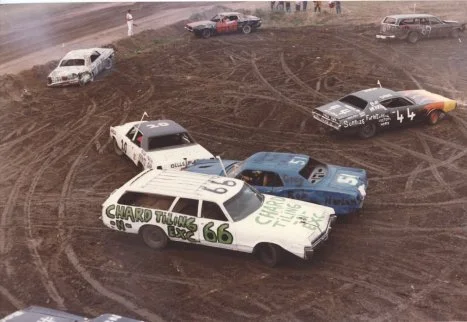
Demolition derby, Scott County Fair, 1980

Demolition derby, Scott County Fair, 1980

In 1970s, the Fair Board purchased 80 acres in St Lawrence Township as a site for the future fairgrounds. New buildings were erected with additional ones added each year for several years. For three generations the residents of Scott County have enjoyed an annual fair. This gala event has brought competitive exhibits, thrills, entertainment and recreational activities, along with ever-present food. Who, young or old, doesn’t have great memories of the fair?

Originally published in the Scott County Scene, summer 2018

Creameries Around Every Corner

Scott County has a long agricultural history, as does much of the Minnesota River Valley area. When most people think agriculture, the first idea they have is of farming but agriculture as an industry is more than crops and cattle. When farmers harvest their yields, the next step of the process begins, turning that raw good into a finished product. A major industries that sprang up on the late 19th and early 20th century in Scott County was creameries which did just that.

Creameries could be found in every township, and nearly every major town had one. Most of these creameries started as Co-Ops, businesses that were founded and owned by the local farmers that made use of the business. While the list of creameries in the county is long, a look at three will help illustrate their impact on agriculture in the county: Joel, Blakeley, and Marystown.

Joel Creamery Building in 2006

Joel Creamery Building in 2006

The Joel Creamery was a small one man operation, and produced primarily butter. This creamery served the local farmers in Joel, but also had buyers in Belle Plaine Township. Butter is a staple of creamery production, and most every creamery produced it in some quantity. The Joel Creamery opened its doors in 1893 and remained in operation for 24 years, owned and operated by A.C. Schmit. Upon its closing, Schmit thanked his patrons for their support. For many in the early 20th century, local creameries were the primary way that people acquired dairy products.

 Marystown Creamery was opened in the early 1900s and, like Joel, produced mainly butter. However Marystown specialized in sweet cream products. The creamery turned out several thousand pounds of butter.

Marystown Co-Operative Creamery Stock

Marystown Co-Operative Creamery Stock

By 1924, the Marystown Co-Operative Creamery had been leased out to the Redman Ice Cream Company, producing the cream that would go into their Ice Cream though not actually producing the desert itself. In 1925, the creamery became a depository for local farmers to drop off their milk and cream. In 1927, however, the creamery closed and the building was torn down not long after.

Lydia Co-Operative Creamery Calendar

Lydia Co-Operative Creamery Calendar

 Perhaps the longest running of the small town creameries was that of Blakeley. Beginning operations in 1917, the creamery quickly boomed in business as local farmer bought in. On its first day in operation it is reported that it churned 1000lbs. of butter. In 1928 it produced 399,170 pounds of butter. By 1933, the Blakeley community was receiving $160833, or over $3 million dollars today, in revenue from the creamery. The average patron received about $22, or $426 today, annually. Rather a substantial profit considering they were in the height of the great depression. Blakeley creamery continued to operate until 1970.

Creameries were a means of production in the agriculture industry, but more than that they provide for their community. Goods coming out of the churns were bought by locals who couldn’t easily travel to larger towns, and farmers received dividends on the cream and milk they brought into the businesses. For many farmers, the creameries became a nucleus of farming in their area along with the feed mills, and grain mills. Creameries today are not as abundant as they once were, and few Co-Op creameries still exist at all. These business remind us of the larger impact agriculture has on our communities and ways in which people survived and prospered in decades past.

Written by Dave Nichols, Curator

A Schoolhouse in Blakley

The following are the memories of Clara Simcox, who attended Salsbury School in Blakley in 1904. Her story was transcribed for the book “Blakley Township’s Walk Through History, published in 1976

One room schoolhouse outside Shakopee, early 1900s. Photo from the SCHS Collections.

One room schoolhouse outside Shakopee, early 1900s. Photo from the SCHS Collections.

The schoolhouse I remember was much like the others in the township. Some of the “seats” were double- a row of these along the east wall, and single seats otherwise. The teacher’s desk was at the south end of the room. On either side in the front there were book cases for the library books, of which there were quite a few. Also, a large dictionary had a special stand. The black boards were behind the teacher’s desk and one on each side wall. the room was lined with tin. A large stove with a tin jacket stood on the northwest corner. We carried the drinking water form the August Kahle well. There was no pump on the well, but the water was drawn with buckets. We had a pail and one dipper, which we all drank from. Later a crock fountain was installed where the water was emptied into. After recess or at noon when we all came in from playing, usually everyone had to have a drink, so one pail of water did not hold out for a day. I started school in October 1904. We only had 8 months of school in those days

My first teacher was Ms. Helen Theissen. At the time I thought she came as near to an ange as any human being could. She made my early recollections of school never to be forgotten. Ms Theissen taught all subjects in all eight grades. We always had a very large and good library and many books were read to us for our opening exercises. She also taught us songs which we sang during opening exercises when she did not read to us.

So many nice things happened in country school. Our holiday program was always a mountain-top experience. Several weeks before Christmas we were allowed to go along when the older pupils cut juniper branches in the coulee. We helped carry them to the schoolhouse and the teacher and older students decorated the schoolhouse with them. We also gathered “bittersweet” and “wahoo” to give the effect of the red and green Christmas colors.

Practicing for programs was always so much fun. Who dressing rooms were made with sheets for the boys and girls (Later we had curtains and did not have to bring the sheets from home). Members of the school board put up a stage at the front of the room. The teacher always trimmed the tree after we were excused for the day when the program was to be held in the evening. The first Christmas I was at school, Santa was late getting there after the program. He brought his wife along. He explained that he was late because one of the deer had fallen and broken its leg and they had to put splints on it. Of course, there was no doubt in our mind that this was the case.

In later years we drew names and Santa would distribute the gifts as well as the bags of nuts and candy. At that time we appreciated all we got and no one criticized the kind or amount. Out programs consisted of songs, recitations and dialogues.

In the spring of that year we always observed Arbor Day. Some of he older boys were dispatched to the nearby coulee to get a tree and we planted it with proper ceremony. Then, too, our annual trip to Salisbury’s hill to pick up Mayflowers or hepaticas which was another exciting experience. We gladly sacrificed our opening exercise and recess so we could have a longer noon hour for the trip.

We always played games during recess and the noon hour after we had our lunch. “Ball” was the most popular, but we also played “ante ante over”, “run sheep run”, “grey duck”, “stealing sticks”, and others. In winter we always had a “fox and goose” ring. We had an enrollment of at east 30 pupils.

Minnesota River Valley: The Beginnings

Excerpt From “Shakopee: An Environmental History” by Kathryn Cravens

The land features seen in the Minnesota River Valley today are largely the result of glaciers that moved across the landscape for millions of years. During the Ice Age, which began about 2 million years ago, large sheets of ice (sometimes up to a mile in thickness) moved across North America. As the glaciers traveled, they picked up and carried with them rocks and soil. During warmer periods, when the glaciers melted and receded, they left behind these rocks, or glacial till. In some places this till is so thick that it forms hills. In other places, the rocks scattered across the landscape are reminders of the glaciers’ former presence

The bulk of Lake Agassiz juxtaposed with the modern Great Lakes and state/national boarders 

The bulk of Lake Agassiz juxtaposed with the modern Great Lakes and state/national boarders 

Aside from the rocks left behind as glaciers melt, they also shaped the earth in other ways. The sheer weight and movement of the glaciers sculpts the earth into new land forms by creating hills and valleys. Minnesota, including Scott County, is a land of 10,00 lakes because of the glaciers. In many places, buried glacial ice eventually melted and left behind depressions in the earth that became filled with water to create the ponds, wetlands and lakes that define our state’s landscape.

Perhaps the most visible evidence of Scott County’s glacial heritage can be seen by drivers on Highway 169. In open areas, drivers can look to the north and see the bluff line on the other side of the river. Looking south they can see another bluff line. These bluffs mark the original banks of Glacial River Warren.

Glacial River Warren was a product of the last major era of glaciers, known as Wisconsinan Glaciation, which began about 100,000 years ago. About 12,000 years ago, the glaciers had melted significantly and this meltwater formed Lake Agassiz, an enormous body of water larger than all of today’s great lakes combined.

The Minnesota River- shown as a thin blue line above- inserted inside the approximate historical footprint of Glacial River Warren

The Minnesota River- shown as a thin blue line above- inserted inside the approximate historical footprint of Glacial River Warren

Beginning around 11,500 years ago, for a time Lake Agassiz drained south through Glacial River Warren. Not surprisingly, a lake the size of Agassiz required an equally impressive outlet river, which is why the banks of Glacial River Warren were so far apart. The Minnesota River is a tiny stream in comparison to what would have been the raging waters of the Warren.

Approximately 8,500 years ago, the drainage form Lake Agassiz shifted back north to Hudson Bay. Today, the north-flowing Red River on the border between Minnesota and North Dakota is all that remains of the large drainage basin that was Lake Agassiz.

Hikers on the MN River Valley State Trail will see many seeps and springs trickling out from the base of the bluff. These springs are important water sources that made settlement and industry possible throughout Scott County.

The Home of Memories

dsc02999.jpg

I had a professor in school who imparted an idea to me that strikes at the heart of what museums do. He said “Artifacts, books, papers, all of them are the home for memories. Like a character in a cartoon has a thought bubble, so too do objects. Their thoughts are of the stories they hold.” What a wonderful way to look at objects, and I have always continued to look at objects that way. Every item in our collection is “thinking” of its part, and the stories it can share. Our role as a museum and a keeper of these artifacts is to put those thoughts into view.

We recently held our first of what will hopefully be several History Story Shares. The goal of this program is two-fold: First, it allows people to share the stories of their treasures without having to say goodbye to them. Second, it allows us to hear, share, and collect more history about our county than we would through donated items alone. Everyone has something personal to them, an heirloom, a lucky pair of shoes, something; and each of those somethings have a story to them. We want those stories, its those pieces of the past that help us tell the future about today.

In thinking more and more about the stories within an item, I am reminded of the idea that where we have been tells us where we are going. Looking at a rotary phone and comparing it to a cell phone is a story in itself. Its a legacy, and that is what museums and history are meant to do, preserve the legacy of us, people. Our past, and future, are tied up in how we got from A to B and that journey is the story of history and it is contained in the old rocking chairs, heirloom lockets, and tiny keepsakes that many of us have but seldom reflect on.

We hope that in the coming months we can do more story shares across the county, and hope to see and hear stories from all over. If you have an item with a great story, consider stopping by the museum and sharing it with us.