Early Childhood in Credit River in the 1940s: Part 3

Part 3
Written by Angeline Mares Stone for the Credit River Reunion, January 17th, 1999

Steam powered thresher, 1965, from the SCHS Collections

Steam powered thresher, 1965, from the SCHS Collections

During the summer, we got to see the Kalal kids, Mary and Willy, and play with them. Our parents were friends and the families worked together at threshing time, a high point of the harvest season. Along with the Kalinas, our relatives, the crews arrived in the early morning after livestock chores were done. The air of excitement, of great work, was unmistakable. The work was hard, I dare say, especially for the women, for I remember that Mom would work in the fields, shucking wheat, and still plan and prepare the meal that would be served to the very hungry men. My sister, Mary Jo, as her assistant during those years. Our tasks as children were limited to taking lemonade out to the men as they worked in the hot afternoon sun. They were always appreciative of our efforts and made us feel useful. Another task we often had was to even out the grain as it came tumbling into the wagon from the thresher. We were barefoot and the grain would tickle our toes.

These were the assigned tasks, but on one occasion, my sister Nancy and I were given another task, snapping the fresh green beans; it seemed like mountains of them. We sat on the front stoop, snapping away. “Tsk, tsk” said one of the ladies, arriving that morning as she passed her way into the house. We hung our heads in shame- and sorrow. We would rather have been playing with the Kalal kids, like we did the day before But the day before we let ourselves get carried away in fun, and thought it would be really great throw lots of straw into the outdoor stock tank and splash around in it. We gave no thought to what affects this would have on livestock looking for water or anything else. We were just having fun. But our misdeeds became known during evening chores and we were punished in the worst way- we could not have company the next day. The chore of snapping beans was the mild punishment because we really liked the Kalal kids.

St. Wenceslaus Catholic School in New Prague, early 1930s. From the SCHS collections.

St. Wenceslaus Catholic School in New Prague, early 1930s. From the SCHS collections.

Our experiences were not limited to farm and school. During my second grade I attended St. Wenceslaus School in New Prague in order to prepare for First Holy Communion My father had made the decision to take our family to New Prague to church after going to Credit River for awhile. New Prague became a spiritual home for us and I was comfortable there. When my parents were given the option of keeping Ewald buried in the American soldiers cemetery in Margraaten, Holland or having him brought back to America, they chose to have him brought back and buried in New Prague. On October 12, 1948, a funeral Mass was held at St Wenceslaus for Ewald. It was also our parents’ thirtieth anniversary. The support of the Credit River and New Prague people gave our family a solid sense of community. And I acquired a sense of a much larger world.

We were connected to the Twin Cities too mostly through relatives living there. My sister, Edith, having just graduated from high school became part of the household staff at the Archibald Bush home on Summit Avenue, and once in a while we got to visit her. I felt lost in that huge mansion- nothing in it seemed familiar. While Edith worked in St Paul she met Dorothy Broshofke who would later become Mile’s wife. Dorothy began to visit our home and play the piano. I remember my mother loving this and she made known her favorite songs. Two that I remember are “Juanita” and “The Swiss Boy”. My own repertoire of songs increased greatly because of those songfests and there was one more reason to be joyful.
In June of 1949, Miles and Dorothy were married. They had two wedding dances, one in St Paul and one at Armie and Mac’s in “downtown Credit River”, the nerve center of the Credit River community at that time. Everyone knew everyone else and they danced their hearts out at that place. We would dance there again soon, for we were about to say “good-bye” to our life in Credit River.

Dad bought the Bill Deegan farm in Lakeville and in the all of 1949 we moved. During the week that we moved, a windstorm blew the roof off a chicken coop at our new place. And somehow, when the livestock moved, my new pet chicken Annie got lost. She didn’t make it to our new home. And so I grieved the loss of her and the end of my life in Credit River. But I would keep forever in my heart the memory of rich experiences I had when I lived there.

Early Childhood in Credit River in the 1940s: Part 2

Part 2: School
Written by Angeline Mares Stone for the Credit River Reunion, January 17th, 1999

Schoolhouse, district 37, around 1960. From the SCHS Collections

Schoolhouse, district 37, around 1960. From the SCHS Collections

In September of 1945, I was old enough to start school. Scott County’s District 30 school building was located at the end of our long driveway and the walk to school was in itself a journey. There were three hills, of which the middle one was named “the big hill”. A kid could walk and walk and not see the school building until he or she reached the big hill. Coming home, one could to see the farmhouse until the hill was climbed. A metaphor for life- we work the little hills and hope for a chance, once in a while, to see the big picture from the highest hill. The imagery has stayed with me to this day.

I liked school, but parts of it seemed scary. Everyone, except for my first grade classmates Nancy and Pat Kane, was bigger then me. In an eight-grade schoolhouse, watching the big kids could be intimidating and occasionally amusing. I remember intense arguments at recess about the merits of John Deere tractors versus the Ford tractor. The big boys got physical with each other hem their verbal debating skills had reached their limit and would look pretty scare to the resto f us. But the big boys were entertaining. I remember the spring day when two or three of them jumped on an ice flow on the creek which ran behind the school. The melting ice sent the water rushing and the boys “rode the rapids”. They looked brave and ridiculous all at once, for they had put themselves in more danger than they had planned to. Somehow they got off the ice before it carried them away. Mr. Herzog, the school superintendent, visited us and from thereon we were forbidden to cross the fence and play near the creek. Life became just a bit duller at District 30.

But learning was fun and it was enriched for us younger students because we were right there as the eighth graders read aloud the poem “Evangeline”, Longfellow’s story of young lovers torn apart as the French settlers were driven from their homes in Nova Scotia.

I was in fourth grade when my sister, Nancy, Started school. By then the old coal furnace had been replaced by an oil heater. Mrs. Hedlund had it replaced the year before. And then Mrs. Hedlund was replaced by Miss Cates. My family thought it would be cute if my sister, while reading Dick and Jane aloud, would substitute Czech for English when reading “One Two Three”. I watched as they tutored her to get the words right; “Jeden, Dva, Tri”. The next day, O watched from the next row of seats, stifling myself, knowing Nancy would be translating the written words. She carried it out, I giggled. Miss Cates, surprised at first and then annoyed, made it clear there was to be no more of that. There wasn’t.

At school, we got to know the neighborhood kids, the Schneiders, the Kalals, the Troms and the Kanes, Ralph Borka, LeRoy Farrell, and Barb McMahon. We would play London Bridge, Baseball and a real favorite, Prisoners Base. When the boys weren’t arguing about tractors, I really loved recess!

Early Childhood in Credit River in the 1940s

Part One: World War 2
Written by Angeline Mares Stone for the Credit River Reunion, January 17th, 1999

I was not quite ten years old when our family moved from Credit River to Lakeville, but those first years were filled with rich experiences. those ten years included a world war in which two brothers, Miles and Ewald became soldiers, and another brother, Clem, helped my parents Frank and Emma Mares run the 196 acre farm.

I was the sixth child in a family of seven children. From my vantage point, I watched the constantly busy lives of people older than I. The events in the wider world were contrasted by the pastoral setting of the white frame farmhouse set on a hill, surrounded on one side by a grove of Chinese elms, and on the other side by farm buildings. The daily lives of grown ups were immersed in caring for livestock, growing crops, and maintaining the farm and household. Amidst the tasks of daily living, they had to absorb the realities of a war far away on two fronts, Europe and Japan.

1943 US Army jacket from WW2. From the SCHS Collections.

1943 US Army jacket from WW2. From the SCHS Collections.

And yet so close, for there were letters from Ewald and Myles which arrived with regularity, describing parts of that far away world. The letters supplemented the radio broadcasts, and I do remember the muffled voice of the overseas correspondents, especially the name David Shoenbrun. The necessity of rationing to conserve materials for the war effort also brought the war into the daily lives; it required real ingenuity and resourcefulness to maintain a farm and household under those conditions, Through determination, a certain daily rhythm was established.

The hailstorm of July, 1944 abruptly disturbed that rhythm. I was four and I remember that the windows in our kitchen were shattered, broken glass lying all over the floor. My mother picked me up as she went to light a fire in the stove. I can remember her hands trembling as she did so , and I remember piles of hail outside our back door. In the aftermath, I realized that my little black pet hen had become a victim of the storm.  A machine shed was destroyed, crops were destroyed and once again the grownups were required to reestablish their lives.

Somehow they did. In Europe, the Normandy Invasion had take place the month before, and now letters from Ewald were written from France.After her long days of work, my mother would take time to sit at the kitchen table and write letters to her sons. I remember her letting me draw an outline of my hand and color it to send off with her letter. I was four and could not write then but I wanted to say something I guess.

The announcement that the war was over in Europe was good news in our home. But my mother worried aloud when the mailbox at the end of our long driveway failed to yield a letter from Ewald. Her worst fears were realized on May 16, 1945. I hardly remember anything about that day except for its very ending. My brother, Clem, tells me that it was a sunny spring day, that he had just finished planting corn and had put the work horses into the barn for the night. It should have been a good day. 

I Remember a man coming to our front porch door one never used by friends and relatives. I stood off to the right of the porch and watched as my mother began to tremble and my father fell to the ground and rolled in agony. Ewald had been killed in Germany on May 3rd, five days before Germany surrendered, My Aunt Ann walked me and my younger sister Nancy away from the house and I remember her trying to explain to that not-quite-three-year-old what death meant.

This intense memory was the opening of my awakened childhood. I knew that a brother was killed in the war, a brother of whom I had only one memory- that of him standing in the doorway, seeming to fill it with his large frame. I witnessed the sadness of my mother and the anger of my father and felt both myself.

Yet there was also joy at times. The war was over in August of that year. My older brother Myles came home and I remember a party given to celebrate his return. A large container of ice cream, housed in canvas to keep it cold, was placed near a door in the large kitchen. The party spilled over into the dining room as more people arrived and the atmosphere of celebration signaled permission to be happy once again.

The Scott County Fair: An Old Institution

Written by Marge McNeil

Fairs have been held in Shakopee since 1857 when an agricultural society was organized by Major R. G. Murphey and D. L. Howe. It was under the auspices of this society that the fair was held in 1857. It is recorded that some fine samples of produce, wheat and corn were exhibited and that the fine hogs show caused recently arrived immigrants to marvel at the possibilities of the new land.

Trapeze artist at the Shakopee Fair, 1905. Photo from the SCHS collections. 

Trapeze artist at the Shakopee Fair, 1905. Photo from the SCHS collections.

In 1872 the Scott County Agricultural Society was organized. Fairs were held annually by this society until 1898. In the 1870s few farmers in Scott County were able to produce anything worthy of exhibition purposes, as they were lucky to raise enough to eke out an existence for themselves and their families. Everybody could raise giant pumpkins though, and there was considerable rivalry among farmers in this respect. Horse racing was then the sport of kings and no county fair was complete or of any consequence without a racing card. Among the amusement features of these early fairs were balloon ascents, tent vaudeville shows, and magic acts.

Trapeze artist at the Shakopee Fair, 1905. Photo from the SCHS collections. 

Trapeze artist at the Shakopee Fair, 1905. Photo from the SCHS collections.

In September of 1912 three days of fun, frolic and frivolity marked Scott County’s Agricultural Fair and Street Carnival. Shakopee was the lotus for thousands of pleasure seekers after progress in agriculture. Domestic arts, fine arts, music, dancing, free shows and carnival antics were presented creating an atmosphere of neighborly good fellowship. The Shakopee Street Fair and Carnival offered two open air exhibition stages, one at Lewis and Holmes and the other at Bridge Square. Adding to the festivities were ballgames, dancing until 3am, and of course…politicians.

In 1915 a decision was made that a County Fair would be held in Jordan in September to replace the mid-winter fair that had been held annually for a number of years. The acreage known as Schultz & Hilgers park was leased for a term of years to serve as the fairgrounds. The crowd for the three-day event was estimated to be seven thousand and it was considered to be successful. Entries in the agricultural department totaled 355. Friday’s livestock parade was the hit of the fair. For the second year of the fair a new women’s building was built. Attendance was estimated at 21,000 with 1607 exhibits in all departments. Entertainment included band concerts in the afternoon and evening, trained animal acts, entertainers, free movies, parades and a Grand Ball with two orchestras.

Livestock auction at the Scott County Fair, 1955. Photo from the SCHS Collections 

Livestock auction at the Scott County Fair, 1955. Photo from the SCHS Collections

There were several other fairs of note.  The 1927 fair was a record breaker in the department of 4-H club work, which was growing in importance throughout the county. Sadly, no fair was held in 1947 because of September’s rampant polio epidemic. Finally the Sunday afternoon parade was canceled in 1962 when the cost of engaging parade units became higher then the county merchants could support.

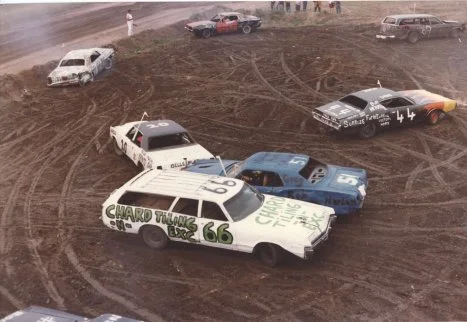
During the 1960s the fair board began to feature more local talent for the grandstand entertainment rather than pay professional acts. Tug-of-war contests were scheduled with teams made up from people from throughout the county, tractor pulls became popular, and in the 1970s demolition derbies were featured which are still a main grandstand attraction today. For fifty-seven years the fair was successfully staged in the park in Jordan

Demolition derby, Scott County Fair, 1980

Demolition derby, Scott County Fair, 1980

In 1970s, the Fair Board purchased 80 acres in St Lawrence Township as a site for the future fairgrounds. New buildings were erected with additional ones added each year for several years. For three generations the residents of Scott County have enjoyed an annual fair. This gala event has brought competitive exhibits, thrills, entertainment and recreational activities, along with ever-present food. Who, young or old, doesn’t have great memories of the fair?

Originally published in the Scott County Scene, summer 2018

Creameries Around Every Corner

Scott County has a long agricultural history, as does much of the Minnesota River Valley area. When most people think agriculture, the first idea they have is of farming but agriculture as an industry is more than crops and cattle. When farmers harvest their yields, the next step of the process begins, turning that raw good into a finished product. A major industries that sprang up on the late 19th and early 20th century in Scott County was creameries which did just that.

Creameries could be found in every township, and nearly every major town had one. Most of these creameries started as Co-Ops, businesses that were founded and owned by the local farmers that made use of the business. While the list of creameries in the county is long, a look at three will help illustrate their impact on agriculture in the county: Joel, Blakeley, and Marystown.

Joel Creamery Building in 2006

Joel Creamery Building in 2006

The Joel Creamery was a small one man operation, and produced primarily butter. This creamery served the local farmers in Joel, but also had buyers in Belle Plaine Township. Butter is a staple of creamery production, and most every creamery produced it in some quantity. The Joel Creamery opened its doors in 1893 and remained in operation for 24 years, owned and operated by A.C. Schmit. Upon its closing, Schmit thanked his patrons for their support. For many in the early 20th century, local creameries were the primary way that people acquired dairy products.

 Marystown Creamery was opened in the early 1900s and, like Joel, produced mainly butter. However Marystown specialized in sweet cream products. The creamery turned out several thousand pounds of butter.

Marystown Co-Operative Creamery Stock

Marystown Co-Operative Creamery Stock

By 1924, the Marystown Co-Operative Creamery had been leased out to the Redman Ice Cream Company, producing the cream that would go into their Ice Cream though not actually producing the desert itself. In 1925, the creamery became a depository for local farmers to drop off their milk and cream. In 1927, however, the creamery closed and the building was torn down not long after.

Lydia Co-Operative Creamery Calendar

Lydia Co-Operative Creamery Calendar

 Perhaps the longest running of the small town creameries was that of Blakeley. Beginning operations in 1917, the creamery quickly boomed in business as local farmer bought in. On its first day in operation it is reported that it churned 1000lbs. of butter. In 1928 it produced 399,170 pounds of butter. By 1933, the Blakeley community was receiving $160833, or over $3 million dollars today, in revenue from the creamery. The average patron received about $22, or $426 today, annually. Rather a substantial profit considering they were in the height of the great depression. Blakeley creamery continued to operate until 1970.

Creameries were a means of production in the agriculture industry, but more than that they provide for their community. Goods coming out of the churns were bought by locals who couldn’t easily travel to larger towns, and farmers received dividends on the cream and milk they brought into the businesses. For many farmers, the creameries became a nucleus of farming in their area along with the feed mills, and grain mills. Creameries today are not as abundant as they once were, and few Co-Op creameries still exist at all. These business remind us of the larger impact agriculture has on our communities and ways in which people survived and prospered in decades past.

Written by Dave Nichols, Curator