History of Credit River Part 2: The Township Grows

Credit River’s first municipal building was the post office, built in 1856. It was initially called the New Dublin post office. 

The choice of names is not surprising. The vast majority of the township’s early European American settlers were from Ireland, coming to the United States to escape the potato famine and to take advantage of the possibility of land ownership. Land in places like Credit River went quickly. The early Irish families claimed land through the homestead act or the territorial land act. All of this land had been claimed by 1870. 

These early European American settlers lived mostly in the northern part of the township, which was almost exclusively Irish. In 1870, as the final land was claimed, records show that the township was ⅔ Irish and 95% Catholic. 

After the post office, the town built a church. The first church building was a log cabin built in 1862 on a hill overlooking Cleary lake. Unfortunately, this early building burned down. The township’s second church was completed in 1871 and named St Peters. It featured a hand carved altar, stained glass windows, a choir loft, a tower that was sixty-five feet high, and a 1200 pound bell. St Peters stood next to where Credit River Cemetery is now located, along Highway 27.

The church didn’t have a dedicated priest. Instead, a traveling priest would come through first monthly, then weekly to perform the service. In the late 1980s, several elderly lifelong residents recalled that in the winter or during difficult weather conditions Sunday services would begin when the priest arrived, not at an appointed time. This meant that they sometimes did not start until late afternoon. 

Sketch of St Peter’s Church in Credit River. From the Shakopee Valley News, August 12, 1987

Sketch of St Peter’s Church in Credit River. From the Shakopee Valley News, August 12, 1987

According to early residents, much of the town’s social life was centered around St Peter’s Church. The church hosted weddings, banquets, anniversary celebrations and card parties. It was not uncommon for the people in the town to arrive at Sunday services very early, and stay several hours after the service ended to chat with their neighbors. 

In 1878 a reporter from the Shakopee Courier took a weekend trip to Credit River in order to write an article about what life was like in the community. He went in December and wrote of his journey “It was slightly chilly outside of a good buffalo robe especially in an occasional blinding snowstorm.” He said of his arrival “When we got to the settlement we found everybody going to church so we fell in line and did likewise.”

Outside of the church, the township was home to a blacksmith shop, general store, creamery and village hall. There were taverns attached at various points to both the store and the town hall. 

The village hall was a public place, and residents remember parties, weddings and basket socials being held there. A basket social was a tradition where a young woman would pack a basket with a meal or baked goods. Men would bid in the basket, with the hopes of sharing the meal with the lady who originally packed the food. The money was generally donated to a charitable cause. 

Scott County Memories: Wash Day

These recollections were dictated by Frances Brandl of Belle Plaine in 1980 and originally shared in the collection “As I Remember Scott County”

Monday was wash day. Anyone who didn’t wash on Monday was not considered a good housekeeper. Sunday evening the old copper wash boiler was brought in from back porch and filled with water from the cistern. We were very fortunate to have a large cistern with plenty of water and a pump in the kitchen. Then two large tubs and the wash bench were brought in, one tub for washing clothes and one tub for rinsing clothes. The rinsing water was put in the tub to which was added Mrs. Edwards Liquid Bluing. One had to be very careful not to add too much or one had blue clothes.

In the morning, the first boiler of water was poured into the washing tub and then filled again for boiling the white clothes. Clothes were scrubbed on a washboard- a board with corrugated metal on which one rubbed the clothes up and down and lathered them with good homemade lye soap. All white clothes were boiled in the boiler - again with lots of homemade soap added to the boiling water. Usually the two front lids were removed so the boiler set right on the flame for a good fast boil, especially in the summertime when one didn’t want any more heat in the house then necessary.

Ann and Clara Albrecht on a train platform, 1913. Photo from the SCHS Collections.

Ann and Clara Albrecht on a train platform, 1913. Photo from the SCHS Collections.

After a few minutes of boiling, the clothes were removed with a wooden stick and put in rinse water. Now it was time to hang them out to dry. Clothes were hung out winter or summer, especially all white clothes. The outdoors helped to bleach and keep them white. One big problem in wintertime was to make sure the wind was not from the north, because of the trains going by. In those days there were many trains and loots of coal soot. This stuff would fall down on the clothes and that was really bad. Also, one would have to remember to shut down the rain spout going into the cistern in the fall of the year and leave it turned off until after a good rain in the spring had washed all the soot from the roof. Way back then we had a pollution problem, but of course it was not thought of as such. One just had to be alert and keep and eye on the wash line when trains were going by.

All aprons, dresses, men’s shirt collars, cuffs and petticoats were starched. This starch wa made with flour and water mixed to a milky consistency, then boiling water was added until it became pudding-like. Sometimes if articles needed a heavier starch, sugar was added. This often was used on petticoats and lace doilies. Some folks even put a bit if butter in the starch- they claimed it ironed smoother.

History of Credit River Part 1: Beginning of the Township

he township of Credit River was platted in 1854. European American settlers arrived to the area later that year. The first of these was John Spratt, who came from Illinois. Second was William McQuestion. 

There are three different stories that describe how Credit River got its name, though none have been officially verified as fact. 

The first says that the town and river were named after a generous shopkeeper who used to give “down on their luck” Irish families credit. The second story is similar, stating that the French traders of Mendota used to give Irish immigrants credit on their way up the Mississippi to the Minnesota river as they traveled West. 

The third story is the most commonly told, and also the most dark. In this tale, Reverend Albert Ostet from Lakeville came to deliver mass at the Credit River settlement. On one of his trips the river was so swollen with floodwater that he couldn’t cross. He turned back towards home.  When he got back to Lakeville he found out his mother was dying. He gave the river “credit” because if it hadn’t been flooding he wouldn’t have been able to see his mother before she passed away. 

In 1855 many more families came to Credit River, with names that are still prominent in the area today: Cleary, Hough, Suel, White, Regan Reardon, Casey, Sherin, Flemming, Faricy. 

For the Hough (later spelled Haugh) family, this was their second time in America. When they first came across the Atlantic, they decided that they didn’t much like the United States, and turned around for Ireland. When they got home, they unfortunately discovered that their land had been sold, and felt they had no choice but to make the journey to America once again. When they arrived for the second time they decided to settle in Credit River. 

Some of the most well known of these early Credit River citizens was the family of Cornelius and Bridget Cleary. Cornelius came to the United States in 1850 from County Clare in Ireland to escape the potato famine. He lived in New York for five years and worked to pay for his family’s passage to the United States. After the entire family arrived they traveled to Dubuque, Iowa (a common waypoint for Irish families who were interested in homesteading in the West), and then claimed territorial land on the shores of the lake in Credit River. 

The original 1857 Cleary log home. Photo from the Prior Lake American, March 19, 2005

The original 1857 Cleary log home. Photo from the Prior Lake American, March 19, 2005

There they built a log cabin, and became known in the area for allowing passing missionaries to stay in their home. The first church services in the township were held in the Cleary cabin, along with the first Credit River municipal elections. 

In his 1875 obituary, Cornelius Cleary was described as “an excellent citizen and friend”, and “the real first settler of the town”. 

In an interesting side note, William McQuestion, the second European American to settle in Credit River, eventually moved on to Prior Lake. His descendant Cora McQuestion became the first female mayor of Prior Lake (and one of the first in the nation) during the 1920s. She was elected to the position after singlehandedly foiling a bank robbery with her shotgun. 

Scott County Memories: A New Market Hotel

These recollections were dictated by Helen Kaufenberg of New Market in 1980 and originally shared in the collection “As I Remember Scott County”


New Market MN around 1900. Photo from the SCHS Collections.

New Market MN around 1900. Photo from the SCHS Collections.

My earliest memories of my childhood are the first ten years of my life that I spent in the hotel that my parents operated. It was a busy little lace as very few people owned cars. The traveling salesman would come by train to the neighboring village of Elko. Then they would come to New Market. If they came in the evening, they would have to stay until the next day. Also the farmers from neighboring Cedar Lake Township had to haul their grai to the elevator at Elko by team, so many of them would stop at the hotel for a meal. They were charged twenty five cents. This was around 1910 to 1920. We had several girls who helped with the cooking and other chores.

I remember mother getting up some mornings at 3 o’clock to do the laundry. There was no electricity and it was a little scary to come downstairs alone. I laso recall that some of the laundry was sent to the cities by train. It was put in large canvas hampers around 4 feet long and 3 feet high.

There were dances held in the Village Hall and during intermission a supper was served at the hotel. On one particular night they served a turkey supper. They had everything waiting for the crowd when the stove pope in a the wood range fell down. It was really a disaster.

St. Nicholas Catholic Church of New Market, 1890. Photo from the SCHS Collections.

St. Nicholas Catholic Church of New Market, 1890. Photo from the SCHS Collections.

Another time, my folks told about a burglary at the Post Office next door. A salesman for the Schmidt Brewery had been on the train and got off at Elko. He had seen to suspicious men get of the train. He immediately walked around to the other side of the train and walked toward the train elevator. He called from the depot and alerted the people at New Market, so when the hotel closed at 11 o’clock, some of the people stayed up and watched through a window at the back of the hotel. They were watching the Post Office and also the bank which was next door. The salesman got ahold of a gun and opened the window just enough to put the gun through. When the burglars tried to get in the back door of the Post Office they were frightened away. There was evidence that the burglars had waited in the choir loft of the church as there were cigarettes and cigar stubs left behind.

The Butter Battle

On January 20th, 1930, the front page of the Shakopee Argus Tribune ran the headline: “Butterfat Prices Lowest in Years: Cause Is Too Much Oleo Say Men Who Have Studied the Question”. The article goes on to state that butter was selling for nearly ten cents per pound less than it had a year earlier, and that over 30,000,000 pounds of unsold butter currently sat in storage.  

This was of particular concern to Minnesota’s Farmers. At the time, Minnesota produced 276,000,000 pounds of butter annually.

Pride of Jordan Sweet Cream Butter Carton, Jordan Cooperative Creamery, 1957

Pride of Jordan Sweet Cream Butter Carton, Jordan Cooperative Creamery, 1957

To the modern reader, the date of this headline might ring a bell. Just a few months before, on October 29th 1929, the stock market had crashed. The decade that followed would come to be known as the Great Depression.  

But in January of 1930, the crash seemed more like an isolated incident. It was covered in Scott County newspapers. Concern was expressed for honest bankers who had lost their fortunes, but the November 7th, 1929 article in the Argus covering the Great Crash chastised “very little sympathy is had for the person who goes upon the stock exchange. It is a gamble pure and simple, and a precarious game”  

At the time, the butter surplus and falling dairy prices were not connected to the stock market crash. They were attributed to a new interloper on the market: Oleo, shorthand for Oleomargarine.  

Oleo was invented and patented in 1869 by a French Chemist, Hippolyte Mège-Mouriès, as a direct result of a challenge by Emperor Napoleon III of France who offered a prize to anyone who could produce a cheap butter alternative for use by the armed forces and lower classes. 

Originally oleo was made primarily of beef fat, but in the early 1870s, Henry W Bradley of New York received a patent for creating a margarine that replaced the beef fat with vegetable or coconut oil. Shortages of dairy during WW1 pushed the product into prominence and soon it was being sold nationwide as a cheaper alternative to butter.  

This was not met with cheers by the dairy industry. Increasingly, Oleo was blamed for falling dairy prices. Unfortunately, as money got tight, the very farmers that were suffering a shortfall began purchasing inexpensive oleo to make ends meet. The Shakopee Argus noted in their January 20th, 1929 article “I said once that any farmer who would cash a cream or milk check and purchase oleo with the money should be ashamed to look a cow in the face. If a dairy farmer won’t eat his own product and help his own business then he should and will be eventually driven out of business and a coconut cow from the tropical countries will be his ruination”. 

After the stock market crashed, economic instability increased in the United States, and butter prices continued to fall. Ten years previously, farmers had pushed themselves to meet the production demands of World War I. This rapid production increase had left many farmers with debts that they struggled to pay off. To offset debts, farmers continued to stretch the output of their farms to capacity, hoping to sell more and more for a profit. Unfortunately, this led to a surplus of goods on the market. Alongiside the mass layoffs and financial turmoil of the great depression, the cycle of surplus and debt was catastrophic.  

Headline from the Shakopee Argus Tribune, February 6th, 1930

Headline from the Shakopee Argus Tribune, February 6th, 1930

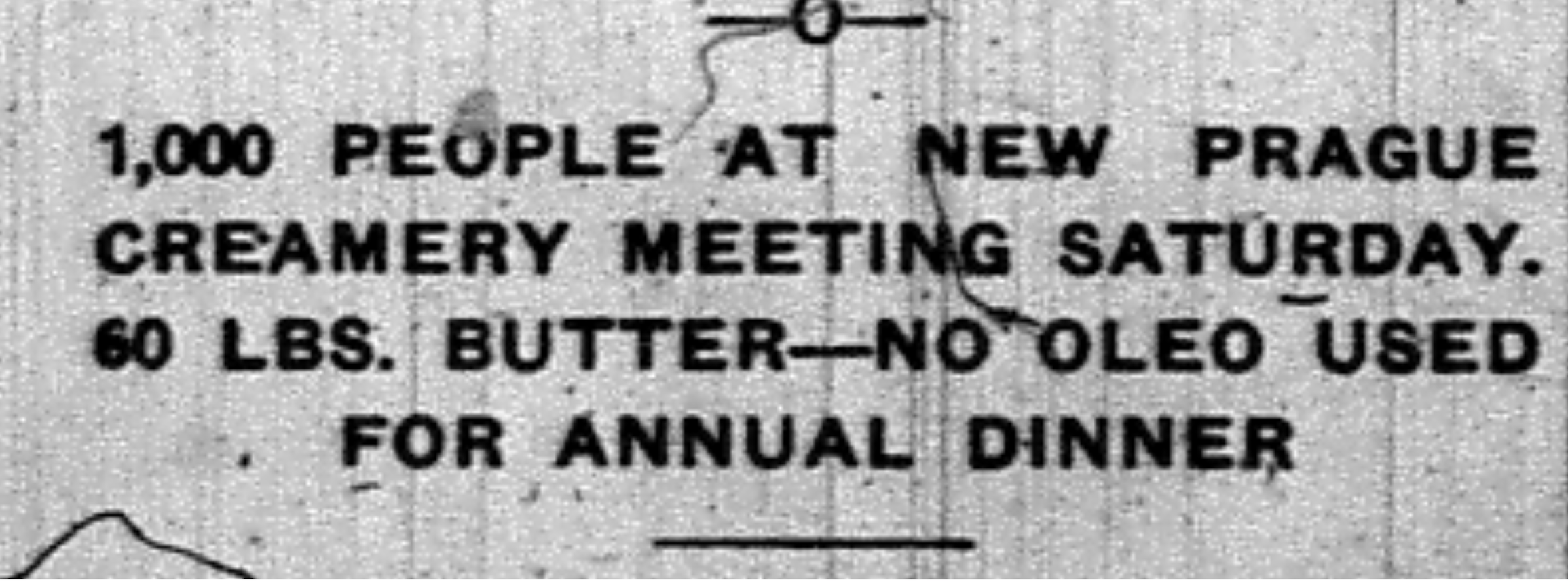
The Shakopee Argus Tribune addressed farming concerns in a Feb 6th, 1930 article: “The trouble with the butter price situation is not so much overproduction as it is underconsumption. Too much butter substitute, or oleo, is being used”.  On February 13th the editor of the Argus told the story of Welcome, Minnesota where merchants had agreed to refuse to stock oleo. He wrote “This is a good move and would, without question, bring definite results if it would become widespread. Oleo is simply a substitute for butter, the same as peanut butter or another spread, and does not provide the essential healthful qualities of butter”  

On February 20th, the Argus Tribune offered some advice to farmers wishing to combat the Oleo problem. “Advertising – advertise the use of butter and other dairy products” In fact, they confided, “there is no better medium in the world to advertise them then your local weekly newspaper, which in this case is the Shakpoee Argus- Tribune.”  

Headline from the Shakopee Argus Tribune, February 20th, 1930

Headline from the Shakopee Argus Tribune, February 20th, 1930

In March, Oleo was still enemy number one. On March 20th, the production of Oleo was broken down. It was noted that 1000 lbs of Oleo was comprised of coconut oil ($40.00), soy bean oil ($15.00), skimmed milk ($1.50), and salt (1.00). The author also lamented “Including labor and other overhead, this means a cost of only eight cents per pound of oleo. Where is there a dairyman in Scott County who can compete with it?”. It was instead put on local merchants to make the “right” choice and agree to “advertise butter only”.  

By March 27th, local dairy farmers had gotten their wish. According to the Argus Tribune “Shakopee merchants last week entered into an agreement with each other not to sell or handle any more oleo…that the dairy farmers will appreciate this voluntary action of our merchants goes without saying”.  

Dairy farmers had a hard road ahead. Scott County was not the only area where farmers were suffering during the Great Depression. The butter battle was national. Farmers pushed back through legislation, and bills were passed demanding that word “butter” not be used in any oleo advertising. It was also illegal to dye oleo a pale yellow to match butter. Instead, oleo was packaged with a small baggie of dye, allowing housewives to change the color of their spread at home. The last of these dye laws was on the books until 1976.  In Wisconsin the battle against oleo became violent. In 1933 the state was home to series of dairy strikes where farmers refused to sell their butterfat for less than $1.50 per 100 lbs. Eventually the state brought in armed guards and used tear gas to martial dairy trucks through the farmers’ blockade to market.  

Unfortunately, margarine was on the market to stay. By the 1950s, Americans became concerned about fat. Margarine, which had been lambasted for its “dangerous chemical properties” began to be marked as a healthful alternative to butter. By the mid 1960s, Margarine was outselling Butter. The reign of Oleo did not last though- today, amid concerns about trans fats, butter is on the rise. For the first time in 50 years the dairy farmers are getting their wish and butter once again outselling Margarine.