To Grandmother's House We Go

The following is an excerpt of “To Grandmother’s House We Go,” written by Roger Huss and recently added to the SCHS Research Library. For the full text, visit SCHS or email rogerhuss@optonline.net. If you would like to write for the SCHS blog, contact us at info@scottcountyhistory.org.

This excerpt begins with the fourth generation of the Huss family.

Do you remember the words to the song: "Over the river and through the woods / to grandmother's house we go?" It began as a Thanksgiving song and soon was adopted as a Christmas song. Well, this is a story about generations of Huss families, and they all had grandmothers. I had a special one, Elizabeth (Lenz) Huss, the only one I remember. We lived together on the Huss family farm at Union Hill. That farm was owned by four Huss generations, and, if you count the children of the fourth, five Huss generations called that house home. And they all celebrated Christmas.

With the seven daughters married and away, the Huss house was a quieter place, but not for long–John and Martha Huss began having children, part of the fourth generation. There were 9 children in their family. The daughters of Mathias and Elizabeth, except for Anna, were also having children. And, so Grandpa and Grandma Huss were blessed with 43 grandchildren that became the fourth generation, born over a span of 41 years. With all the uncles and aunts and cousins visiting our house on the farm during the Christmas season, it was an exciting place. Grandpa Huss died in 1933, but Grandma Huss, who died in 1950, lived to see all of her grandchildren except one, who was born the year after her death. 

So, what was Christmas like at that time at our house? It was fun being in a family of 9 children, and exciting with the visits of the uncles and aunts and their children, among them children of our ages. There was no limit to the fun we had and the trouble we could get into, especially the boys. In our home, and I think in the homes of our cousins, many of the customs handed down from previous generations were preserved. The Christmas season started with St. Nikolas Day on December 6th and ended on the Feast of the Epiphany on January 6th. That is one month of celebrations, but it started even earlier, in a way, because the children were admonished to be good to avoid St. Nikolas leaving a piece of coal as a gift. He usually made a short personal visit to our house, riding into the dining room on a donkey (so strange with eyes that looked like buttons), followed by a helper who brought the gifts, and Black Peter who carried the coal. I don't remember Black Peter leaving coal, surely because we were good kids. Pa had a personal connection with St. Nikolas, making sure visits were made to other families in the area, sometimes even leading St. Nikolas from place to place so that no one would be missed.

The next big event was the school play involving all the students from the Union Hill School. Several times, the play was an operetta with orchestral accompaniment by a small group of local musicians. Christmas vacation began the day after the play.

We always had a Christmas tree, and when electricity became available in the late 1930s, we used electric Christmas tree lights. If one bulb failed, the entire string of lights would go out, and it was necessary to find the bad bulb and replace it.

Santa came to our house on Christmas Eve, but only after the farm chores were done and, in the house, after the dishes were washed and the house was cleaned. The children helped even more than usual because they were full of anticipation. Sensing the excitement, Grandma Huss would suggest to Ma and Pa that she would take the children to the basement to await the arrival of Santa. Of course, our parents liked the idea and said they would join us shortly, which seemed awfully long to us. We met in the furnace room, enjoying the warmth of a crackling fire in the furnace and the delightful smell of burning wood (our answer to a fireplace which we did not have). After praying and singing carols, many of them in German because they were the songs Grandma knew, the anticipation grew as we wondered where Santa might be. When the suspense got to be just right, Pa would say he thought he heard something upstairs and suggested we check to see if Santa had arrived, but not too early, since Santa did not want to be seen. And, so, one of the younger children would crawl up the stairs quietly, open the door a crack, and, surely, Santa had arrived, left the gifts, and was on his way to the next stop.

Gifts would typically consist of items of clothing (perhaps to be worn at Christmas Mass), toys and lots of candy, nuts, and fruit. Grandma would have gifts for grandchildren, not store- bought, but rather, handmade woolen mittens and stockings that she had been knitting all year long. The best toys I remember are the Christmas horses, the first one a toy, and the other one a real animal. The toy horse was a tricycle with reins used to turn the head attached to the front wheel, and pedals under the horse to provide the power. We must have driven it around the dining room table a thousand times, and not without a few arguments about "it is my turn." The real horse was a Shetland pony, only about four feet tall, that we found tied to the washing machine on the front porch. We also got a buggy for the pony and would use it to visit friends, and even Grandma would ride along, particularly to pick chokecherries along the fence lines.

We did not stay up very late on Christmas Eve because we had to get up early on Christmas morning to attend the first Mass of Christmas at 5 AM. Mass was preceded by a visit to the crèche set up at a side altar where a reading known as The Genealogy of the Crib took place. It consisted of scriptural writings about the nativity and the lineage of Jesus. Then, the priest, along with all the servers dressed in red cassocks and white surplices, processed to the sanctuary. The four active servers joined the priest at the altar while the other servers carried candles to their places along the front of the communion rail. The choir, which would sing at three Masses, would rehearse for several months for the occasion. Union Hill was noted for the quality of its male choir and in some years would have orchestral accompaniment to the choir. Since most of the instrumentalists in the orchestra were also choir members, a mixed choir of men and women was formed to bring the choir up to the desired number of singers.

By the time the 10 o'clock Mass, the last Mass on Christmas day, had ended, throats were dry and a visit to the tavern in Union Hill was in order, especially because there was free beer until noon when the tavern closed for the day. This was a time for the men in the community to meet, socialize, and avoid being in the way at home while the women were preparing the Christmas dinner. Because all were having such a good time in the tavern, frequently the free beer flowed beyond noon, and it was not unheard of to receive a telephone call at the tavern suggesting (or demanding if it was the second call) that it was time to come home, that dinner was ready.

Food was an essential part of the Christmas celebration. Midnight Mass eventually became popular, and it became customary after returning home to have a snack, a liberal portion of homemade sausages: bratwurst, leberwurst, and blutwurst. The sausages might also be served for breakfast on Christmas morning or, instead, rings of delicious, warm baloney made in a meat market in Jordan. Christmas dinner served at noon (or a little later if the men were delayed at the tavern) would usually have as its main course chicken or ham and sometimes, but rarely, duck or goose, with mashed potatoes and gravy provided in liberal quantity. Vegetables would be those harvested from the garden in the summer: canned beans, peas, carrots, corn, and sauerkraut taken from the stone crock in the basement. It was considered acceptable to serve sauerkraut regardless of the type of meat being served. The meal was topped off with Ma's special dessert, lemon meringue pie - heavy on the filling and light on the meringue. Beer was the preferred type of libation, but always drunk before the meal, not with it. Usually, Pa would buy a gallon of sweet wine for use during the Christmas season and what was left might not be touched until the next Christmas. Interestingly, the term “cholesterol” was not part of the vocabulary at that time.

 Lots of visiting was done at Christmastime while we were on vacation from school, back and forth between our house and that of others. With Grandma Huss living with us, of course there were visits from her seven daughters, their husbands and families. Those who lived far away, the Krieglmeiers and Kaisers who lived in St. Paul (considered far away), sometimes would stay with us for several days or with other relatives in the area. With our household of nine children plus Pa, Ma, Grandma, and the hired man, adding uncles, aunts and cousins made it an exciting place. And, even if at the last moment guests would accept Ma's offer to stay for dinner or supper, it seemed to be no problem (at least to us children). It merely meant going to the basement for more potatoes for the kettle, some jars of canned meat, canned vegetables and fruit, and the addition of more plates at the table. And, for Pa, perhaps a trip was made to the tavern at Union Hill for a jug of beer.

The 27th day of December was a special day of celebration, the feast-day of St. John the Evangelist, the patron saint of the church at Union Hill, and of Pa, as it was for his grandfather, Johann Huss. While not a Christmas event, it fit nicely into the holiday season. At the church there would be a Solemn High Mass requiring three priests - celebrant, deacon and subdeacon - with the two extra priests coming from the Franciscan Monastery in Jordan. In a custom Johann brought over from Germany, in the evening there would be a name's day party at the Huss home. The guests would give the greeting: "Heilige Johannes Tag," or “Holy St. John's Day.” There would be card games and usually a pony of beer (four gallons in a wooden keg), and at the end of the evening, a lunch would be served.

The next event in the season was important to me but was given little attention. It was my birthday on December 29th. Birthdays were quiet affairs, maybe there would be a special cake, but there were no elaborate parties nor lavish gifts. New Year's Eve was a non-event for children; they went to bed. Pa might take his shotgun and visit a neighbor where they would fire a shot at midnight to announce the arrival of the new year. The festive season was winding down. The Christmas season ended on a religious note on the feast of the Epiphany on the 6th of January. While it was not a holy day of obligation to attend Mass, most of the parishioners in Union Hill did so.

And, so, while the days of the Christmas season were exciting for children, the days that followed were the dreary days of winter. But there was school, farm and house work, and games that were received at Christmas time, that kept children occupied. Eventually it would be spring, followed by summer and fall. The yearly cycle was complete and it was time once again for the wonderful and exciting season of Christmas.

And that is what Christmas was like for the fourth generation. Some things new, but many still the same–the customs Johann and Elizabeth Huss brought with them from Germany, the traditions of their ancestors.


Fifth and Future Generations

Time passes and things change! Now, into the seventh generation, most of the old customs have died out and are a matter of history rather than practice. I treasure them, and my reason for writing this article is to preserve and share that history with those who have an interest in it.

The last Huss that was an owner of the same farm Johann and Elizabeth Huss owned at Union Hill was my brother Linus, and his wife, Theresa (Shaughnessy). With six children on a working farm it was a lively place, leaving fond memories with our children who enjoyed vacationing there and got a bit of appreciation of what farm life was like. And, now, a large electrical power line is being built that runs along the road running through the farm, with an enormous substation standing on the hill to the east. I guess you can't stop progress; the power line must run through somebody's property.

I am saddened by the power line, but I am glad I have memories of those earlier times on the farm. How awesome, standing on the outdoor porch on a summer's day, looking east over the creek meandering through the pasture and seeing the beautiful landscape for almost a mile in the distance. The sun shone on the fields of green hay, tall corn in neat rows, and oats and barley turning from green to yellow, soon ready to be harvested. The dog was there too, anxiously waiting for the signal to run to the pasture to herd the cattle under the stone bridge and into the barn for evening milking. At 6 p.m., the Angelus bells at St. John’s were rung, and it was time to go into the house, recite the Angelus Prayer, and eat supper.

Thoughts

Drawing on my 8 years of memories of her while she was alive, I thought a lot about my Grandma Huss as I was writing this article, "To Grandmother's House We Go." Grandmas are always special, but she was extra special. While there are lots of endearing qualities that could be mentioned to describe her, when my brothers, sisters and I get together to talk, what we agree is most striking is that we do not remember Grandma and Ma ever having a cross word between them. They were saints. 

Little Shipyard on the Prairie, Part 3

This post was written by guest blogger Charles Pederson. If you would like to write for our blog, contact us at info@scottcountyhistory.org

Read Little Shipyard on the Prairie, Part 1 and Part 2.

Parts 1 and 2 of our story revealed the unexpected origins of Port Cargill, a shipyard in a most unlikely location. Part 3, the final chapter, discusses the nuts and bolts of launch, how the AOGs entered wartime service, and what became of them.

Launch!

Speedily setting up the shipyard, Cargill signed an initial contract with the U.S. Navy for six auxiliary oilers and gasoline vessels (AOGs). By the end of the war, the shipyard at Savage was to produce 18 AOGs and four towboats.

The USS Agawam was the first AOG turned out at Port Cargill. On May 6, 1943, its mostly empty hull was launched into the deep pool dredged in the river. It was positioned in an empty docking slot for initial fitting.

The launching of a vessel was quite an event. Dave Kenney, in Minnesota Goes to War, describes a typical sideways launch, as was practiced at Port Cargill:

Workers waxed and greased the huge twenty-four-by-eighteen-inch timbers—called sliding ways—that lay between the blocks on which the keel was laid. At the assigned moment, dozens of men armed with sledgehammers began driving wedges under the sliding ways until they lifted the keel off its blocks. The men then knocked the blocks away and ran from beneath the vessel as fast as they could. At that point, the ship was being held in place only by a hawser [thick mooring rope]. On the signal, the ship’s sponsor cracked a bottle of champagne . . . on the bow, and the launch master pressed a button that dropped a guillotine on the hawser. The ship, now free of all restraints, slid down the ways and crashed into the water.

It was an exciting moment waiting to see whether the vessel would right itself. It always did.

After initial fitting at Port Cargill, the Agawam was ready for delivery early in the morning of November 5, 1943. The vessel was expected to navigate the tricky intricacies of the Minnesota River 14 miles to Saint Paul and the Mississippi River. This was by no means a sure thing. Tugs and towboats escorted the ship. Its masts had been removed and laid on the deck so the ship could slide beneath bridges spanning the waterway. Kenney writes that “at several crucial points along the way, crews armed with trucks and cables stood by, ready to pull the tanker out of trouble should it run aground.”

The planners and crews needn’t have worried. The Agawam reached Saint Paul that same afternoon. The St. Paul Pioneer Press greeted its arrival: “A sleek gray ship, whose cavernous insides may carry fuel for planes to blast Germany or Japan, arrived in St. Paul. Fears that the vessel would be grounded on the turns on the Minnesota River . . . proved baseless.”

Finishing Touches

After completion at Port Cargill, the AOGs were towed to the Mississippi River, and thence to New Orleans. There the ships received final fittings, including a camouflage paint job as required. Then they were taken out for shakedown—testing the vessel under real-world operating conditions. Once the vessels received a clean bill of health, they steamed through the Panama Canal to the Pacific to support the war effort.

The entire list of AOGs includes (in order of production) Agawam, Elkhorn, Genesee, Kishwaukee, Nemasket, Tombigbee, Chehalis, Chestatee, Chewaucan, Maquoketa, Mattabesset, Namakagon, Natchaug, Nespelen, Noxubee, Pecatonica, and Pinnebog. Port Cargill produced its last ship, the Wacissa, in May 1946, about nine months after hostilities had ceased in Japan.

Additionally, four towboats had been born of the shipyard: the Bataan, Coral Sea, Milne Bay, and Bou Arada.

What Happened After

Many of the AOGs survived World War II and went on to have fruitful wartime and postwar lives.

The Agawam, for example, Port Cargill’s first ship, supported the invasion of the Philippine Islands in March 1945. Immediately after Japan surrendered, the Agawam was sent to Yokohama, Japan, to fuel Army bases through early 1946. It was stationed in various areas until it was decommissioned in 1960 and placed in reserve until being scrapped in 1975.

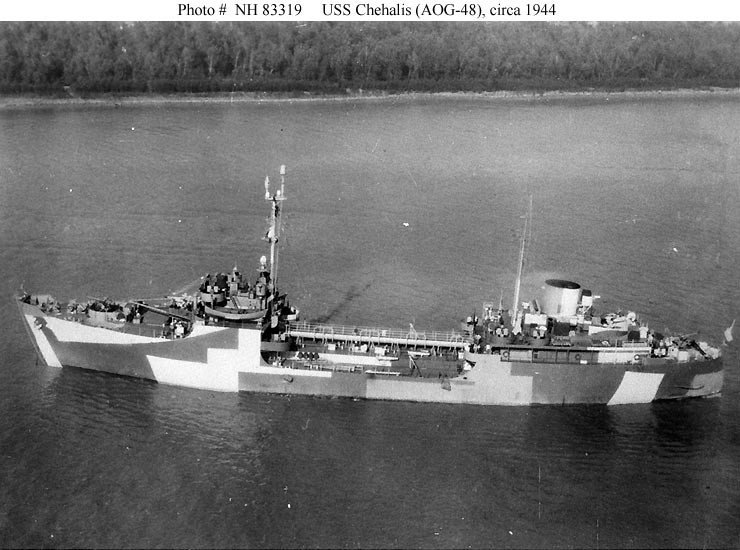
Not all Cargill-manufactured AOGs had happy or peaceful careers. The USS Chehalis (pictured in camouflage paint), was launched in late 1944. Five years later, one of its gasoline tanks exploded, and the ship burned and sank. The hull was raised in 1955 and sold to American Samoa. Courtesy of Archives Branch, Naval History and Heritage Command, Washington, DC. 

Some of the AOGs remained in the U.S. military, serving in Korea and Vietnam. Many received official recognition for their service during these conflicts. Some were sold to militaries in Greece, Colombia, and Taiwan. Some became civilian vessels, used for fishing or other commercial pursuits. Many were sold for scrap metal.

Several of the AOGs were used well into the early 2000s. The longest-lived vessels were the Elkhorn (renamed Hsing Lung) and Pecatonica (Chang Pei), which ended their useful life in 2008 as part of the Taiwanese Navy.

After World War II ended, government contracts for shipbuilding dried up. Port Cargill was converted into a grain shipping hub, which proved far more profitable than building ships had been. Today, hundreds of trucks a day drop off grain, salt, and other commodities at the port. From there barges carry the commodities down the Minnesota River to its confluence with the Mississippi, and from there to the rest of the world.

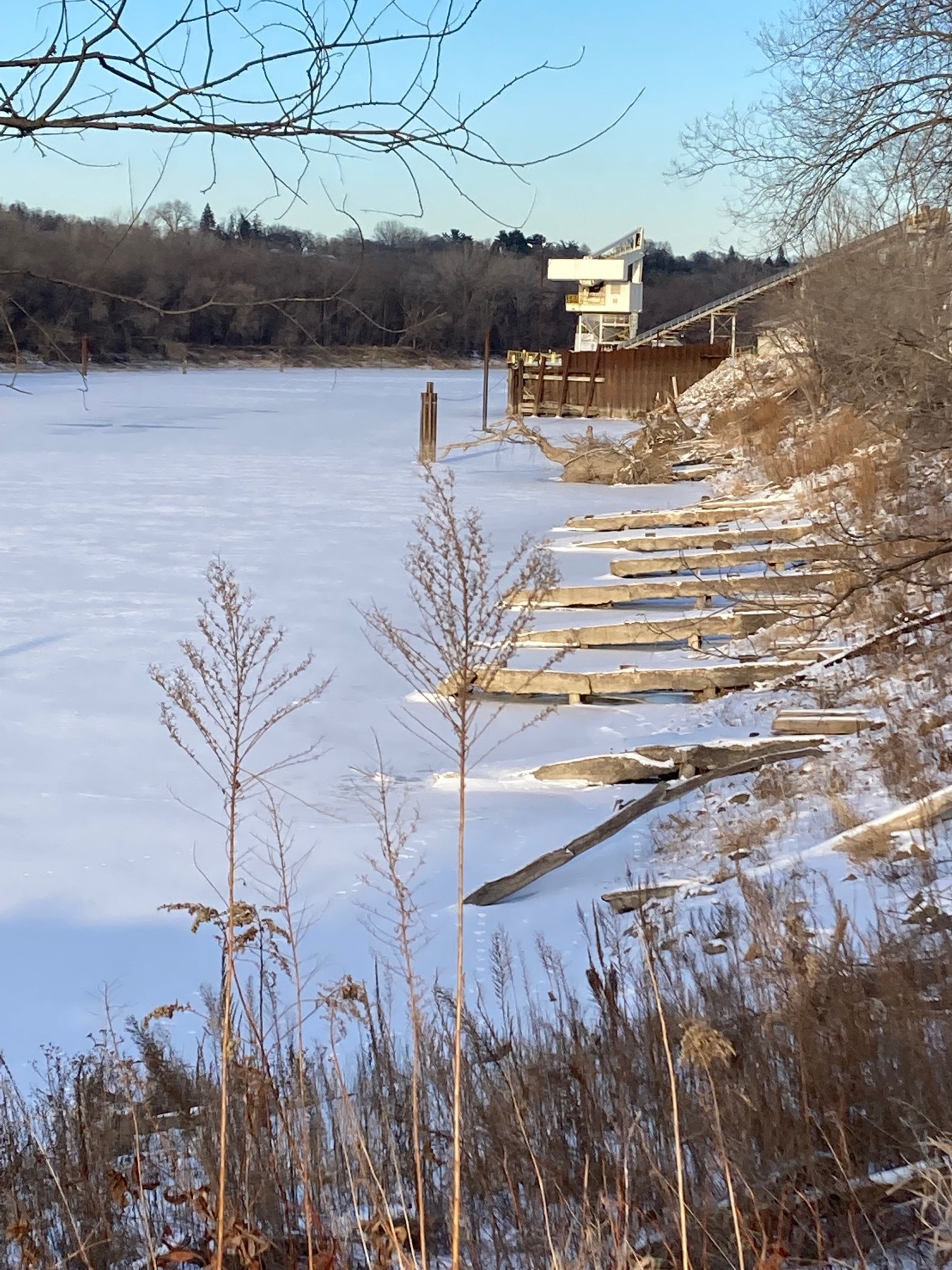
One or two buildings from the original site still quietly stand sentinel, perhaps contemplating the busy past. The sliding ways’ fingers still reach into the quiet waters of the Minnesota River, into a patriotic past.

Early 2022: A quiet winter evening at the remnants of the sliding ways at Port Cargill shipyards. Courtesy of Charles Pederson, with thanks to Cargill Inc.

Learn More!

Blegen, Theodore H. (1975). Minnesota: A History of the State (2nd ed.). University of Minnesota Press.

British Pathé. (2020, November 10). Five Ships Launched Sideways (1938). [Video].

Cargill.com. (n.d.). Building Ships to Provide Wartime Resources.

City of Savage. (n.d.). History: Cargill Ship Building.

Colton, Tim. (2021, August 7). Emergency Shipyards: Cargill.

Congressional Record. (1944, March 24–June 12). Launching of the U.S.S. “Chehalis”: Extension of Remarks of Hon. Fred Norman of Washington in the House of Representatives, Tuesday, May 2, 1944.

Duluth Seaway Authority. (2004). Launching the Quint Fleet [PDF].

Federal Reserve History. (2013, November 22). The Great Depression: 1929–1941.

Jordan Independent. (1942, April 2). Ocean Shipbuilding Will Be Done at Savage.

Kenney, Dave. (2005). Minnesota Goes to War: The Home Front During World War II. Minnesota Historical Society Press.

Minnesota Digital Library. (n.d.). Port Cargill, Scott County, Minnesota [Photograph].

MNOpedia. (n.d.). Launching the Agawam [Photo].

Naval History and Heritage Command. (n.d.). Agawam III (AOG-6).

Nelson, Tim. (2015, October 19). From Humble Beginnings to Global Power, Cargill Marks 150 Years. MPR News.

Roosevelt, Franklin D. (1939, September 3). Fireside Chat. The American Presidency Project.

Roosevelt, Franklin D. (1941, January 6). President Roosevelt’s Annual Message (Four Freedoms) to Congress (1941). Our Documents.

Roosevelt, Franklin D. (1942, January 6). State of the Union Address: Franklin D. Roosevelt (January 6, 1942). In Infoplease. https://www.infoplease.com/primary-sources/government/presidential-speeches/state-union-address-franklin-d-roosevelt-january-6-1942

Tapalaga, Andrei. (2020, July 14). The Tragic Story of the Dionne Quintuplets. History of Yesterday.

Time. (1943, September 13). Production: The Farmer Goes to Sea.

U.S. Bureau of Labor Statistics. (n.d.) CPI Inflation Calculator. https://www.bls.gov/data/inflation_calculator.htm

U.S. Naval History Division. (1959). Dictionary of American Naval Fighting Ships (Vol. 5). Navy Department, Office of the Chief of Naval Operations, Naval History Division. Click “Read for Free” button.

Wurzer, Cathy. (2010, June 16). Minn. Companies Helped Fight WWII in Surprising Ways. MPR News Morning Edition.

Zenith City Press. (n.d.). May 8, 1943: The “Dionne Quints” Launch Five Ships.

Thank you to Cargill for sponsoring this series and providing access that makes this story possible.

Little Shipyard on the Prairie, Part 2

This post was written by guest blogger Charles Pederson. If you would like to write for our blog, contact us at info@scottcountyhistory.org

Read Little Shipyard on the Prairie, Part 1.

Welcome to Part 2 (of three parts). This part describes the origin story of a landlocked shipyard in the middle of Minnesota.

The Basic Outline of Minnesota War Production

With its purchase of land, Cargill was ready to dive into its Minnesota shipbuilding enterprise. Was it as wacky an idea as it seemed?

Minnesota already had a thriving shipbuilding industry, particularly in the north. Minnesota historian Theodor Blegen commented, “Duluth was a natural center for ship-building, [turning out] oil tankers, submarine chasers, and coast guard cutters.” The Navy had already signed contracts with one Minnesota company after another. Between the Twin Ports of Duluth and Superior, five companies were capable of building warships at the start of the war: Marine Iron and Shipbuilding, Inland Waterways, Zenith Dredge Company, Scott-Graff Lumber Company, and Industrial Construction Company.

Along with ship construction, the production of guns, ammunition, bombsights, and food were occurring throughout the state. Companies were making everything from small-arms ammunition to barbed wire to machine guns. Hormel was cranking out blue cans of Spam. Northern Pump of Fridley created ships’ guns. The University of Minnesota developed K Rations for the troops to eat. General Mills and Pillsbury taught people on the home front to stretch their meals during times of rationing. Honeywell manufactured gunsights. From Winona to the Iron Range, Minnesota wartime manufacturing had stepped up to answer FDR’s plea for more materiel.

The basic outline of Cargill’s idea was simple: Ships were to be built and launched in Savage, then towed to the Mississippi. They would then be shepherded downriver to New Orleans for final fitting-out with engines, paint jobs, and other necessaries. Finally, after real-world testing of all the equipment and systems, the auxiliary oilers and gas tankers (AOGs) would steam to the Pacific war zone.

But the whole enterprise was maybe not so straightforward as the basic outline implied.

Crazy? Maybe. But Maybe Not

Time magazine, in 1943, wrote,

“When Cargill began buying farm and meadowland along the tree-shaded Minnesota River near Savage, Minn, [a] little over a year ago, even Cargill-wise farmers hooted at the fantastic reason: Cargill was going to set up a shipyard to build ocean-going vessels. They had some excuse for hooting.”

From Savage to the Mississippi River, ships would have to negotiate 14 miles of the meandering Minnesota River. At an average depth of 3.5 feet, the Minnesota was far too shallow for the large tanker ships being proposed for the Savage shipyard.

Not only skepticism but also downright ridicule was aimed at the crazy idea. A letter to the editor of the St. Paul Dispatch disgustedly maintained, “It is hard for me to understand why vessels of any description whatsoever should be launched on a small muddy stream such as the Minnesota river . . . [and] why the government should have even considered placing a shipyard at a point where heavy dredging must be undertaken before the ships can be moved.”

The craziness of river depth was ironed out by the Army Corps of Engineers. They not only dredged the entire 14-mile length to a depth of 9 feet but also scooped out a 20-foot launching pool at the shipyard riverbank.

And not everyone thought a local employment opportunity was in the least crazy. The Jordan Independent of April 2, 1942, remarked that “with three-shift activity, Savage shipyards will employ approximately 1,000. . . . Most of the workers at the yards will be Minnesotans, of whom a number may be Scott County [residents].” At its peak, the shipyard employed about 3,500 workers. Many of these were females taking on “men’s work” in unprecedented numbers nationwide while the males were off fighting and doing other “war stuff.”

The Ships

Despite controversy, Cargill broke ground at the Savage shipyard in April 1942. By early September, the first keel—for the USS Agawam—was laid. And nine months later, the first AOG was launched in May 1943. During this period, the Army Corps of Engineers first dredged a deep pool for launching and fitting the ships. Then they undertook to scoop out a deep channel in the shallow Minnesota River. The cost to dredge a channel from Savage to the confluence of the Minnesota and Mississippi Rivers was $250,000, a cost that Cargill bore. (This amount equals $4.3 million dollars in 2022.)

Cargill’s first Navy contract was for six AOGs and several towboats to move them. AOGs were meant to supply fuel to military forces fighting the Japanese in the Pacific theater of operations. The AOGs were an all-Minnesota production, with equipment from manufacturers all over the state.

The Genesee, third AOG from Port Cargill, was launched side-on into the Minnesota River at Savage, on September 4, 1943. Courtesy of Minnesota Historical Society.

AOGs were given Native American names of U.S. rivers. At about 300 feet in length, each was as long as a football field. Each AOG carried a complement of 11 officers and 120 crew. Although not specifically armed for battle, each AOG carried four 3-inch guns and twelve 20mm machine guns. To fulfill their duty of refueling naval ships and land bases, the ships could carry up to 410,000 gallons of gasoline or 8,000 barrels (336,000 gallons) of oil.

Along with a total of 18 AOGs, Cargill built four towboats to lead them from Savage to the Mississippi. Towboats of this type were named for turning-point battles in the Pacific and North Africa: the Bataan, Coral Sea, Milne Bay, and Bou Arada.

Stay tuned for Part 3, the fascinating conclusion of the story of the shipyard at Port Cargill! It discusses the nuts and bolts of launch, how the AOGs entered wartime service, and what became of them.

Thank you to Cargill for sponsoring this series and providing access that makes this story possible.

Little Shipyard on the Prairie, Part 1

This post was written by guest blogger Charles Pederson. If you would like to write for our blog, contact us at info@scottcountyhistory.org

Welcome to Part 1 of a three-part story about a little-known episode in Scott County History: the Savage Shipyards and Port Cargill.

Picture a 1944 black-and-white newsreel: At water’s edge, a gargantuan gray warship, ready for launch at the riverbank. A small group of dignitaries stands on a nearby reviewing stand. The ship’s sponsor, bottle of champagne in hand, swings the bottle out on a delicate ribbon toward the ship. A spray of bubbles where the bottle breaks, a rousing cheer from a crowd of onlookers, and the ship immediately slides with a massive roaring splash sidelong into the river. Another weapon in the arsenal of democracy has been launched.

During World War II, this scenario was repeated in shipyards throughout the United States. Big impressive coastal shipyards fabricated big, impressive seagoing vessels. On a smaller scale, Savage, Minnesota, got in on the action as well. Savage was already doing its share to fight fascism in the Pacific Ocean during World War II, at the U.S. military’s Japanese language school, Camp Savage. Port Cargill and the Savage Shipyards would become another way this small town contributed in big ways to the war effort.

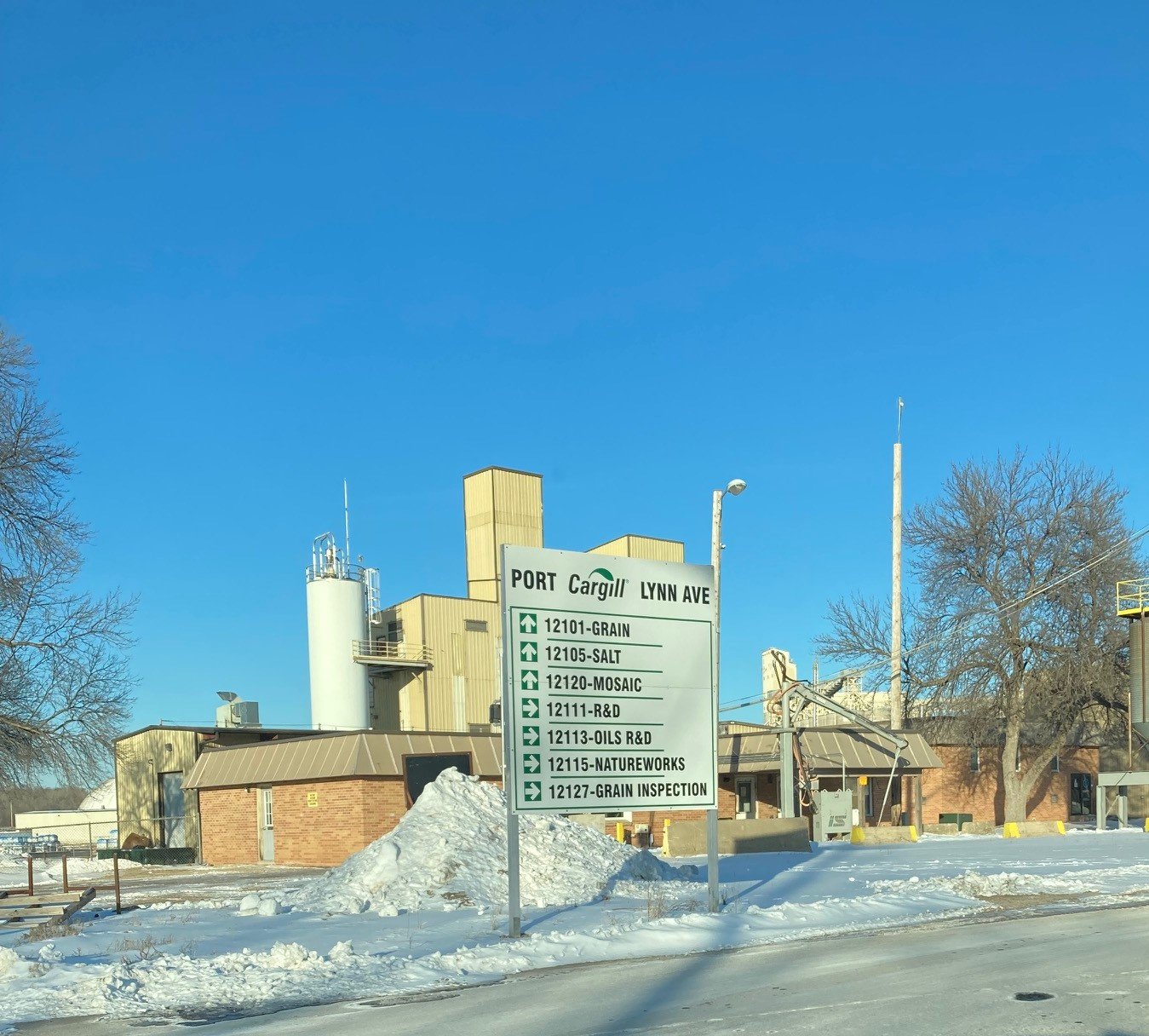
Port Cargill, also known as the Ports of Savage, continues to serve as transit point for commodities. The modest entry belies a little-known history. Courtesy of Charles Pederson, with thanks to Cargill Inc.

Out of Depression and Into the War Years

The U.S. Great Depression (1929–1941) had caused the country to pull back into itself. Tired of foreign wars and exhausted by economic disaster, most people wanted to forget about the world’s problems and just go about surviving. For years, many people had believed that getting mixed up in other countries’ problems would be a mistake.

When war broke out in Europe in 1939, the U.S. Congress was intent on maintaining U.S. neutrality. Franklin Delano Roosevelt (FDR), however, pushed back. In one of his cozy “fireside chats,” he asserted that when there is war anywhere, “the peace of all countries everywhere is in danger. . . . I cannot ask that every American remain neutral in thought.” He began a steady push to increase war production and help the Allies in Europe.

Naturally, increasing wartime production wasn’t as easy as just turning on a faucet. In 1941, FDR knew that to switch to a war footing would be “no small task. And the greatest difficulty comes at the beginning of the program, when new tools, new plant facilities, new assembly lines” are laid out. He was particularly interested in shipping. “New [shipyards] must first be constructed before the actual materiel begins to flow steadily and speedily from them.”

Gearing Up to Manufacture Shipping

In the mid-1930s, only about 10 U.S. shipyards were turning out vessels fit for war. By 1942, the deadly German submarine fleet was sinking more ships than the U.S. could produce. Not, however, until the Japanese military attacked the U.S. naval base at Pearl Harbor did most Americans realize the national danger. The attack awoke the U.S. “sleeping giant.”

Roosevelt believed his fellow citizens were ready to hear his exhortation. A month after the attack, FDR advocated increasing the number of merchant ships from 1.1 million in 1941, to 6 million in 1942, to 10 million in 1943. “These figures and similar figures for a multitude of other implements of war will give the Japanese and the Nazis a little idea of just [how little] they accomplished in the attack at Pearl Harbor,” he said in his State of the Union address.

The U.S. military began looking for additional shipbuilding facilities. Among the vessels needed were tanker ships called auxiliary oilers and gasoline haulers (AOGs). The Navy, still worried about Japanese attacks on the West Coast, found that inland shipyards were desirable. And Minneapolis-based Cargill company was ready to help meet the desire.

Sleepy Rural Village to Bustling Work yard

Cargill was a large company known primarily for shipping grain. High grain-shipping costs during the Depression had already spurred Cargill executives to design their own novel multiunit grain barge. But the unfamiliar new design caused shipyards to shy away from fabricating that crazy contraption. So in 1937 Cargill created its own makeshift shipbuilding facility at its Albany, New York, grain yard. Along with its 300-foot barge system, the Albany shipyard turned out the tanker ship Victoria. Completed in 1941, the Victoria was sold to the Argentine government, “in time to become the first Argentine ship torpedoed in World War II,” wrote a Time magazine journalist.

Shipmakers may have been leery of the barge, but it captured the interest of the U.S. Navy. After seeing Cargill’s efforts in New York, it negotiated with Cargill to build naval vessels. In a Time article, a Cargill executive stated, “That’s how we got into ship building and ocean transportation, because the U.S. government asked us.”

Rather than expand the makeshift yard in Albany, Cargill zeroed in on the village of Savage, Minnesota, in northern Scott County on the Minnesota River. The shipbuilding equipment would be physically moved from Albany to the town, which had much to recommend it. First, it was near a handy source of labor in Minneapolis. Second, the proposed shipyard was far from the coasts and insulated from Japanese attack. Finally, Minnesota was already well advanced in war production. All conditions satisfied the Navy.

Cargill quietly began to purchase land for the enterprise.

Thanks for reading Part 1, the roots of Port Cargill. Part 2 (of three parts) focuses on the crazy idea of plopping a shipyard in the middle of Minnesota. Part 3 will delve into how the ships were built, how they entered wartime service, and what became of them.

Thank you to Cargill for sponsoring this series and providing access that makes this story possible.

Snail Mail: The FBI Visits Mudbaden

Today we rarely receive handwritten letters but they were once a primary method of communication. In this blog series, we’re highlighting some of the interesting letters in our collection. 

Today’s letter was written by Olaf Olsen to Francis Mathiowetz of Sleepy Eye, MN on December 17, 1947. 

At the time, Olsen was the manager of the Mudbaden Sulphur Springs in Jordan.  In the letter, Olsen explains that he is sad to see Mathiowetz leave as he was one of the better employees. He also mentions that the FBI came looking for Mathiowetz after he left. But we are left to wonder, ‘why was the FBI looking for Mathiowetz?’ 

Scroll down past the image to read the full text of the letter.

“Dear Francis: 

Thank you for your greeting card, letter, etc. We did not like to see you go Francis, for always we classed you among our better employes. [sic] We have had several since you left, but for some unknown reason, none of them seem to stick very long. I sometimes think that it must be down in the ‘sticks’ as some call it, and perhaps that is true, for after all, if you do not have relatives or good friends with whom you can visit, there is not much to stay here for, especially, if youth is still with you. I mean this, for I often thought that it would be pretty much the same with me also, if I were younger. Mudbaden has one redeeming feature, and that is, it is a good place to save money. 

We shall be glad to see you at any time Francis, should you have occasion to be up this way. 

For your information, there has been one party checking on you since you left. He introduced himself, saying he was with the F.B.I. Whatever I could say I did say, there naturally was nothing I could say that was not in your favor. 

I have shown Mike your card, saying you had sent your best wishes to him. We all wish you a Merry Christmas and trust you will have a Very Happy and prosperous New Year. 

Sincerely Yours,

[signature of Olaf Olsen]”