
Since the SCHS member field trip this year will be at the former Mudbaden Sulphur Spa building (now the SCALE regional training facility), it seemed fitting to share some info and images of the building's former life and the uniqueness of that industry in Scott County. You can find a blog post series about the history of Mudbaden starting here so I'm not going to rewrite that, but instead I thought I'd share some some "fun facts" (or at least hopefully different/new things).
For a short period of time three sulphur spas were operating at the same time: Mudcura (just on the Carver County side of the border), Mudbaden, and the lesser talked about and shortest lived, Jordan Sulphur Springs.
Arthur C. Clausen
If you look at the main entrance portion of Mudcura and Mudbaden (as seen in the images in this article), you'll notice that they look quite similar. The same architect, Arthur Carlos Clausen, designed both buildings. [NRHP nomination form for Brookings Central Residential Historic District, 1994 - cites Arthur Clausen architect file]. Arthur came from an artistic background and was the grandson of a well-known Minneapolis painter, Peter Gui Clausen. He was born to Adler C. and Stella Clausen in 1882 and his sister, Grace, was born in 1885. By the 1900 Federal Census Stella is listed as a widow (in reality, they were divorced or separated whether by her choice or not. In any case, Adler doesn't die until 1946).
Living in Minneapolis, Stella found work as a teacher and Arthur worked his way up the architectural field starting as a draftsman and his sister, Grace, worked in design. From at least 1909-1914, Grace created tiles which would go around fireplaces in the Minneapolis area. Arthur self-published architectural plan books in which he was able to advertise Grace's designs. I'm unsure whether of Grace's tiles were used at either Mudcura or Mudbaden. Besides designing Mudcura and Mudbaden, Arthur is known for designing many houses in the Pantown area of St. Cloud. His career in Minnesota was short-lived and by 1922, Arthur had left Minnesota for the west coast.
The Jordan Sulphur Springs
About a mile up the road from Mudbaden, on the former Wescott place, another group was working on plans to build a sanitarium in 1912. The Jordan Sulphur Springs and Mudbath Sanitarium was organized in 1911 and lasted until 1924 at which point it merged with Mudbaden.
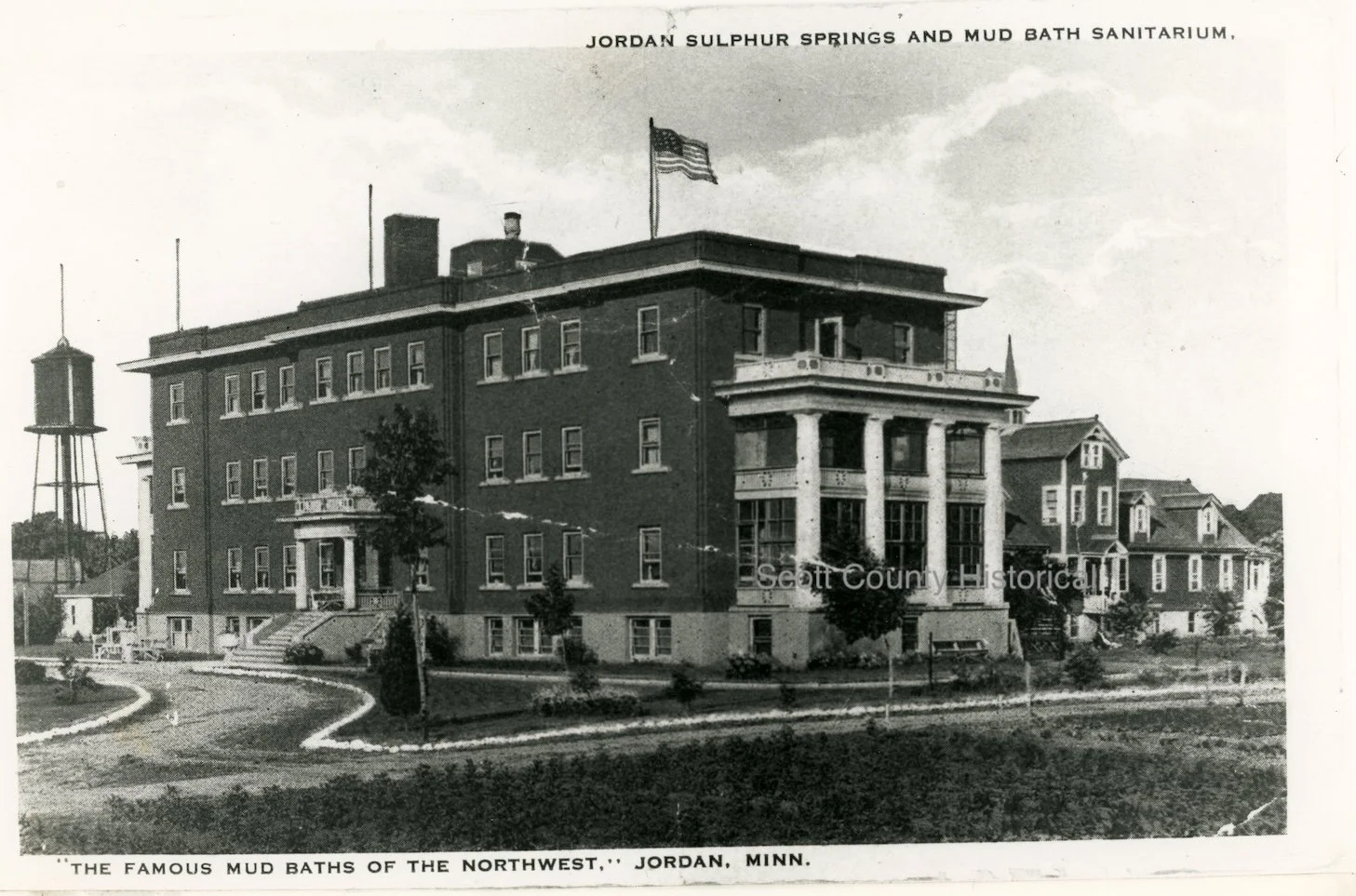
Jordan Sulphur Springs Main Building
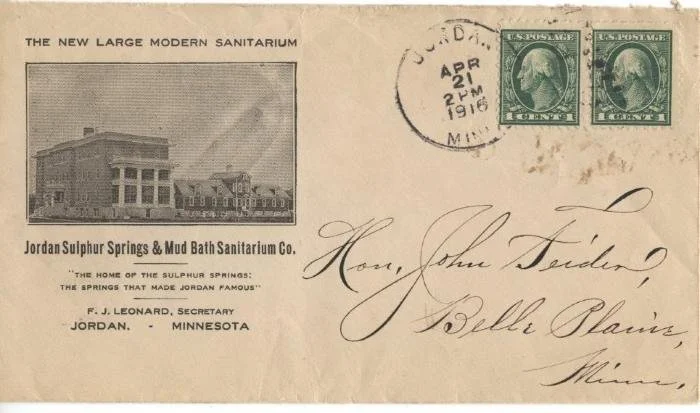
Letterhead from Jordan Sulphur Springs & Mud Bath Sanitarium, addressed to the Honorable John Feider, of Belle Plaine.
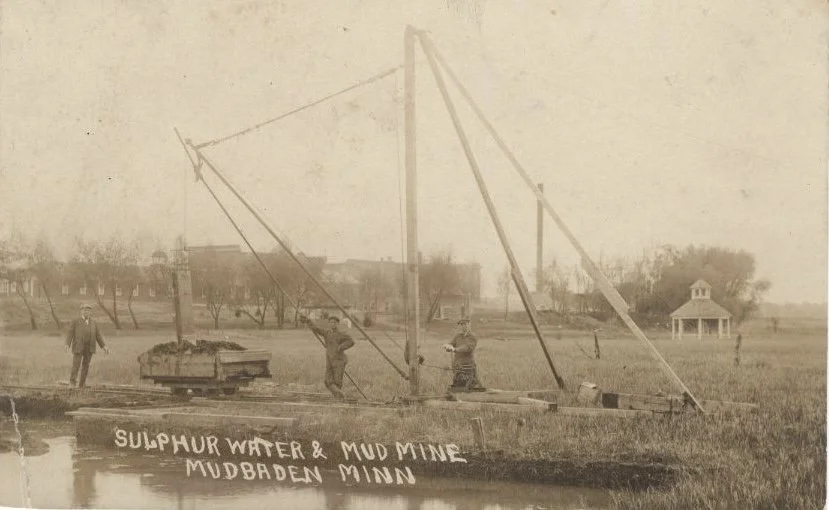
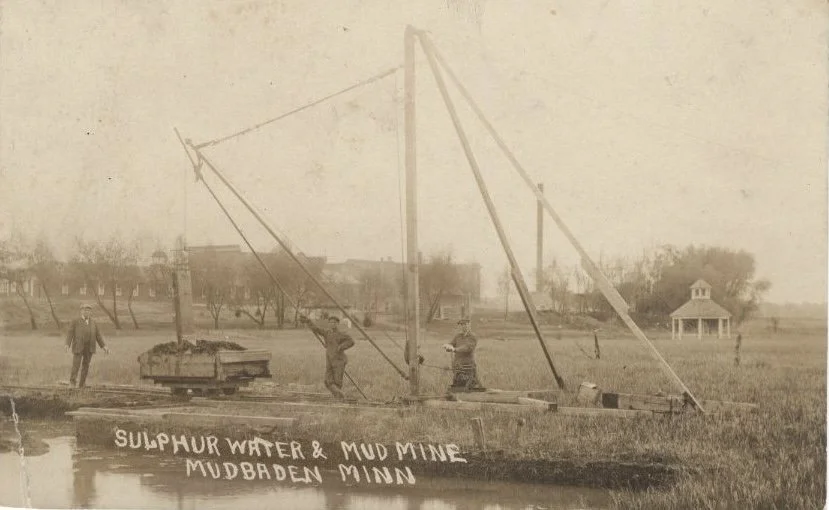
Photo postcard showing two men in a bog harvesting mud using a pulley and track system near the sulphur spas in Jordan.
The Jordan Independent provided a very descriptive announcement of the new Mudbaden building in their report. Since the building has changed from its original design, these give us a glimpse into the past.
“The length of the new building is 242 feet, and the total length of the sanitarium 425 feet. There are four steam heated sun porches measuring in all 282 feet and two open verandas of 84 feet total length.
The main lobby and main dining room in the new building are halls that would do credit to a metropolitan hotel. The lobby is 40 x 70 feet, with two beautiful fireplaces. The ceiling is lofty and beamed and the woodwork handsome quartered oak. The big dining room is 68 feet long and 32 feet wide. At either end is a great mullioned window, giving view upon charming landscape. The lofty ceiling is handsomely beamed. A seven foot wainscot of quartered oak is another notable featured of adornment. The diners are served from a great kitchen, which in the extensiveness and completeness of its appointments is said to be second to none in the state. Besides the main dining hall there are three dining rooms, also an amusement hall, 40 x 70 feet, operating room, club room, etc.
Mudbaden will be able to give accommodation and treatment to 200 patients by the time the 1916 season opens. There are telephones and hot and cold water in the rooms. Every attention and care can be given to patients. All diseases will be treated except insane and contagious, it is announced.” [Jordan Independent Oct 14, 1915 p2].
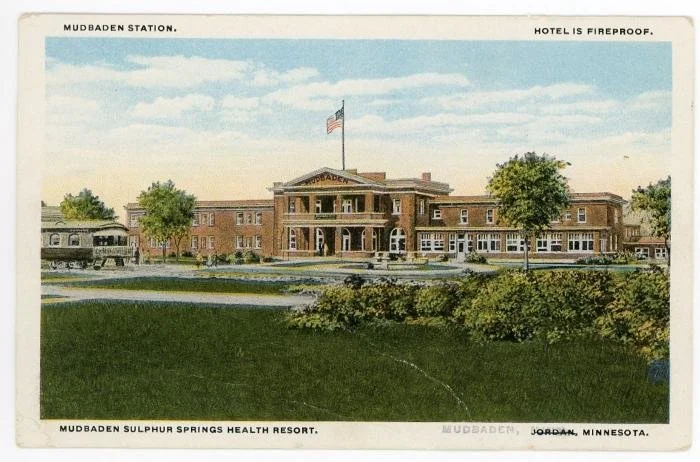
Colorized postcard of Mudbaden - note the train on the left.
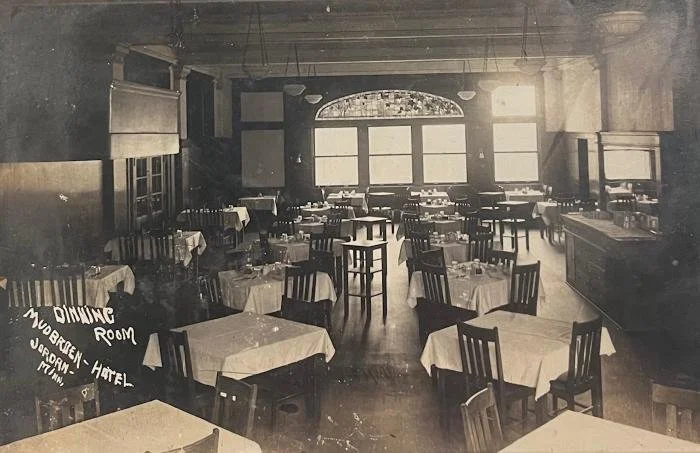
One of the dining rooms at Mudbaden.

A fork from Mudbaden - MUDBADEN is engraved on the handle.
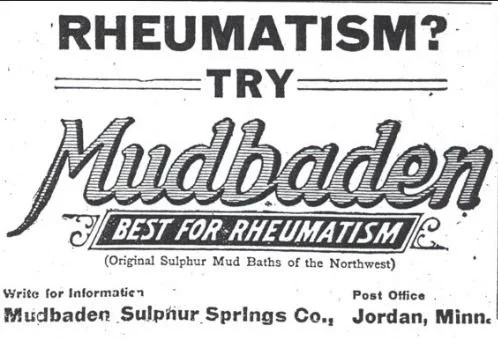
One of the many advertisements for Mudbaden - this appeared in the Shakopee Argus Tribune in 1926.
A Unique Part of the Mudbaden Real Estate Sale
The popularity of sulphuric mudbaths and other spa treatments was losing interest and numbers had diminished by World War II. In 1948 David Braun purchased Mudbaden from the E.H. Seeman estate. In 1952, Braun announced the sale of Mudbaden to the Sacred Heart Novitiate of South Bend, Indiana. Eight acres of sulphuric mud was withheld from this real estate transaction.
Verne Hedwick, the last manager of Mudbaden, announced that Watertown, SD would be the new location of the sulphuric mudbath sanitarium. In order to assure the same excellent treatment was assured, arrangements were made with Jordan trucker, Ray Lucas to haul “sufficient tonnage” of sulphur and lithia mud from the river bed to Watertown.
Changes in Architecture
When Mudbaden changed hands becoming a seminary, some of the interior features of the building also changed to accommodate the new residents. The Jordan Independent detailed these changes in their April 30, 1953 edition as follows.
"Central feature of the novitiate is the chapel in the former lobby of Mudbaden. The chapel furnishings were designed and executed by the E. Hackner Co. of La Crosse, Wisconsin, nationally known designers. The chapel was made possible through the benefactions of many friends."
"The alter, designed specifically for the novitiate chapel room with all its furnishings is of black walnut. The pews are of oak. The alter is in the form of a table. Above it a richly carved canopy. A large hand-carved crucifix hangs from the canopy and has black walnut panels with polychromed lines to imitate cloth as its background.
The circular tabernacle of hammered satin bronze has graceful lines and gives the alter further attractiveness. On the door of the tabernacle are two embossed anchors side by side the emblem of the Congregation of Holy Cross.
Polychromed symbols of the Sacraments pierce the carved frame surrounding the paneled background of the altar."
"The four walls of the chapel, paneled eight feet up from the floor in birch, part of the original design of the chapel room, are slanted to match the black walnut of the altar."
"Specially designed light fixtures have been installed to give ample brightness to the sanctuary and body of the chapel. The chapel will seat 110, leaving generous sanctuary and back aisle. [...] The sacristy is immediately off the sanctuary. It has a vesting table and drawers which run from the floor to the ceiling, all in the richly veined birch. The dining room of the former sanitarium still serves its old purpose. What was formerly the bakery room has been converted into a refectory for the professed religious on staff.
Forty-Five Rooms for Students
The kitchen connecting both the large and small dining rooms has been completely modernized. The floors are of three-colored quarry tile. The lower six-foot section wall is of ceramic tile. Sound-proof metal cabinets have been installed along the walls on both sides of the kitchen's double door. [...] The bath section of the building has been converted into a large conference room, a library, a small classroom, and work space."
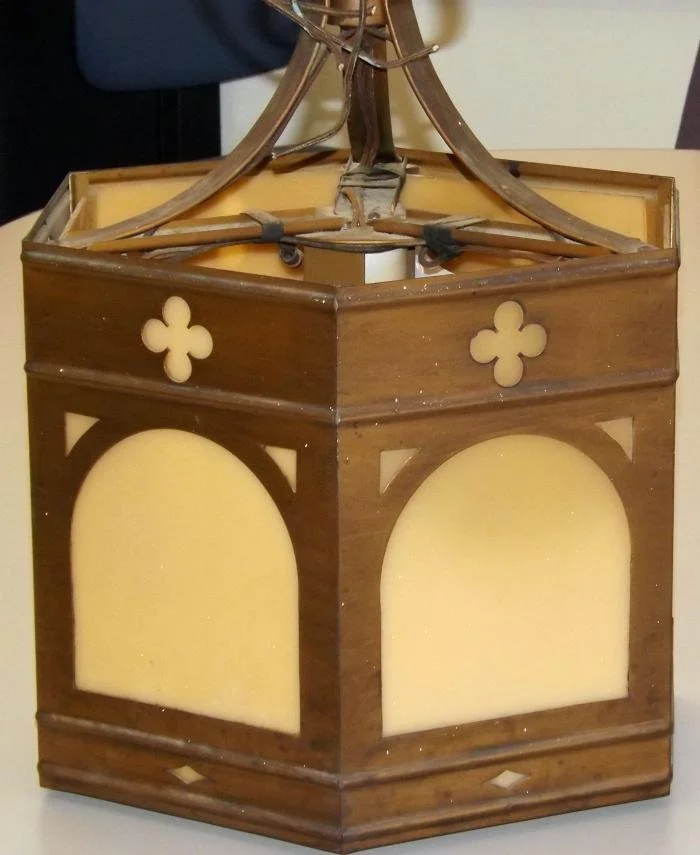
A light fixture that once hung in the Sacred Heart Seminary. One of the two in SCHS’ Collections.
Mudcura Sanitarium
The third sulphur spa in the area we will briefly touch on is Mudcura. Mudcura was located across from Shakopee in Chanhassen. While located outside of Scott County, there were a number of people who sought treatment there or were employed there from Scott County.
Dr. H. P. Fischer, of Shakopee, Dr. F.W. Goodrich, of Eden Prairie, and Dr. T. M. Larsen, of Jordan, joined forces in the new venture of Mudcura. They purchased the Alexander Cameron farm and 120 acres along a bluff with many several springs of mineral and sulphur water.
A Scott County Argus newspaper report from September 1908 noted that work would begin as soon as details could be finalized. When Mudcura opened, they had a staff of about 20. By 1930, 61 staff resided on site, while there were other employees who lived off site and commuted. Dr. Fischer died at the age of 70 in 1940. During World War II, the numbers began to dwindle and the sanitarium was sold to the Black Franciscans of Kentucky in 1951 who opened Assumption Seminary the following year. The seminary operated until 1970 at which point the building remained abandoned, minus those who broke in. In 1997, the building was destroyed in an arson fire. Today, the DNR owns the land and uses it as a natural preserve.
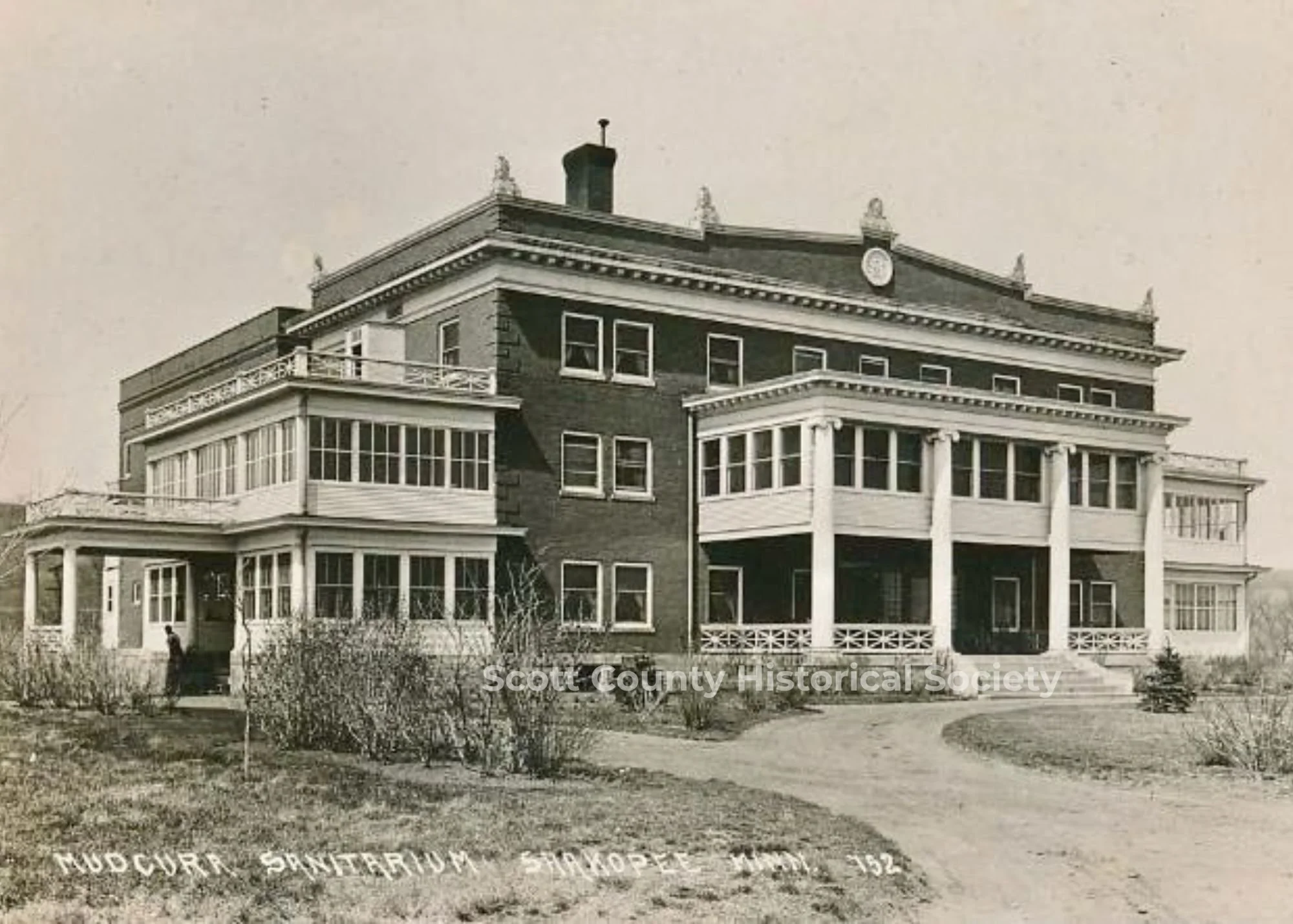
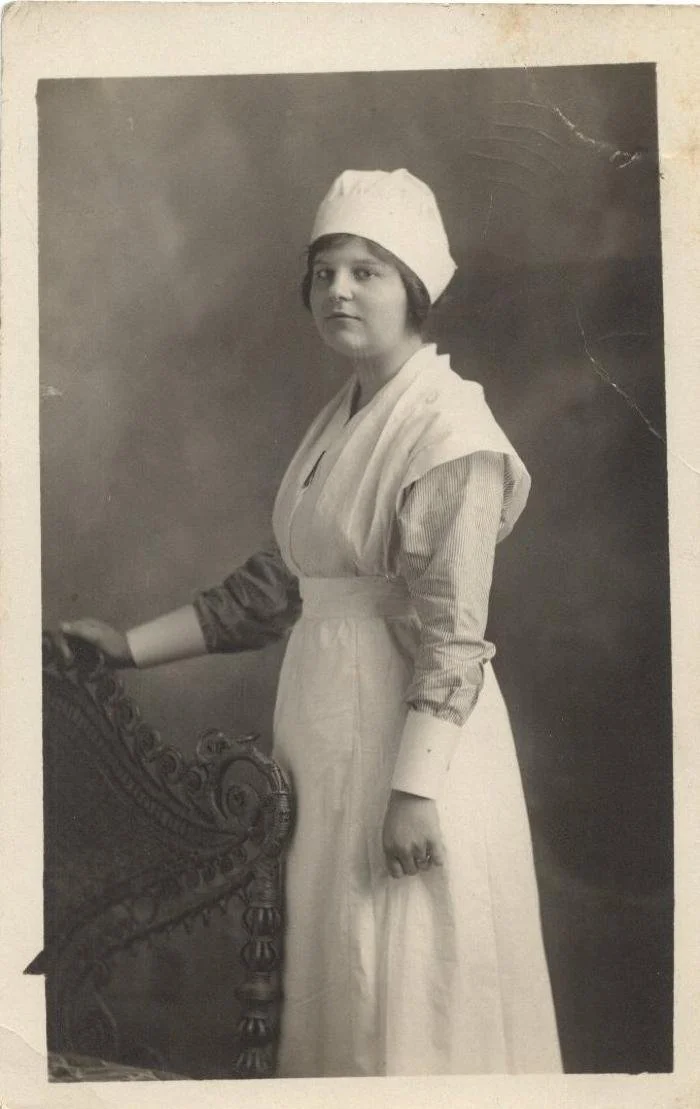
Mudcura Nurse in uniform, circa 1925.
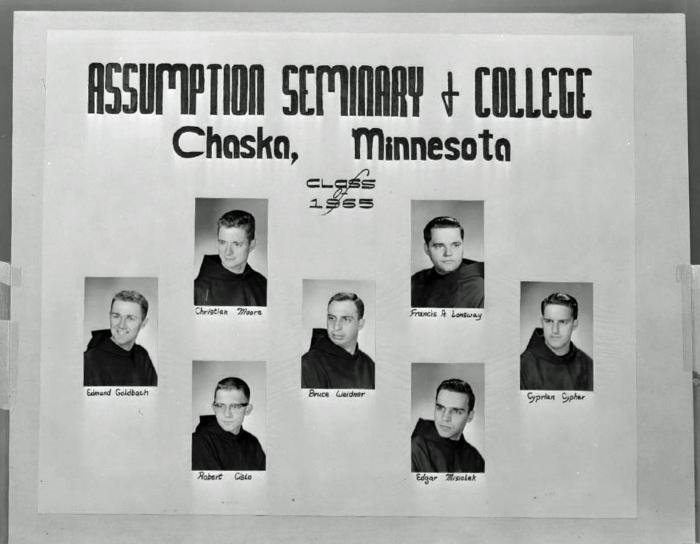
Class of 1965, Assumption Seminary. Credit: LeRoy Lebens.
While the popularity of the sulphur spas diminished following World War II, the beauty industry took hold in the 1950s and 1960s. By the 1980s and 1990s, the concept of pampering oneself and the commercialization of day spas took off. Today we have at-home face-masks and a variety of creams available for people of all ages.
If you're interested in learning more about any of the above businesses, feel free to stop by Scott County Historical Society and search through our subject files!