Black Friday: A Little History

While holiday gift-giving is a centuries-old tradition, the holiday shopping season is not – it was defined by of all things, parades!  By the mid-20th-century parades were drawing large crowds and not just in large cities. Many parades were sponsored by local retailers (usually department stores), who by attaching their names to the parade, increased store visibility with holiday shoppers. Over time, Thanksgiving parades came to be seen as the unofficial start to the shopping season. In fact, Macy’s first parade on November 27, 1924 was advertised as a Christmas Parade with the arrival of Santa marking the official start to holiday shopping. (Note, the first few Macy parades included live animals from the Central Park Zoo, who were replaced with large balloon animals in 1927.)
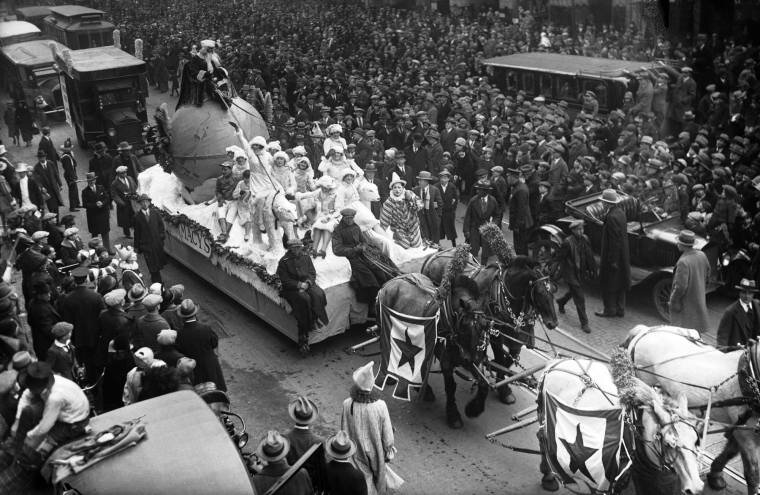
Macy’s 1st Thanksgiving Parade 1924, Bettman Archive – Getty Images

Macy’s 1st Thanksgiving Parade 1924, Bettman Archive – Getty Images

But where does the term Black Friday come from?

Originally, the term was used to describe a financial crisis in 1869 when James Fish and Jay Gould worked together to buy up as much gold as possible ,to drive up the price and corner the market. However, their conspiracy unraveled on Friday, September 24, 1869, sending the stock market into a free-fall, ruining investors and tanking the economy. That day came to be known as “Black Friday.”

So if that’s where the term comes from, why is it associated with shopping? Well, we have to back up a bit.

President Lincoln designated the last Thursday of November as Thanksgiving and, as noted above, that day came to be known as the start of the holiday shopping season. This was fine until 1939, when Thanksgiving fell on November 30, leaving only 24 shopping days (actually, a bit less as most stores weren’t open on Sundays). President Roosevelt gave in to pressure and moved Thanksgiving up a week to allow more time for shopping. (Remember, this was during the depression and a longer shopping season was seen as good for the economy.)  This move caused controversy and confusion, particularly because he made the declaration in October! Congress finally passed a law in 1941 making the fourth Thursday in November the official Thanksgiving holiday.

Franklin Thanksgiving, Bettman Archive – Getty Image

Franklin Thanksgiving, Bettman Archive – Getty Image

By the 1950s it was clear that many people were taking the Friday after Thanksgiving off work, giving themselves a four-day holiday and getting a head start on holiday shopping. Although the day after Thanksgiving isn’t a Federal holiday, many state and school employees were given the day off, increasing the number of potential shoppers. This came to a head in Philadelphia where the annual Army / Navy college football game takes place on the Saturday after Thanksgiving. Thousands of people flooded into the city to not only take in the game, but to shop. The combination of football fans and shoppers was a bad mix – city cops had to work extra-long shifts, deal with large crowds and traffic, and the headache of shoplifters who took advantage of the situation too. By the 1960s locals were calling the crazy day after Thanksgiving “Black Friday”, a name that stuck and spread.

Black Friday came into its own during the 1980s and 90s when large big-box stores like Walmart, Target and Best Buy advertised blowout sales. By the turn of the 21st century deal-hunters were camping out in parking lots and waiting in lines through the wee-hours of the morning to be the first to get bargains.  At times, some crowds have turned a bit violent with fist-fights breaking out.  There’s even a website called Black Friday Death Count!

Today Black Friday has to share space with Cyber Monday and Small Business Saturday, but Thanksgiving is still seen marking the start of holiday shopping.

If shopping isn’t your thing, a group in the UK (Buy Nothing Day ), invites people to escape the “Shopocalypse” by engaging in anti-commercial activities, suggesting you stay at home with a good book or organize a free concert, anything as long as you don’t buy anything.

All of us at the Scott County Historical Society wish you and yours a warm and filling Thanksgiving Holiday.

(FYI: The museum is closed for Thanksgiving and Black Friday – we’re eating goodies and shopping!  The museum – and our museum store are open on Saturday.)

A Short History of Thanksgiving

Early Thanksgivings:

Setting aside time to express gratitude and feasting to celebrate harvests where both practices that predated European and English arrival in North America.  Similar practices are recorded as being part of life for more than one American Indian nation. Feasts of thanks were recorded by both the Spanish and French settlers who came to North America in the 16th century.

Thanksgiving card made by Patricia Donnelly of Cedar Lake Township for her her mother, 1950. SCHS Collections

Thanksgiving card made by Patricia Donnelly of Cedar Lake Township for her her mother, 1950. SCHS Collections

Thanksgivings were also commonplace among the early British colonial settlers. The first settlement at Jamestown in 1610 routinely held thanksgiving feasts. In fact, it was written into their charter from the London Company that “the day of our ships arrival at the place assigned… in the land of Virginia shall be yearly and perpetually kept holy as a day of thanksgiving to Almighty God.” Unlike modern Thanksgiving, these feasts did not take place on a particular day of the year. Instead, they were celebrated whenever a community thought recent events warranted a party.

The event that Americans commonly call the “First Thanksgiving” was celebrated by the Pilgrims in October 1621 after their first harvest in what they called the “new world”. This feast lasted three days. Attendee Edward Winslow described it thusly:

Our harvest being gotten in, our governor sent four men on fowling, that so we might after a special manner rejoice together after we had gathered the fruits of our labor. They four in one day killed as much fowl as served the company almost a week. At which time, amongst other recreations, we retired our arms, many of the Indians coming amongst us, and among the rest their greatest king Massasoit, with some ninety men, whom for three days with whom we entertained and feasted, and they went out and killed five deer, which we brought to the plantation and bestowed on our governor, and upon the captain and others. And although it be not always so plentiful as it was at this time with us, yet by the goodness of God, we are so far from want that we often wish you partakers of our plenty

Thanksgiving card listing beloved family members and friends, 1905. From the SCHS Collections

Thanksgiving card listing beloved family members and friends, 1905. From the SCHS Collections

As feasts of thanksgiving were a relatively common cultural practice at the time, the Pilgrims’ feast with the Wampanoag was not identified as the first Thanksgiving until a booklet titled “Of Plymouth Plantation” was published in 1841. The booklet contained collected writings of the Plymouth colonial settlers. The editor, Alexander Young, pointed out the above passage as the original Thanksgiving in a footnote.

The United States:

Thanksgiving was a part of the national identity of the United States from its onset. During the revolutionary war, the Continental Congress declared one or more days of Thanksgiving each year. Rather then falling on an appointed day each year, these Thanksgivings were declared to honor individuals or events such as a battlefield victory. The proclamations were lengthy and wordy affairs, such as this December example:

It is therefore recommended to the legislative or executive Powers of these United States to set apart Thursday, the eighteenth Day of December next, for Solemn Thanksgiving and Praise: That at one Time and with one Voice, the good People may express the grateful Feelings of their Hearts, and consecrate themselves to the Service of their Divine Benefactor; and that, together with their sincere Acknowledgments and Offerings, they may join the penitent Confession of their manifold Sins, whereby they had forfeited every Favor; and their humble and earnest Supplication that it may please God through the Merits of Jesus Christ, mercifully to forgive and blot them out of Remembrance; That it may please him graciously to afford his Blessing on the Governments of these States respectively, and prosper the public Council of the whole: To inspire our Commanders, both by Land and Sea, and all under them, with that Wisdom and Fortitude which may render them fit Instruments, under the Providence of Almighty God, to secure for these United States, the greatest of all human Blessings, Independence and Peace: That it may please him, to prosper the Trade and Manufactures of the People, and the Labor of the Husbandman, that our Land may yield its Increase: To take Schools and Seminaries of Education, so necessary for cultivating the Principles of true Liberty, Virtue and Piety, under his nurturing Hand; and to prosper the Means of Religion, for the promotion and enlargement of that Kingdom, which consisteth “in Righteousness, Peace and Joy in the Holy Ghost.

After the end of the Revolutionary war, Thanksgivings continued be periodically declared. President John Adams proclaimed Thanksgivings in 1798 and 1799. Thomas Jefferson was a deist and a skeptic of the idea of divine intervention. Thanksgiving was at that time associated with giving thanks to God, not to other men, and because of this Jefferson did not declare any thanksgiving days during his presidency. James Madison renewed the tradition in 1814. Madison also declared the holiday twice in 1815; however, none of these were celebrated in conjunction with autumn or the harvest.

The Civil War

Thanksgiving as we know it came to life during the American Civil War. In 1863 Lincoln, in a bid for national unity, declared a national day of Thanksgiving, to be celebrated the final Thursday of November, 1863. Of this decision William Seward, Lincoln’s secretary of state, wrote:

Thanksgiving menu from the Mill Pond Club, Shakopee, 1956. From the SCHS Collections

Thanksgiving menu from the Mill Pond Club, Shakopee, 1956. From the SCHS Collections

 In the midst of a civil war of unequaled magnitude and severity, which has sometimes seemed to foreign States to invite and to provoke their aggression, peace has been preserved with all nations, order has been maintained, the laws have been respected and obeyed, and harmony has prevailed everywhere except in the theatre of military conflict; while that theatre has been greatly contracted by the advancing armies and navies of the Union. Needful diversions of wealth and of strength from the fields of peaceful industry to the national defense, have not arrested the plough, the shuttle, or the ship; the axe had enlarged the borders of our settlements, and the mines, as well of iron and coal as of the precious metals, have yielded even more abundantly than heretofore. Population has steadily increased, notwithstanding the waste that has been made in the camp, the siege and the battle-field; and the country, rejoicing in the consciousness of augmented strength and vigor, is permitted to expect continuance of years, with large increase of freedom….It has seemed to me fit and proper that they should be solemnly, reverently and gratefully acknowledged as with one heart and voice by the whole American people. I do therefore invite my fellow citizens in every part of the United States, and also those who are at sea and those who are sojourning in foreign lands, to set apart and observe the last Thursday of November next, as a day of Thanksgiving. 

Since the Civil war a Thanksgiving, in one form or another, has been celebrated annually in the United States. While traditions have varied from feasts to shooting matches, charitable works to football games, Thanksgiving continues to be a time when Americans gather with family and friends to be thankful for the good things that have happened that year.

At the Scott County Historical Society, we are thankful for the wonderful members, volunteers and donors who help us to keep our doors open each day. We are also thankful for the interest in history and community that drives visitors to stop in and attend events. Have a wonderful Thanksgiving!

Walking in a Winter Wonderland

The sun is shining and the snow is sparkling outside the Scott County Historical Society museum. After several days of fog, folks are out on the street enjoying the snow. A sunny day in winter is delightful, whether you are sledding outside or holed up inside where it is warm. Below, find a selection of seasonal photographs from the SCHS collections. Enjoy the winter!

Downtown Shakopee after a blizzard. C.J. Stunk (seen holding a shovel) and several other men are standing on a shoveled First Ave.  Handwritten in pencil on the backside of the image is “Sunday March 12th – 1899. 10 am.

Downtown Shakopee after a blizzard. C.J. Stunk (seen holding a shovel) and several other men are standing on a shoveled First Ave. Handwritten in pencil on the backside of the image is “Sunday March 12th – 1899. 10 am.

Photograph of downtown Shakopee after a March snowstorm. The photo shows First Avenue looking southeast. 1899.

Photograph of downtown Shakopee after a March snowstorm. The photo shows First Avenue looking southeast. 1899.

Two men moving logs on North Meridian Street in Belle Plaine. 

Two men moving logs on North Meridian Street in Belle Plaine. 

Thomas O’Connor delivering mail in Belle Plaine. 1905

Thomas O’Connor delivering mail in Belle Plaine. 1905

Men clearing snow from the roads in Shakopee. 1905.

Men clearing snow from the roads in Shakopee. 1905.

Postcard of Pond’s Mill in Shakopee during the winter. The card is addressed to Miss Clara Logenfeif of Shakopee but is unused.  1908.

Postcard of Pond’s Mill in Shakopee during the winter. The card is addressed to Miss Clara Logenfeif of Shakopee but is unused.  1908.

Winter street scene in New Prague, Minnesota, probably a market day. 1914.

Winter street scene in New Prague, Minnesota, probably a market day. 1914.

The Coller family standing outside their downtown Shakopee home. Seen from left to right are Julius Coller, I, Coe Coller and Julius Coller, II, and their dog (name unknown). 1914.

The Coller family standing outside their downtown Shakopee home. Seen from left to right are Julius Coller, I, Coe Coller and Julius Coller, II, and their dog (name unknown). 1914.

Holiday decorations inside a Shakopee home. 1915

Holiday decorations inside a Shakopee home. 1915

Women ice skating in Shakopee, most likely on the Minnesota river. 1920.

Women ice skating in Shakopee, most likely on the Minnesota river. 1920.

The exterior of 434 South Lewis Street in Shakopee after a snowstorm. 1927. 

The exterior of 434 South Lewis Street in Shakopee after a snowstorm. 1927. 

Two children wearing winter coats in Belle Plaine. 1928.

Two children wearing winter coats in Belle Plaine. 1928.

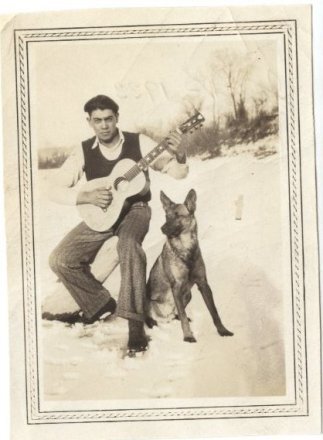
 Harry Weldon playing guitar with his dog during winter. 1933.

 Harry Weldon playing guitar with his dog during winter. 1933.

Arthur Bohnsack with two of his children, Arlyn and June standing in front of their new Chevorlet. Taken in St. Patrick MN. 1940.

Arthur Bohnsack with two of his children, Arlyn and June standing in front of their new Chevorlet. Taken in St. Patrick MN. 1940.

Ray and Loretta (Mamer) Robel of Prior Lake sitting in their living room on Christmas. 1950.

Ray and Loretta (Mamer) Robel of Prior Lake sitting in their living room on Christmas. 1950.

Snowy road after a blizzard in Shakopee. 1950.

Snowy road after a blizzard in Shakopee. 1950.

Christmas card featuring the Pekarna boys. 1954.

Christmas card featuring the Pekarna boys. 1954.

LeRoy Lebens shoveling snow outside his Fifth Avenue home in Shakopee. 1955.

LeRoy Lebens shoveling snow outside his Fifth Avenue home in Shakopee. 1955.

Two Shakopee High School students in winter finery. 1958.

Two Shakopee High School students in winter finery. 1958.

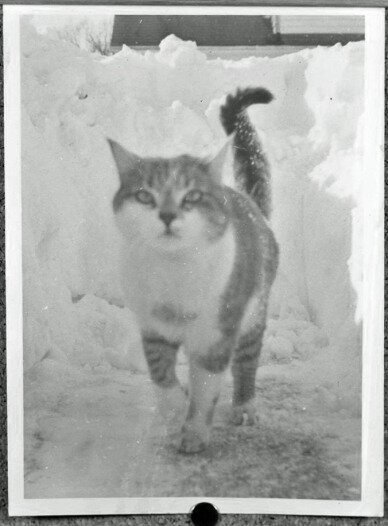
Cat in the snow. Shakopee 1959.

Cat in the snow. Shakopee 1959.

Nevins family holiday decorations, 1960

Nevins family holiday decorations, 1960

Clark family Christmas photo. 1963

Clark family Christmas photo. 1963

The Minnesota River outside Shakopee. 1965.

The Minnesota River outside Shakopee. 1965.

Johnson family Christmas photo. 1970

Johnson family Christmas photo. 1970

Downtown Shakopee block with piles of snow. Date unknown.

Downtown Shakopee block with piles of snow. Date unknown.

Enjoy the winter!

Compiled by Rose James, SCHS Program Manager

Armistice Day

From “As I Remember Scott County”. Passage written by Kathleen Walsh, Belle Plaine

I was about thirteen years old when the word came on November 7, 1918 that World War 1 was over. It was a nasty, cold, rainy day and the town went wild. were were dismissed from school and ran around excited, but to our great disappointment, the evening news brought the word of false report. News reports were much different back then and the telephone was our fastest dispenser of good and bad news.

The O’Connor girls, Ann and Winnie, were the telephone operators then. November 11, about 4:00am, the call came in that the War was officially over. Winnie, the night operator, called Ann. She got up and dressed and went across the street to ring out the good tidings on the bells of the Sacred Heart Catholic Church.

My sister and I had collected noise makers after the false  alarm so we were ready when the real news came. Some of the young men of the borough had stuffed a suit of clothes to represent the Kaiser and had made a cannon noise maker and shot the Kaiser at day break, put the remains in an old style casket from the local undertaker, put that on a flat sled- like thing and lined up for a parade.

Later in the day farmers came to town on steam engines screeching whistles and the band played and we all marched in the parade that followed. It was a day full of excitement and memorable indeed.


Armistice Day, Belle Plaine, 1918. From the SCHS collections

Armistice Day, Belle Plaine, 1918. From the SCHS collections


Armistice Day, Belle Plaine, 1918. From the SCHS collections

Armistice Day, Belle Plaine, 1918. From the SCHS collections

Aprons – Tie One On

The holiday baking season is upon us and one item of clothing will be getting plenty of use… the apron.  Aprons have survived thousands of years as practical, functional clothing items; they served as towels, pot holders, baskets, and more.  Historically, the apron has engendered the feminine aura of domesticity. Some women adorned themselves with the apron as a mantle of pride, a symbol of homemaking, motherhood and nurturing.  Yet others felt it a symbol of constraint or oppression. Despite this, women found ways to be creative and resourceful, making them equally objects of skill and art.  The apron may be a simple object, but is firmly associated with home, motherhood, comfort, work, and servitude.

panier-apron-1800s.jpg

Early aprons were made from muslin, silk, and serge, and formed part of the dress for special occasions as well as everyday wear. Aprons in the early 1700s were in regular use to protect clothing and were usually a simple rectangular piece of fabric fastened with ties or a belt.  By the end of the century, they were fashionable, particularly for upper-class women, and decorated with embroidery and drawn work. The dainty apron of the 1800s became the small tea apron pinned on – and became called the “pinner”, and was often the badge of the parlor maid.

Aprons gained popularity in Victorian England. The ideals of femininity and domesticity ensured their status as upper-class women wore them adorned with embroidery and hand-made lace. It was around the early part of the 1900s that aprons began to slowly diminish in size, previously covering the wearer from neck to toe.

1920sapronpattern1.jpg

During the 1920s, the apron returned to its practical uses, but in a new style. The “Hooverette”, a loose, wrap-around apron, was influenced by the drop-waist, straight-lined dresses of the time. By the 1930s, the apron ended at the knees and the upper bib portion became smaller. During the Great Depression, a resurgence in home crafts resulted in many hand-embroidered aprons. Instead of the traditional white cotton or linen, women used what was available, including flour sacks and clothing scraps.  Aprons weren’t merely decorative, they meant hard work, often by members of an unpaid labor force.  Despite that, wearers found a way to be resourceful and creative.

hostess-apron-pattern.jpg

By the 1940s, aprons decorated with rick-rack and made of calicos and floral prints became symbols of pride. Flour sacks could be edged with stripes, ribbons, or ruffles.  By the 1950s the cocktail apron became a fashion statement. Summoning glamour, they weren’t created for protection. The bib portion was gone, and the length was shortened to well above the knees.  Fashion was more important than practicality.

The 1940’s and 1950s were the heyday of aprons, when commercial and intricately hand-decorated aprons flourished as symbols of family and motherhood. The TV family of the 1950s included the perfect housewife and mother, proudly wearing an apron as a symbol of her occupation. Apron kits became popular, but women continued to make their own. Hostess-aprons of sheer organdy trimmed with lace were more ceremonial than functional. Another change emerged in the 1950s – backyard barbecues, which allowed men to handle the cooking duties.  Aprons for “Dad” covered his larger size and many had whimsical pictures and sayings printed on the front.

sm-caution-red.jpg

In the 1960s aprons plummeted out of fashion, seen as housewifely accoutrements that symbolized a secondary role for women. The apron became a frivolous item. This was also a time of washers and dryers, and better detergent. Ready-made, easy-to-change clothing  became cheaper so the need to protect and cover clothes disappeared.  By the 1970s, aprons were again utilitarian in nature, relegated to waiters and cooks at the barbecue. The bib returned, and fabric became heavy-duty.  Women began to work outside the home more, but cooking duties were still largely her responsibility. The more protective apron allowed women to cover their business clothes as they started dinner.

In recent years, planned menu and scratch cooking have become recreational activities and relegated to the weekend. Today’s aprons fit any size of wearer and are not gender specific, but their use continues to be limited to the kitchen and barbecue. However, snazzy / snappy sayings and beautiful fabrics are still popular today.

Apron etymology: Middle English, alteration of napron, from Middle French, naperon, diminutive of nape cloth, modification of Latin mappa napkin.

Apron: a garment usually of cloth, plastic, or leather usually tied around the waist and used to protect clothing or adorn a costume.

Apron String: the string of an apron – usually used in plural as a symbol of dominance or complete control.

Idiom: “tied to your mother’s apron strings”; wholly depended on or controlled by a woman, especially one’s mother or wife.  This expression, dating from the early 1800s probably alluded to Apron String Tenure, a 17th Century law that allowed a husband to control his wife’s and her family’s property during her lifetime. In other words: a husband could only hold title passed on by his wife’s family, only while the wife was alive.

From the SCHS 2003 exhibit, “Aprons: Tie One One”