Little Shipyard on the Prairie, Part 1

This post was written by guest blogger Charles Pederson. If you would like to write for our blog, contact us at info@scottcountyhistory.org

Welcome to Part 1 of a three-part story about a little-known episode in Scott County History: the Savage Shipyards and Port Cargill.

Picture a 1944 black-and-white newsreel: At water’s edge, a gargantuan gray warship, ready for launch at the riverbank. A small group of dignitaries stands on a nearby reviewing stand. The ship’s sponsor, bottle of champagne in hand, swings the bottle out on a delicate ribbon toward the ship. A spray of bubbles where the bottle breaks, a rousing cheer from a crowd of onlookers, and the ship immediately slides with a massive roaring splash sidelong into the river. Another weapon in the arsenal of democracy has been launched.

During World War II, this scenario was repeated in shipyards throughout the United States. Big impressive coastal shipyards fabricated big, impressive seagoing vessels. On a smaller scale, Savage, Minnesota, got in on the action as well. Savage was already doing its share to fight fascism in the Pacific Ocean during World War II, at the U.S. military’s Japanese language school, Camp Savage. Port Cargill and the Savage Shipyards would become another way this small town contributed in big ways to the war effort.
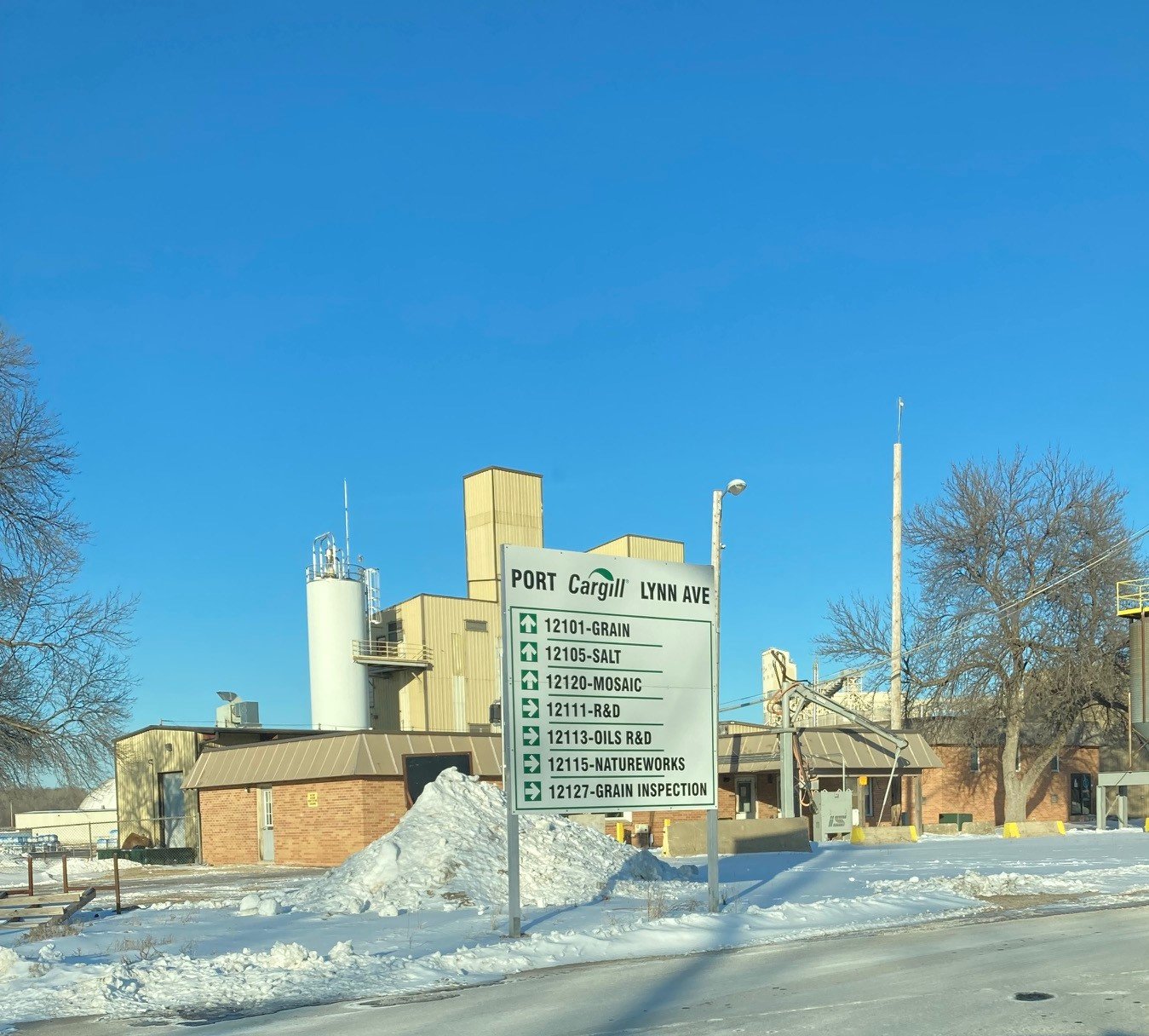
Port Cargill, also known as the Ports of Savage, continues to serve as transit point for commodities. The modest entry belies a little-known history. Courtesy of Charles Pederson, with thanks to Cargill Inc.

Out of Depression and Into the War Years

The U.S. Great Depression (1929–1941) had caused the country to pull back into itself. Tired of foreign wars and exhausted by economic disaster, most people wanted to forget about the world’s problems and just go about surviving. For years, many people had believed that getting mixed up in other countries’ problems would be a mistake.

When war broke out in Europe in 1939, the U.S. Congress was intent on maintaining U.S. neutrality. Franklin Delano Roosevelt (FDR), however, pushed back. In one of his cozy “fireside chats,” he asserted that when there is war anywhere, “the peace of all countries everywhere is in danger. . . . I cannot ask that every American remain neutral in thought.” He began a steady push to increase war production and help the Allies in Europe.

Naturally, increasing wartime production wasn’t as easy as just turning on a faucet. In 1941, FDR knew that to switch to a war footing would be “no small task. And the greatest difficulty comes at the beginning of the program, when new tools, new plant facilities, new assembly lines” are laid out. He was particularly interested in shipping. “New [shipyards] must first be constructed before the actual materiel begins to flow steadily and speedily from them.”

Gearing Up to Manufacture Shipping

In the mid-1930s, only about 10 U.S. shipyards were turning out vessels fit for war. By 1942, the deadly German submarine fleet was sinking more ships than the U.S. could produce. Not, however, until the Japanese military attacked the U.S. naval base at Pearl Harbor did most Americans realize the national danger. The attack awoke the U.S. “sleeping giant.”

Roosevelt believed his fellow citizens were ready to hear his exhortation. A month after the attack, FDR advocated increasing the number of merchant ships from 1.1 million in 1941, to 6 million in 1942, to 10 million in 1943. “These figures and similar figures for a multitude of other implements of war will give the Japanese and the Nazis a little idea of just [how little] they accomplished in the attack at Pearl Harbor,” he said in his State of the Union address.

The U.S. military began looking for additional shipbuilding facilities. Among the vessels needed were tanker ships called auxiliary oilers and gasoline haulers (AOGs). The Navy, still worried about Japanese attacks on the West Coast, found that inland shipyards were desirable. And Minneapolis-based Cargill company was ready to help meet the desire.

Sleepy Rural Village to Bustling Work yard

Cargill was a large company known primarily for shipping grain. High grain-shipping costs during the Depression had already spurred Cargill executives to design their own novel multiunit grain barge. But the unfamiliar new design caused shipyards to shy away from fabricating that crazy contraption. So in 1937 Cargill created its own makeshift shipbuilding facility at its Albany, New York, grain yard. Along with its 300-foot barge system, the Albany shipyard turned out the tanker ship Victoria. Completed in 1941, the Victoria was sold to the Argentine government, “in time to become the first Argentine ship torpedoed in World War II,” wrote a Time magazine journalist.

Shipmakers may have been leery of the barge, but it captured the interest of the U.S. Navy. After seeing Cargill’s efforts in New York, it negotiated with Cargill to build naval vessels. In a Time article, a Cargill executive stated, “That’s how we got into ship building and ocean transportation, because the U.S. government asked us.”

Rather than expand the makeshift yard in Albany, Cargill zeroed in on the village of Savage, Minnesota, in northern Scott County on the Minnesota River. The shipbuilding equipment would be physically moved from Albany to the town, which had much to recommend it. First, it was near a handy source of labor in Minneapolis. Second, the proposed shipyard was far from the coasts and insulated from Japanese attack. Finally, Minnesota was already well advanced in war production. All conditions satisfied the Navy.

Cargill quietly began to purchase land for the enterprise.

Thanks for reading Part 1, the roots of Port Cargill. Part 2 (of three parts) focuses on the crazy idea of plopping a shipyard in the middle of Minnesota. Part 3 will delve into how the ships were built, how they entered wartime service, and what became of them.

Thank you to Cargill for sponsoring this series and providing access that makes this story possible.

Snail Mail: The FBI Visits Mudbaden

Today we rarely receive handwritten letters but they were once a primary method of communication. In this blog series, we’re highlighting some of the interesting letters in our collection. 

Today’s letter was written by Olaf Olsen to Francis Mathiowetz of Sleepy Eye, MN on December 17, 1947. 

At the time, Olsen was the manager of the Mudbaden Sulphur Springs in Jordan.  In the letter, Olsen explains that he is sad to see Mathiowetz leave as he was one of the better employees. He also mentions that the FBI came looking for Mathiowetz after he left. But we are left to wonder, ‘why was the FBI looking for Mathiowetz?’ 

Scroll down past the image to read the full text of the letter.

“Dear Francis: 

Thank you for your greeting card, letter, etc. We did not like to see you go Francis, for always we classed you among our better employes. [sic] We have had several since you left, but for some unknown reason, none of them seem to stick very long. I sometimes think that it must be down in the ‘sticks’ as some call it, and perhaps that is true, for after all, if you do not have relatives or good friends with whom you can visit, there is not much to stay here for, especially, if youth is still with you. I mean this, for I often thought that it would be pretty much the same with me also, if I were younger. Mudbaden has one redeeming feature, and that is, it is a good place to save money. 

We shall be glad to see you at any time Francis, should you have occasion to be up this way. 

For your information, there has been one party checking on you since you left. He introduced himself, saying he was with the F.B.I. Whatever I could say I did say, there naturally was nothing I could say that was not in your favor. 

I have shown Mike your card, saying you had sent your best wishes to him. We all wish you a Merry Christmas and trust you will have a Very Happy and prosperous New Year. 

Sincerely Yours,

[signature of Olaf Olsen]”

“Hey, That’s My (County) Seat”: The Battle for the Heart of Scott County, Part 2

This story is written by guest blogger Charles Pederson. To write for our blog, email us at info@scottcountyhistory.org

Part 1 described the roots of the county seat controversy and the first two attempts to move the seat to Jordan. In Part 2, learn about Jordan’s continuing efforts to bring the county seat to that fair village. And prepare for a surprise plot twist.

Third Attempt to Move the County Seat: 1876

Jordan had already made two previous failed attempts to move the county seat from Shakopee to Jordan. Ever optimistic, though, Jordanites began agitating again for the county seat to move. The scheming began in early 1874, not long after the previous attempt. Jordanites wrote to John Macdonald, Minnesota senator from Shakopee. Their letter’s sentiments fit right into today’s political climate: “We deem any opposition to the passage of the bill [to move the county seat] a sure manifestation of an unwillingness to submit to the voice of the people . . . [and] a desire and intent to defraud them of their rights. . . . Should you refuse us in this request, we shall hereafter consider you unfit to hold any office of public trust.”

In 1876, a bill passed the house but not the senate. The Jordanites again had to accept defeat and gather strength for their next attempt.

Fourth Attempt: 1878

Despite their numerous unsuccessful attempts, Jordanites helped introduce another legislative bill in March 1878 to move the county seat. The motion was defeated—and the residents of Shakopee held a huge reception and party for their senate representative, who had helped defeat it. However, a measure was passed allowing both Jordan and Shakopee to issue bonds to buy land and build or improve county buildings on it. Jordanites doubtless hoped this was their chance to get the county buildings themselves. But the measure was not acted on.

Fifth Attempt: 1889

Like a cicada, the controversy lay dormant for the next eleven years before surfacing again. Shakopee’s place as the county seat seemed to have become fixed and permanent. In 1889, however, as required by Minnesota statutes, a legally recognized petition was presented to the county commissioners. Alas for Jordan, most of the members voted to disregard it, apparently ignoring their duty.

Whence the residents of Jordan got the energy to continue the fight is speculation. In 1890, though, Jordanites convinced a judge to order that the board must consider the petition, as it was legally bound to do. At a February hearing before a Minnesota Eighth Circuit Court judge, the petition was again denied. Julius Coller, a staunch Shakopee cheerleader, wrote with ill-concealed elation that this “dashed the hopes of the would-be Court House removers.”

Sixth Attempt: 1927–1929

Three decades—and a new century—later, the county needed a new courthouse. One cost estimate for a new courthouse was $160,000 (approximately $2.5 million in 2021 dollars). Commercial interests in Shakopee logically imagined that this could lead to another fight over the county seat. To head off that possibility, a private group retained an architect to look at the building. He reported that a new courthouse was not necessary, that simply updating and remodeling the existing structure would be enough. Still, his repair and remodeling estimate was $65,000—more than $1 million today. Though a hefty amount, it was far less expensive than constructing an entirely new building elsewhere (in, say, Jordan). The board accepted that estimate, but Shakopee’s dreams of peace were dashed when the town was forced anyway to defend its status as the county seat.

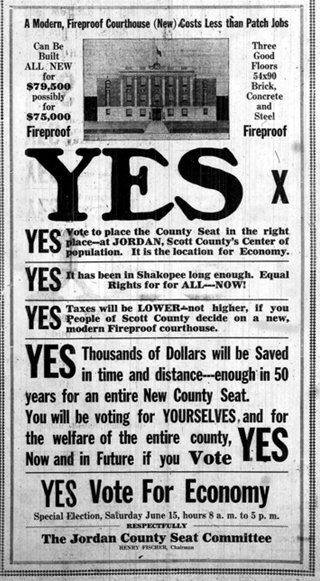
Each side in the controversy placed ads in local newspapers to convince voters of the righteousness of their cause. This pro-Jordan ad appeared in the Jordan Independent of June 13, 1929. Scott County Historical Society Collection.

Just as the momentum for a fight between Jordan and Shakopee—those two old contestants—was building, the rivals must have blinked in shock when a surprise contender entered the fray. A group of residents in Lydia (population 60), seven miles east of Jordan, gave notice of intention to circulate a petition to bring the new courthouse to their town, thus winning the county seat. On November 4, 1927, Lydia residents leading the charge circulated a petition to that effect. Jordan, no doubt kicking itself for being late to the show, circulated a similar petition a week later. By mid-November 1927, canvassers of both towns were busy throughout the county, asking voters to sign their petitions.

What followed was a welter of confusion and rancor. Both Lydia and Jordan met the minimum legal number of signatures for their petitions. Lydia’s eight-day head start should have guaranteed that it be considered first for the county seat move, and indeed, the state Minnesota Supreme Court upheld that view. Both sides were anxious because Minnesota law stated that an election on the question could occur only every five years. Both wanted to strike while the iron was hot. Who knew what political conditions would be like in five years?

Lydia sued to halt Jordan’s petition “on the grounds,” said Lydia banker Martin Imm, “that Lydia announced its intention of obtaining the courthouse before Jordan did and therefore is entitled to file its petition first.” The suit was denied. Lydia then filed notice of appeal all the way to the Minnesota Supreme Court. In response, a Jordan backer obtained a restraining order to halt consideration of Lydia’s petition. Ultimately, the Supreme Court decided that Lydia’s petition had precedence over Jordan’s and could be considered after all.

After all that, the state attorney general ruled that signatures in the Lydia petition were invalid. As found in the 1905 Minnesota statutes, the petition had been filed, and the county board met to decide which, if any, of the signatures to said petition [were] not genuine; and which, if any, of the signers thereof were not, at the time of signing the same, legal voters of said county; and which, if any, of the signatures thereto were not attached within sixty days preceding the filing thereof; and which, if any, of such signatures have been withdrawn.

In other words, the board decided which names on the petition were invalid. More than 700 names were withdrawn from Lydia’s petition. Coller happily reported, “The petition was subsequently rejected.” Undoubtedly with much weeping and gnashing of teeth, Lydia was knocked out of the running.

Lydia’s exit from the race left only Shakopee and Jordan. There were charges of malfeasance, dire warnings of higher taxes, and claims of prejudice against one town or the other. Jordanites claimed Shakopee was avoiding paying taxes. Shakopee replied with outraged explanations why that was untrue.

Each side sent out representatives to speak with voters, and numerous articles appeared in local newspapers, trumpeting why each town was superior to its rival.

Attempting to rouse their supporters, Jordan and Shakopee took their show on the road throughout the county, attempting to rally their supporters in towns and townships during the week leading up to the election. A feature of at least one rally “was the large number of ladies present,” as reported in the Jordan Independent. This might not seem so remarkable until one remembers that women had gained the national right to vote less than ten years previously.

The Shakopee–Jordan county seat battle culminated in a special election in June 1929. This sample ballot instructs voters how to place an X to indicate their choice. Scott County Historical Society Collection.

Finally, election day, June 15, 1929. A majority of county voters decreed that Shakopee retain the county seat: 4,428 voted to keep the county seat in Shakopee, and 2,533 to move it to Jordan. The vote included “approval of the Shakopee proposal to remodel the old courthouse instead of building new,” according to the Jordan Independent. The newspaper continued, “Shakopee was jubilant over its big victory and celebrated in happy abandon Saturday night, Sunday and on.” Church bells, car horns, fire sirens, and huge crowds distinguished the celebration.

They All Lived Happily Ever After?

This 1929 push marked the end of efforts to move the county seat from where it had been for seventy years and has remained for ninety more. Perhaps, however, Shakopee shouldn’t feel too smugly complacent. The law on changing county seats remains in the 2020 Minnesota statutes. You never knowwhen the fight may kick up again!

Further Reading

“Hey, That’s My (County) Seat”: The Battle for the Heart of Scott County, Part 1

This post was written by guest blogger Charles Pederson. If you would like to write for our blog, contact us at info@scottcountyhistory.org

People long for the “good old days” when folks got along. We may look back on the “olden days” as simpler times, but the fact is that the good old days were tough. Scott County is no exception. It featured a decades-long rivalry, complete with “palace intrigue,” that began at the foundation of Minnesota itself. The titanic struggle: to control the center of power, the county seat.

What’s the big deal with a county seat, anyway? Every time a new county is formed, a county seat is designated—and the jockeying to obtain that status can cause powerful feelings of competition among municipalities. The seat may or may not be the largest town in a county, but it is usually where county buildings and the courthouse are located. In fact, the term ‘county seat’ is a shortening of the expression ‘county seat of justice.’ The county seat provides the court system, law enforcement, and other county services. Normally, county seats are created through voting. Why has rivalry in some places escalated to physical violence, intimidation, or fraud in these county seat “wars”? Is it more than the fact that living in or near the county seat can increase property values?

New County, New County Seat

Counties (or their equivalents in other states; for example, Louisiana has parishes and Alaska has boroughs) underlie U.S. administrative organization. Typically, counties are laid out before statehood, during the territory period. Most states therefore already had counties when they entered the Union. Based on population, many early counties covered vast tracts of sparsely settled land. Those large counties filled up with settlers and were eventually broken up into smaller counties, each with its own county seat.

Scott County followed the same general trajectory. On March 5, 1853, due to increasing population, a portion of land was separated from the western edge of Dakota County to become Scott County. About a year later, five appointed county board members voted that Shakopee become the county seat and be the location of county buildings. To cement that decision, the first county court term was held in Holmes Hall, named after Thomas Holmes, one of the first permanent White settlers in the Shakopee area.

It was decided: Shakopee was the county seat. Not everyone, though, agreed with the decision. Over the next six or seven decades, some residents in Jordan resented the decision and consequent status quo. At the founding of the state, they began the first of many attempts to gain for themselves the benefits of hosting the county seat.

First Attempt to Move the County Seat: 1859

By 1856, a building had been rented in Shakopee for use as a courthouse. The next year, bonds were issued in an attempt to raise $10,000 to build a dedicated courthouse and other county structures. This was all meant to reinforce Shakopee’s location as the county seat. Accordingly, construction began, but more than a year later, the buildings still had not been completed. The money ran out. It was suggested that the county was nearly bankrupt through incompetent efforts to build the courthouse. A popular history of Scott County stated that “it was even suggested that the buildings in their incomplete state be sold . . . to discharge part of the heavy liabilities of the county.”

Residents of Jordan saw the lack of a permanent courthouse, the poorly constructed county buildings, and the perceived incompetent leadership as an opportunity to gain the county seat and its benefits for themselves. In 1859, the year following statehood, a bill was introduced in the new Minnesota legislature to move the county seat from Shakopee to Jordan. This caused panic in Shakopee, and civic leaders went into emergency mode. One historian noted that hurriedly raised private donations allowed “the unfinished buildings [to be] enclosed and the county officers located therein, although in small and inconvenient quarters. By these measures the [county seat] change was overruled and Shakopee continued as the county seat.”

The panic in Shakopee abated, but Jordan was far from satisfied with the outcome of events.

Second Attempt: 1872–1873

Discontented Jordanites again plotted to move the county seat. A legislative representative from Jordan, Joseph Chadderdon, introduced a new bill in the state legislature to move the seat to Jordan. The Scott County Mirror newspaper reported that the bill required that “within sixty days after [passage of bill, officeholders would] remove to and hold their office in the said village of Jordan.” The Mirror later ran a chart describing $10,000 that had been deposited in escrow for the move, as well as an additional $20,000 in pledges on passage of the bill. The bill passed the house and senate, but Governor Horace Austin (1870–1874) refused to sign it without further amendment. The bill was amended, and Austin supported it. Nonetheless, no records showed it advancing through the legislature.

Horace Austin, the sixth Minnesota governor, was briefly embroiled in the county seat fight. Minnesota Historical Society Collection.

Despite state inaction, a vote on the issue was set to be held in the county. One historian reported on “a vigorous contest [that] ensued, decided in favor of Shakopee by a majority of ninety-two votes” (969 in favor of moving, and 1,061 against). An opinion writer in the Mirror put a good face on the defeat by insisting that it was actually a victory: “We are just as sure to get the county seat in the next contest . . .as the sun is to rise and set.”

Check back for Part 2 of this ongoing and weirdly fascinating story. It’s full of wrinkles and surprise plot twists!

History of Elko New Market, Part 2

Postcard of the Fred Meinke Saloon and Lunch Room in Elko. A sign on the building reads "Lunch Room/Hamm's Beer/Fred Meinke." 1905. SCHS Collection.

Businesses of Elko and New Market

Elko’s first general merchandise store opened in 1903, conducted by the Herder Brothers. It was followed closely by another important business—a local bar, opened by Peter Ring in 1904. In 1906, the Shien brothers of Lakeville opened a slaughterhouse near the railroad to process all the local “cattle, hogs, poultry, veal and sheep.”

Pete Welter, grocery store owner in New Market. 1895. SCHS Collection.

The New Market Hotel was built in the 1890s and is still standing as a member of the National Register of Historic Places. Helen Kaufberg grew up in the hotel, and described her experiences in “As I Remember Scott County.” She recalls: 

My earliest memories of my childhood are the first ten years of my life that I spent in the hotel that my parents operated.  It was a busy little place as very few people owned cars. The traveling salesmen came by train to the neighboring village of Elko. They would then come to New Market. If they came in the evening, they would have to stay until the next day. Also the farmers from neighboring Cedar Lake Township had to haul their grain to the elevator at Elko by team, so many of them would stop at the hotel for a meal, for which they were charged 25¢. This was about 1910 to 1920. We had several girls who helped with the cooking and other chores.

I remember mother getting up some mornings at 3 o’clock to do the laundry. There was no electricity and it was a little scary to come downstairs alone. I also recall that some of the laundry was sent to the Cities by train. It was put in large canvas hampers around 4 feet long and 3 feet high.

There were dances held in the Village Hall and during intermission a supper was served at the hotel. On one particular night, they served a turkey supper. They had everything waiting for the crowd when the stove pipe on the wood range fell down. It was really a disaster.

Another time, my folks told about a burglary at the Post Office next door. A salesman for the Schmidt Brewery had been on the train and got off at Elko. He had seen two suspicious men get off the train. He immediately walked around to the other side of the train and walked towards the grain elevator. He called from the depot and alerted the people at New Market, so when the hotel closed at 11 o’clock, some of the people stayed up and watched through a window at the back of the hotel. They were watching the Post Office and also the bank which was next to the Post Office. The salesman got a hold of a gun and opened the window just enough to put the gun through and when the burglars tried to get in the back door of the Post Office they were frightened away. There had been evidence that the burglars had waited in the choir loft of the church as there were cigarette or cigar stubs left behind.

The Elko Bank was also almost the target of a burglary during the 1920s. According to the Shakopee Tribune, at 2:00 a.m. on Friday, May 12, 1921, “auto bandits” pulled up to the bank. Before they arrived, they had cut the telegraph wires to the town, hoping to escape before help could be contacted. What they didn’t know was that a bank teller named B. F. Case and his wife had an apartment in the basement of the bank. Case snuck upstairs in the dark with his gun. He fired on the bandits, scaring them away and preventing the robbery.

Gas lighting came to the businesses of New Market in 1901, as was described in the following article giving a summary of New Market happenings that was published by the Shakopee Tribune in May of that year:

Under the radiance of the gas light as reflected from the hardware establishment of Math Hauer on Main street and the saloon of Radermacher and Young on St Joseph's street, our village at night, from a distance, has the appearance of a modern city. We are told that this gas illuminating system is the sole invention of Mr. Hauer, our ingenious mechanic and hardware dealer. The system seems practical, useful, economical and satisfactory in every respect as far as it has been tested. And we hope to see it make such headway in its usefullness, that before long our village officials will adopt it as the means of illuminating the channels of commerce of our village-the streets. We always nursed the idea that if our burgh would once be lit up and assume metropolitan airs in such a manner, so that strangers could see it from afar and behold its beauty in location, as it is nestled in among the Jerusalem-like hills, that the railroad kings and the people in general would no longer believe it a ruined, lost, dirtcovered Pompeii.


St. Nicholas Church

One of the defining features of Elko New Market is St. Nicholas Church. The church’s first incarnation was a log structure built in 1861 on the property of Peter J. Bates. The community soon outgrew the church. In 1872, the Shakopee Mirror wrote: “The Catholics of New Market are preparing to build a new church. It will be much larger than the old one and is rendered necessary by the large increase in their congregation. Our New Market friends are able to do whatever they undertake, and we doubt not their new church will be a credit to them.”

Book titled "Celebrating 150 Years" by the Church of St. Nicholas 150th Anniversary Committee. 2009. SCHS Collection.

This church was replaced, and the new structure dedicated in November of 1911. The ceremonies included a celebration of the 50-year anniversary of the original parish, confirmation of a class of 99 young people, along with high mass, choir, and a sermon in English and German. Four of the original parishioners were present—Mr. and Mrs. Peter Wagner, Anton Degross, and Hubert Kloeckner.

A school was added to the facility in 1915, after parishioners were concerned that local public schools were allowing children from neighboring communities to attend and not teaching religion. The first school building included three large classrooms and started with 126 students in 1916. Because farms at the time were spread out, and Minnesota weather conditions were volatile, it was not uncommon for students to stay in the convent throughout the week and only return home on weekends. Classes were only conducted in English, and some of the sisters, who were teachers, noted that this was a challenge for some students who did not speak English at home. In 1969 the Veseli, Elko, New Market, and Lonsdale Catholic schools merged. Today the descendant of the St. Nicholas school is located in Webster.


Elko Speedway

Elko Speedway opened in 1965, providing a local space for thousands of fans to enjoy the sport. 

In 1987, they became formally associated with NASCAR. Today, approximately 150,000 fans turn up for races each year, which include Late Model, Thunder Car, and Power Stock divisions. According to their website, “The Late Models are highly modified with fabricated frames and fiberglass or aluminum bodies with specialized power plants. Thunder Cars are stock cars with minor engine and suspension modifications allowed. Power Stocks are a low-cost entry level division that are nearly straight from the factory. Other common divisions that also compete at Elko Speedway include the Great North Legends and Bandoleros.”

Elko has added space for concerts, a drive-in theater and concession stand in recent years which have attracted more attention and fans to the area. 

After being closed for a while because of the COVID-19 pandemic in 2020, the racetrack was eager to reopen to 1,500 guests in August of that year. In an interview with Sun This Week, Ryan, then in his 21st season as Elko Speedway’s owner, explained how local race tracks can’t operate without spectators like many of the bigger racetracks. He said, “Our business model depends on spectators. The people who race pay entry fees, but some of the money from ticket sales and concessions also go to purses. We don’t have TV revenue like NASCAR, so we need the fans.”

Racing pennant from Elko Speedway. Ca. 1965-1975. SCHS Collection.

While the ⅜ mile track was closed, Elko’s drive-in theater was able to continue hosting movies and video concerts. 3,000 viewers came to watch the virtual Garth Brooks concert from their cars.